The world's oldest continuous living cultures — from the Dreamtime and ancient land management, through colonisation and the Stolen Generations, to a remarkable modern cultural revival. A respectful guide by Cooee Tours.
Cooee Tours Cultural TeamAustralian Cultural Guides · 14 min read · Updated March 2026
🇦🇺
Acknowledgement of Country. Cooee Tours acknowledges the Traditional Custodians of the lands on which we operate — including the Yugambeh, Turrbal, Jagera, and Yidinji peoples — and pays respect to their Elders past, present, and emerging. We recognise that sovereignty was never ceded. This guide has been written with care and respect, and we acknowledge the limitations of any outsider perspective on culture this rich and complex.
Aboriginal Australian history stretches back at least 65,000 years, making this the world's oldest continuous living culture. From creation narratives that encode deep ecological knowledge to millennia of sophisticated land management, from devastating colonisation to a powerful modern cultural revival — this timeline explores the key eras, events, and milestones of Australia's First Peoples, for any visitor who wants to understand the country beneath the country.
Uluru — sacred to the Anangu people for over 60,000 years
Rock art dating back 20,000+ years at Kakadu
The red earth of Central Australia — shaped by 65,000 years of custodianship
Daintree Rainforest — over 130 million years old, cared for by Kuku Yalanji
Sea Country — the Aboriginal relationship with the ocean runs as deep as the land
Era 01
65,000+ Years Ago
Prehistoric Origins
Archaeological evidence — including ancient stone tools, ochre pigments, and the earliest known ground-edge axes in the world — confirms that Aboriginal Australians arrived on the continent at least 65,000 years ago. The site of Madjedbebe in the Northern Territory's Arnhem Land provides some of the most compelling evidence of this deep antiquity, with artefacts dated through luminescence techniques to between 65,000 and 80,000 years old. Some researchers suggest the actual date of arrival may push closer to 80,000 years.
To put this in context: when the first Aboriginal people reached Australia, the pyramids of Egypt were still more than 55,000 years in the future. Stonehenge wouldn't be built for another 61,000 years. The world's oldest written language is approximately 5,000 years old. Aboriginal Australian culture predates all of these by extraordinary margins — making it, by any reasonable measure, the oldest continuous culture on earth.
Those earliest Australians arrived via a land bridge and short sea crossing from what is now the island of New Guinea, during an ice age when sea levels were significantly lower than today. They quickly spread across the continent — adapting to environments ranging from tropical rainforest to temperate coast, arid desert to alpine highland — developing extraordinarily diverse ecological knowledge, social systems, languages, and cultural practices suited to each landscape.
Lake Mungo: Sites at Lake Mungo in New South Wales contain ceremonial burial remains estimated at 40,000 years old — among the earliest known ritual burials anywhere in the world. The pigments and careful arrangement of remains reveal sophisticated spiritual and social practices of remarkable antiquity.
Era 02
Foundation
The Dreamtime
The Dreamtime — or the Dreaming, as it is known in many languages — forms the spiritual and legal foundation of Aboriginal life across Australia. It is important to understand from the outset what the Dreamtime is not: it is not mythology in the Western sense of "stories from a distant and closed past." The Dreamtime is a living, ongoing reality — a framework connecting ancestral beings, the natural world, and human responsibility that operates simultaneously in what Western culture would call past, present, and future.
In the Dreaming, ancestral beings of extraordinary power moved across an unformed land, singing it into existence. As they walked, they shaped mountains, rivers, waterholes, and plains — singing each feature into being through songlines that still traverse the continent. These songlines are simultaneously navigation systems, historical records, trade routes, legal codes, and sacred maps. Learning to read Country — to hear it and understand it through the framework of the Dreaming — is a lifelong process that unfolds across generations.
Songlines: Each songline follows the path of an ancestral being across Country, encoding precise geographical knowledge, ecological information, and cultural law in sequences of song. A single songline might span hundreds or thousands of kilometres, crossing the territories of many different language groups — who each hold a section of the song and are custodians of that part of the story.
Dreamtime stories are not uniform across Australia — there are hundreds of distinct nations and language groups, each with their own creation narratives, ancestral beings, and ceremonial traditions. What they share is a structural understanding: that the land is alive with ancestral meaning, that humans have obligations of care toward Country, and that the spiritual and the practical are not separate categories. This understanding informed millennia of sophisticated environmental management long before the concept of "sustainability" existed in Western thought.
Era 03
Pre-1788
Pre-Colonial Societies
Before European contact, the Australian continent was home to hundreds of distinct Aboriginal nations, each with their own language, governance structures, territorial boundaries, trade networks, and ceremonial traditions. Population estimates for pre-contact Aboriginal Australia range from around 300,000 to over one million people. The idea — long promoted as justification for colonisation — that Aboriginal people lived in simple, static, hunter-gatherer societies has been progressively and thoroughly dismantled by both archaeological evidence and the growing recognition of Aboriginal expertise.
Aboriginal societies practised sophisticated agriculture and aquaculture long before European arrival. The Gunditjmara people of what is now southwestern Victoria built a complex system of stone channels, weirs, and eel traps at Budj Bim — a site now recognised as a UNESCO World Heritage area — that managed eel populations across hundreds of hectares. Similar systems for harvesting yams, seeds, and other resources existed across the continent. The term "hunter-gatherer" obscures an economic system of considerable complexity and productivity.
Cultural burning: One of the most consequential and now widely recognised Aboriginal technologies is fire-stick farming — the deliberate, carefully managed use of fire to reshape landscapes, clear travel routes, encourage new plant growth, manage animal habitats, and reduce the fuel loads that lead to catastrophic wildfires. This practice shaped the Australian landscape over tens of thousands of years. Modern land managers are increasingly working with Traditional Owners to reintegrate cultural burning, finding it significantly more effective than European-style fire suppression in many contexts.
Trade networks extended across the continent, with items including ochre, stone tools, shells, seeds, and ceremonial objects travelling hundreds or thousands of kilometres along established routes. These networks required sophisticated diplomacy, agreed protocols, and maintained relationships between language groups — a social infrastructure of considerable complexity. The material culture of pre-contact Aboriginal Australia included ground-edge stone axes that are among the earliest in the world, bark canoes, complex fish trap systems, woven baskets and nets, and elaborately crafted ceremonial objects and artworks.
Era 04
1788–1800s
British Colonisation & Frontier Wars
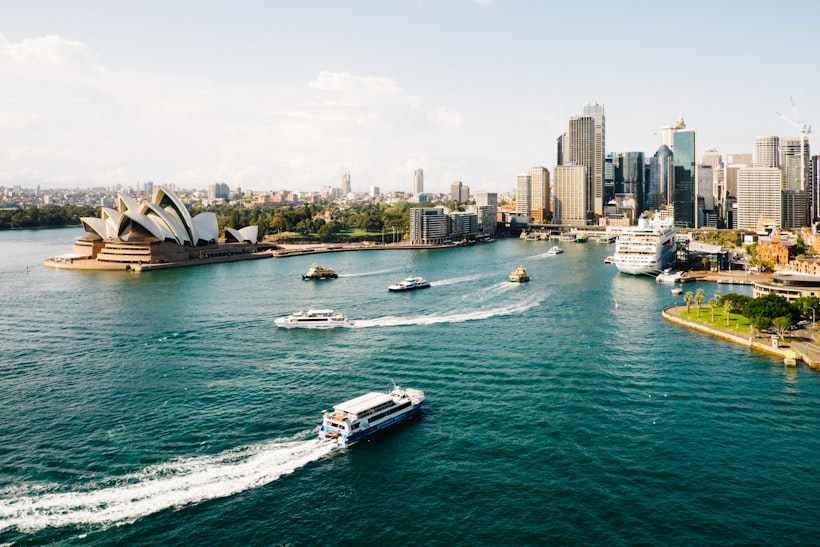
The First Fleet arrived at Botany Bay in January 1788, and then moved to Port Jackson — now Sydney Harbour — to establish Britain's first Australian penal colony. This event marked the beginning of one of the most rapid and devastating disruptions to any human culture in recorded history. The continent was claimed under the legal fiction of terra nullius — "land belonging to no one" — a concept that wilfully ignored millennia of existing Aboriginal law, land ownership, and custodianship. Aboriginal people had never ceded sovereignty.
The immediate impacts were catastrophic. Smallpox, introduced through contact with European settlers, swept through Aboriginal communities who had no immunity to the disease — killing enormous proportions of some populations within months of first contact. In some regions, up to 90% of the pre-contact population died within decades. Dispossession followed rapidly as settlers seized land for farming and grazing, destroying the resource bases and sacred sites upon which Aboriginal communities depended. Resistance — active, sustained, and sometimes militarily significant — arose across the continent throughout the 19th century.
The Frontier Wars: Armed conflict between Aboriginal peoples and colonial forces — sometimes called the Frontier Wars — continued across Australia for more than 150 years, from 1788 until the early 20th century. These conflicts are increasingly recognised as a significant part of Australian history. The Battle of Pinjarra, the Myall Creek Massacre, the Queensland Native Mounted Police, and dozens of other named events represent a history of violence that shaped the Australia that exists today. Many of these stories are only now being widely told.
Despite devastating losses, Aboriginal cultures demonstrated extraordinary resilience. Communities maintained ceremonial practices, oral traditions, and social structures under conditions of extreme duress. Knowledge was passed through generations, sometimes in secret, sometimes in modified forms adapted to new circumstances. The deep roots of tens of thousands of years of cultural continuity proved more durable than colonisers expected or, in some cases, intended.
Era 05
1910s–1970s
The Stolen Generations
Among the most devastating of the colonial policies directed at Aboriginal Australians was the systematic removal of children from their families — a practice now known as the Stolen Generations. From approximately the 1910s through to the 1970s, government authorities and church-run institutions removed Aboriginal and Torres Strait Islander children from their families, communities, and Country. The stated aim was assimilation: to eliminate Aboriginal culture within a generation by raising children in European institutions, forbidding them to speak their languages, and severing their connections to family, Community, and Country.
The scale was enormous. Estimates suggest that between one in three and one in ten Aboriginal children were forcibly removed during this period — with higher rates in some communities. Children were placed in missions, residential schools, and with European families, where they were frequently subjected to harsh conditions, cultural suppression, and — in many documented cases — physical, psychological, and sexual abuse. Many never saw their families again. Many never learned the names of the Country they came from.
Intergenerational trauma: The effects of the Stolen Generations did not end when the policies did. The trauma — of removal, of cultural disconnection, of the suppression of language and identity — reverberates through generations. Survivors today share their stories as acts of cultural resistance and healing. Many Aboriginal communities continue to experience the social effects of this era, including elevated rates of mental health challenges, family disruption, and disconnection from Country and culture.
Despite this systematic destruction, Aboriginal cultures survived. Knowledge was preserved in fragments — in the memories of Elders, in oral traditions maintained in secret, in artworks created in conditions of extreme oppression, and in the deep psychological connections to Country that no institution could fully sever. In 2008, Prime Minister Kevin Rudd delivered a formal national apology to the Stolen Generations in the Australian Parliament — a moment of profound historical significance and, for many survivors and their families, both deeply moving and long overdue.
Era 06
1970s–Present
Modern Cultural Revival & Ongoing Resilience
The 1970s marked a turning point. A wave of Aboriginal political activism — building on earlier movements and galvanised by the 1967 referendum, which gave the Commonwealth power to legislate for Aboriginal people and include them in the census — pushed for land rights, cultural recognition, and self-determination. The Aboriginal Tent Embassy, established on the lawns of Parliament House in Canberra in 1972, remains one of the world's longest-running protests for Indigenous rights.
The landmark Mabo decision of 1992 overturned the legal fiction of terra nullius, recognising native title in Australian law for the first time and opening a pathway for Aboriginal and Torres Strait Islander communities to claim formal recognition of their connections to Country. This decision transformed the legal landscape and restored, at least in part, the recognition of what had always been true: that Aboriginal people had sophisticated and legally coherent relationships with the land long before European arrival.
Language Revival: Of the 250+ distinct Aboriginal language groups that existed before colonisation, approximately 150 languages are still spoken today — though many are critically endangered with only a handful of fluent speakers. Dedicated language revival programs, often working from recordings, written records, and the memories of Elders, are bringing languages back from the edge of extinction. Languages carry knowledge, worldview, and connection to Country that cannot be fully translated — their survival matters.
Aboriginal art, music, and literature now thrive on a global stage. The Western Desert painting movement that began at Papunya in 1971 brought Aboriginal visual art into international galleries and auction houses, creating economic pathways for remote communities while transmitting cultural knowledge in coded visual form. Aboriginal writers, filmmakers, musicians, and artists increasingly shape Australian cultural life. Indigenous-led tourism, cultural centres, and land management programs now share traditional knowledge ethically with visitors, creating economic benefit for communities while building genuine cross-cultural understanding. The story of Aboriginal Australia is not a story of the past — it is one of the most compelling stories of cultural resilience and renewal in the modern world.
Aboriginal Australian culture is not archaeology. It is a living system — carried in language, ceremony, song, and the daily act of knowing Country. Understanding this is the foundation of understanding Australia itself.
— Cooee Tours Cultural Advisory · Brisbane, Queensland
Timeline Snapshot
Key Moments in Aboriginal History
65,000+ Years Ago
First Aboriginal peoples reach the continent via land bridge and short sea crossing. Archaeological evidence at Madjedbebe places this as the earliest confirmed human presence in Australia — and among the earliest anywhere outside Africa.
40,000+ Years Ago
Lake Mungo ceremonial burials — among the world's earliest known ritual burials. Extensive rock art traditions established across the continent, including the Murujuga petroglyphs in Western Australia (estimated at 30,000+ years old) and Kakadu rock art sites.
8,000–10,000 Years Ago
Rising sea levels at the end of the last ice age flood coastal lands, displacing coastal communities and reshaping Country — an event remembered in oral traditions as "the great flood" across dozens of language groups. The Gunditjmara begin constructing the Budj Bim aquaculture system.
Pre-Contact
Hundreds of distinct nations, each with unique language, law, and territorial custodianship. Complex aquaculture, fire management, and trade networks operate across the continent. Total population estimated between 300,000 and 1,000,000+.
1606
First documented European contact with Aboriginal Australians, as Dutch explorer Willem Janszoon encounters communities on Cape York Peninsula, Queensland.
1788
The First Fleet arrives at Port Jackson. Colonisation begins. Terra nullius declared — a legal fiction that wilfully ignores existing Aboriginal sovereignty, law, and land custodianship.
1788–1800s
Frontier Wars, land seizure, and introduced disease devastate Aboriginal populations across the continent. Resistance movements — armed and strategic — persist in many regions for more than a century.
1910s–1970s
Stolen Generations policies forcibly remove Aboriginal and Torres Strait Islander children from their families. Cultural disruption, language loss, and intergenerational trauma result.
1967
A national referendum — supported by 90.77% of Australian voters — gives the Commonwealth power to legislate for Aboriginal and Torres Strait Islander peoples and count them in the census. A landmark moment in the movement for rights and recognition.
1971
The Western Desert Art Movement begins at Papunya, NT. Aboriginal artists begin painting Dreaming stories on canvas — launching one of the most significant art movements of the 20th century.
1972
The Aboriginal Tent Embassy established on the lawns of Parliament House, Canberra — one of the world's longest-running protests for Indigenous rights. It remains there today.
1992
Mabo decision. The High Court overturns terra nullius, recognising native title in Australian law for the first time. A legal and cultural watershed.
2008
Prime Minister Kevin Rudd delivers the national apology to the Stolen Generations in Parliament. A moment of profound historical significance for survivors and their families.
2019
Budj Bim aquaculture system — built by the Gunditjmara people at least 6,600 years ago — inscribed on the UNESCO World Heritage List, recognising Aboriginal land management as a feat of engineering and environmental science.
2020s
Language revival programs, cultural burning reintegration, Indigenous-led tourism, and continued reconciliation work. The oldest living culture on earth continues to adapt, survive, and flourish.
Quick Reference
Quick Facts
65,000+ YearsMinimum age of Aboriginal presence in Australia — the world's oldest continuous living cultures, confirmed by multiple archaeological sites.
250+ Language GroupsDistinct languages existed pre-contact. Approximately 150 are still spoken today, with dedicated revival programs rescuing others from the edge of extinction.
The DreamtimeNot a past event — a living spiritual and legal framework that connects ancestral beings, Country, and human responsibility across all time.
Cultural BurningAboriginal fire-stick farming shaped Australian ecosystems for 65,000 years. Modern land managers are reintegrating this practice with significant results.
1992: Mabo DecisionThe High Court overturned terra nullius, recognising native title in Australian law and acknowledging what Aboriginal people had always known: sovereignty was never ceded.
Budj Bim (2019)UNESCO World Heritage Site — an Aboriginal aquaculture system in Victoria at least 6,600 years old. One of the world's earliest known large-scale engineering projects.
With Cooee Tours
Experience Aboriginal Heritage on Country
The most meaningful way to engage with Aboriginal culture is through experiences led by Traditional Owners and Indigenous guides — people who hold the knowledge, the language, and the deep connections to Country that no museum or guidebook can replace. These tours share knowledge on Country, support Aboriginal communities economically, and offer visitors a depth of understanding that transforms a holiday into something genuinely significant.
Gold Coast Hinterland Indigenous Experience
Cultural walks through ancient subtropical rainforest — Dreamtime stories, traditional plant knowledge, and local ecology shared by Indigenous guides with deep connections to this Country.
Explore the world's oldest tropical rainforest — over 130 million years old, cared for by the Kuku Yalanji people — with guided insights into bush tucker, Indigenous lore, and the extraordinary relationship between people and landscape.
Hands-on learning about traditional food plants, medicinal species, and the ecological knowledge encoded in Country — guided by people who know it best. A truly immersive and respectful cultural experience.
We encourage all visitors to deepen their understanding through Aboriginal voices and primary sources. The following organisations and works are a starting point.
AIATSIS — The Australian Institute of Aboriginal and Torres Strait Islander Studies: the national authority on Aboriginal and Torres Strait Islander history and culture.
Reconciliation Australia — Resources, research, and pathways for meaningful reconciliation between Aboriginal and non-Aboriginal Australians.
Dark Emu by Bruce Pascoe — A rigorous, paradigm-shifting examination of pre-colonial Aboriginal agriculture, aquaculture, and land management. Essential reading.
Sand Talk by Tyson Yunkaporta — Indigenous thinking systems and their relevance to contemporary challenges. A remarkable and challenging book.
The White Girl by Tony Birch — A deeply human novel about the Stolen Generations era and survival.
Talking to My Country by Stan Grant — Personal and political reflections on Aboriginal Australian identity and history.
Frequently Asked
Frequently Asked Questions
How old is Aboriginal culture in Australia?+
At least 65,000 years, based on archaeological evidence from sites including Madjedbebe in Arnhem Land. Some research suggests the figure may be closer to 80,000 years. This makes Aboriginal Australians the custodians of the world's oldest continuous living cultures — predating ancient Egypt by more than 55,000 years, and encompassing a period of human history so vast that it is genuinely difficult to comprehend.
What is the Dreamtime, and is it still relevant today?+
The Dreamtime (or Dreaming) is the foundational creation narrative and spiritual legal framework of Aboriginal peoples. Ancestral beings shaped the land, waters, animals, and human laws during the Dreaming. It is not a past event — it is a living framework that connects past, present, and future, transmitted through songlines, dance, visual art, and ceremony. For Aboriginal people, the Dreaming remains a present, operative reality — not mythology, but living law. Its relevance has never diminished.
When did British colonisation of Australia begin?+
British colonisation began in January 1788, when the First Fleet arrived at Botany Bay and then moved to Port Jackson (now Sydney Harbour). The continent was claimed under terra nullius — "land belonging to no one" — a legal fiction that deliberately ignored millennia of Aboriginal law, custodianship, and sovereignty. Aboriginal people have never ceded sovereignty. The impacts of colonisation — disease, dispossession, frontier violence, and cultural disruption — were catastrophic and continue to shape Australian society today.
What were the Stolen Generations?+
The Stolen Generations refers to Aboriginal and Torres Strait Islander children who were forcibly removed from their families by government and church authorities between approximately the 1910s and the 1970s. The stated aim was cultural assimilation — to eliminate Aboriginal identity within a generation. Children were forbidden to speak their languages, were separated from Country and family, and were frequently subjected to harsh and abusive conditions in missions and residential institutions. A formal national apology was delivered by Prime Minister Kevin Rudd in 2008. The intergenerational trauma of these policies continues to affect Aboriginal communities today.
What is cultural burning and why is it important now?+
Cultural burning (also called fire-stick farming) is the practice of deliberately and carefully burning land in controlled patterns to regenerate plant growth, manage animal habitats, reduce fuel loads, and maintain healthy Country. Aboriginal Australians practised this for tens of thousands of years, fundamentally shaping the continent's ecology. European colonisation suppressed these practices, replacing them with fire suppression strategies that have contributed to increasingly catastrophic bushfire seasons. Modern land managers — often working in partnership with Traditional Owners — are now reintegrating cultural burning, finding it significantly more effective than European approaches in many Australian landscapes.
How can I engage with Aboriginal culture respectfully as a visitor?+
The most meaningful engagement comes through experiences led by Aboriginal people themselves: join Indigenous-led tours and cultural experiences, support Aboriginal artists and organisations directly, read works by Aboriginal authors, visit community-run cultural centres and keeping places, and seek to understand the particular Country you're visiting and the people connected to it. Always ask permission before photographing ceremonial sites or objects, and follow the guidance of your hosts. Cooee Tours partners with Traditional Owners across Queensland to offer guided cultural experiences that share knowledge respectfully and benefit communities economically.
Experience Aboriginal Heritage on Country
Cooee Tours partners with Traditional Owners to offer cultural experiences that share knowledge respectfully, on Country, with guides who carry it. The most authentic way to engage with Australia's deepest story.
Aboriginal history is not a closed chapter in a schoolbook. It is the deepest current running beneath every aspect of Australian life — the Country beneath the country, the law before the law, the story inside every story this continent tells about itself. Understanding it changes how you travel here. It changes what you see when you look at a landscape, what you hear when someone speaks of Country, what you feel when you stand in a place that has been known and named and sung for sixty thousand years.
We invite you to engage — respectfully, curiously, humbly — with the oldest living culture on earth. Not as a spectacle, but as a relationship. It is one of the most rewarding things a traveller in Australia can do.