South Rim
The classic Grand Canyon experience — Mather Point, Yavapai, Hermit Road, Desert View Watchtower. Year-round, full visitor services, free shuttle network, every iconic photograph you've seen.
277 miles long, a mile deep, and one of the Seven Natural Wonders of the World. Three rims, dozens of viewpoints, and choices most first-time visitors get wrong. Here's the guide our USA specialists send Australian travellers — including which rim to actually visit.
The Grand Canyon is one of the few places on Earth that genuinely exceeds its photographs. Carved over six million years by the Colorado River through northern Arizona, it's 277 miles long, up to 18 miles wide, and a mile deep — a scale that's almost impossible to take in until you're standing at the edge of it. Most Australian visitors come for a single afternoon and regret not staying longer. Two days at the South Rim is the sweet spot. This guide covers all three rims, the dozen things you genuinely shouldn't miss, and the practical questions Australians actually ask.
The single biggest planning mistake is going to the wrong rim for what you actually want. Here's the honest side-by-side.
The classic Grand Canyon experience — Mather Point, Yavapai, Hermit Road, Desert View Watchtower. Year-round, full visitor services, free shuttle network, every iconic photograph you've seen.
1,000 ft higher than the South Rim, cooler, alpine forest, dramatically less crowded. Closed in winter (mid-Oct to mid-May) due to snow. Bright Angel Point and Cape Royal are the highlights.
Managed by the Hualapai Tribe (not the National Park). Home of the Grand Canyon Skywalk — a horseshoe glass bridge 4,000 ft above the canyon floor. The closest rim to Las Vegas.
If you have two days at the South Rim, these are the dozen experiences I prioritise. Numbered roughly in order of importance for first-timers.
The first viewpoint as you enter from the south, and the most-photographed spot in the park. Arrive 20 minutes before sunrise — the canyon turns gold then red as the light hits.
The most famous trail in the canyon — descend just to the 1.5-Mile Resthouse for a genuine canyon hike without the danger of overcommitment. Allow 3–4 hours round-trip; the climb out is twice as hard as the descent.
Mary Colter's 1932 stone tower at the eastern end of the South Rim — climb to the top for the best 360° view in the park. The drive itself (Desert View Drive) is one of the most underrated parts of the South Rim.
The 7-mile road west of Grand Canyon Village, closed to private vehicles most of the year — take the free Red Shuttle to Powell, Hopi, Mohave, and Pima Points. Hopi at sunset is a classic.
The other big descent trail. Hike just to Ooh Aah Point (1.8 miles round-trip, 90 minutes) — one of the best short hikes in any US national park. The view earns the name.
The horseshoe glass bridge 4,000 ft above the canyon floor at Eagle Point. Touristy and pricey (USD $89+) but a thrilling perspective. Most worthwhile as part of a Las Vegas day trip — phones and cameras must be checked.
From Tusayan (South Rim) for over-canyon scenic flights from USD $239. From Las Vegas, longer tours include landing on the canyon floor — Champagne picnic optional from USD $499. Worth doing once.
Three-hour Canyon Vistas Mule Ride along the rim from USD $158, or the legendary overnight ride to Phantom Ranch at the bottom of the canyon (book 13+ months ahead via lottery). A century-old Grand Canyon tradition.
The 1901 vintage train from Williams, AZ, to the South Rim — 65 miles each way, complete with on-board musicians and a staged "train robbery." Day-trip or overnight options. A genuinely fun way to arrive.
Half-mile paved trail from Grand Canyon Lodge to a knife-edge viewpoint with 270° views. The North Rim's signature short walk — vertigo-inducing and stunning. Open mid-May to mid-October only.
From half-day smooth-water trips out of Page (USD $129) up to legendary 14-day full-canyon white-water expeditions (USD $5,000+). The 1-day motorised half-canyon trip from Diamond Creek is the best taste-test.
The unbroken westward view from Hopi Point makes it the most popular sunset spot. Arrive 45 minutes early; bring layers — the temperature drops fast at 7,000 ft. Free shuttle drops you 200 m away.
The honest version. Most Australian visitors underestimate, see one viewpoint, and leave wishing they'd stayed.
| Time | What You Can Do | Best For |
|---|---|---|
| Half day (4 hrs) | Mather Point, Yavapai Geology Museum, brief walk on Rim Trail | Tour-bus stops only — you'll feel rushed |
| 1 full day | Add Hermit Road shuttle, Bright Angel partial hike, sunset at Hopi Point | Tight itineraries — but you'll skip a lot |
| 2 days | All major South Rim viewpoints, two trail hikes, Desert View Watchtower, sunset and sunrise Best | Most travellers — the sweet spot |
| 3 days | Add helicopter tour, mule ride, or full Desert View Drive day with Tusayan Pueblo | Active travellers, photographers |
| 5+ days | Combine South + North Rim, day-trip to Antelope Canyon & Horseshoe Bend | Repeat visitors, deep-divers |
| 7+ days | Add Sedona, Monument Valley, possibly Bryce/Zion in a Southwest loop | The classic "American Southwest" trip |
Elevation matters. The South Rim sits at 7,000 ft and the North Rim at 8,000 ft — temperatures are dramatically cooler than what you might expect from "Arizona desert."
Best season — mild temps, snowmelt, wildflowers, fewer crowds than summer. North Rim opens 15 May. Book South Rim lodging 4–6 months ahead.
Crowded, hot below the rim, afternoon monsoon thunderstorms. Avoid hiking down between 10am–4pm. School-holiday peak — book 6+ months ahead.
Arguably equal-best with spring. Aspens turn gold on the North Rim in late September. Crowds drop after Labor Day. Clear, dry, perfect.
Snow on the rim, mostly clear days, almost no crowds. North Rim closed. Some trail closures. Photographically extraordinary — fresh snow on red rock.
The American Southwest stacks its highlights close together. These are the trips most worth tacking onto a Grand Canyon visit.
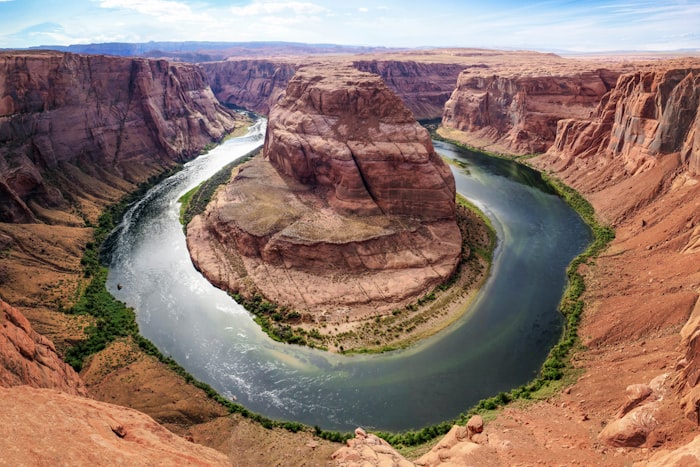
The slot canyon (Upper or Lower) photographs every Australian has seen — plus Horseshoe Bend, the U-turn of the Colorado River 1,000 ft below the cliff edge. Together a perfect day trip from the South Rim or an overnight in Page. Antelope Canyon must be booked through Navajo guides — book 2+ months ahead.
Cathedral Rock, Devil's Bridge, the Chapel of the Holy Cross, and a vortex-energy art town with excellent dining. The Pink Jeep tour is a justifiable splurge. Combine with a Grand Canyon visit by spending 2 nights in Sedona, 2 nights at the canyon.
The cinematic mesas of every classic Western. Self-drive the 17-mile Valley Drive or book a Navajo guide for backcountry access. Stay at The View Hotel for sunrise from your room. A genuine must-do for a wider Southwest trip.
Bryce's hoodoos and Zion's red-rock canyon walls are arguably as visually arresting as the Grand Canyon and dramatically less crowded. The "Mighty 5" Utah loop adds Capitol Reef and Arches for a 7–10 day national parks epic.
The specifics for Australian travellers — getting there, what you need, and what tends to surprise people.
Practical guidance from Australians who've made the trip multiple times. Sort these 6–8 weeks before departure and you'll arrive ready.
The on-the-ground advice we give every client. Small things — but they make the difference between a good visit and a great one.
The crowds gather for sunset. The light is identical at sunrise and there are 1/10th the people. Mather Point and Hopi Point both work. Set the alarm — you can sleep in tomorrow.
Four free shuttle routes at the South Rim. Hermit Road (Red) is closed to private cars most of the year. Park at the Visitor Centre and shuttle everywhere — much faster than driving.
3–4 litres per person per day if hiking. Free water stations at trailheads and key viewpoints. The dry air dehydrates you faster than you think — Australians notice it most.
Park rangers beg visitors not to attempt the river-and-back-in-a-day hike. People die every year. The descent is fine; the ascent in heat is brutal. Overnight at Phantom Ranch instead.
Within 60 minutes of sunrise/sunset for warm light on the rocks. Midday flattens the canyon photographically. The first hour after sunset (blue hour) is also extraordinary.
Mather Point and Visitor Centre lots fill by 10am in summer. Park at Market Plaza — usually has spaces 2 hours longer. Or arrive before 8am.
"The Guide" is free at the entry station. It has the day's ranger talks, shuttle times, weather warnings, and trail closures. Free walking tours and geology talks daily — book at the visitor centre.
The Grand Canyon is an International Dark Sky Park. On a moonless night, the Milky Way is visible to the naked eye. Stay on the rim past 9pm and look up.
Elk wander Grand Canyon Village; rangers fine visitors who get within 25 m. Squirrels are habituated and can bite — never hand-feed. California condors fly the South Rim — look up.
The questions Australian travellers ask us most often. If yours isn't here, our USA team is on the phone seven days a week.
From Vegas day-trips to multi-park Southwest road trips, our USA specialists handle flights, car hire, in-park lodging, and the activities that book up months ahead — like Antelope Canyon, Phantom Ranch, and helicopter flights with canyon-floor landing.
🇺🇸 Speak to a USA Specialist Browse USA Guides 📞 0409 661 342