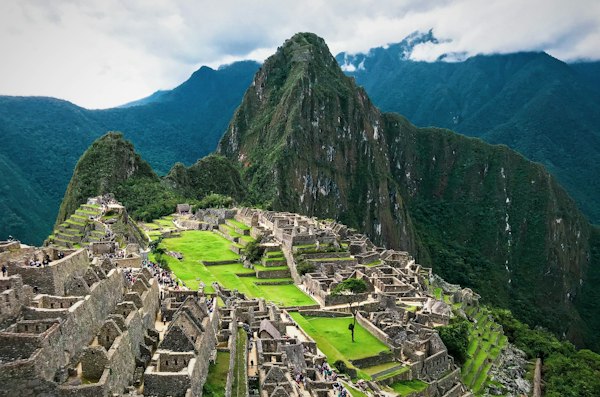
Machu Picchu at dawn, the valley below filled with cloud, the citadel above it. A canyon twice the depth of the Grand Canyon where Andean condors soar at eye level from the rim. A floating city on the world’s highest navigable lake, where the Uros people build their islands from totora reeds the same way their ancestors did. Peru contains three worlds — the Andes, the Amazon, and the coast — and each is a trip of its own.
Peru (population 34 million — 1,285,216 km² on the Pacific coast of South America — bordered by Ecuador, Colombia, Brazil, Bolivia, and Chile — home to the Amazon River’s headwaters, the world’s highest navigable lake, and the largest surviving corpus of Inca architecture on Earth) is the South American destination that concentrates the continent’s most iconic sites within a geography that also makes them genuinely challenging to reach. That challenge is a significant part of what makes them worth reaching. Machu Picchu (the 15th-century Inca citadel at 2,430m above sea level on a mountain ridge above the Urubamba River — the most visited archaeological site in South America — the construction whose precision (the stones fitted without mortar to tolerances of 0.5mm — no blade can be inserted between the joints) has never been satisfactorily explained given the tools and technology available to the Inca in the 15th century) requires either a 4-day trek over a 4,215m mountain pass or a train and bus combination through a valley that narrows to a canyon. Both are worthwhile. Neither is casual.
Peru’s three geographic zones each have a defining experience: The Andes (Cusco, the Sacred Valley, Machu Picchu, the Inca Trail, the Rainbow Mountain (Vinicunca — the mineral-stained mountain whose red, pink, yellow, and green bands became accessible as a hiking destination only after its permanent snow cover melted in the early 2010s due to climate change — the altitude (5,200m) and the colour combination make it one of the most photographed landscapes in South America), the Colca Canyon, and Lake Titicaca). The Amazon (Madre de Dios — the Peruvian Amazon’s most biodiverse lodgeable zone — the Tambopata National Reserve — 1.5 million acres of primary jungle accessible from Puerto Maldonado (a 45-minute flight from Cusco)). The coast (Lima — one of the finest food cities in the Southern Hemisphere — the birthplace of ceviche — the Larco Museum (the finest pre-Columbian gold and ceramics collection in the world) — the Barranco district and the Miraflores clifftop).
Each of Peru’s six defining experiences represents a different world — and together they make the country irreplaceable on any South America itinerary.
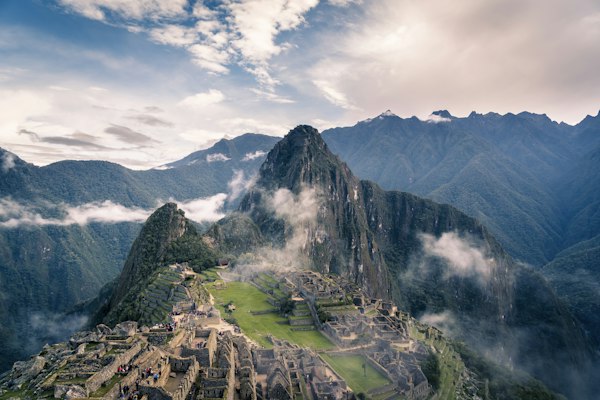
Machu Picchu (the 15th-century Inca royal estate — built under the rule of Pachacuti Inca Yupanqui (the ninth Sapa Inca — the ruler who transformed the Inca from a regional chiefdom into a continental empire between 1438 and 1471 — the Inca Empire at its territorial peak under Pachacuti covered 2 million km² from present-day Ecuador to central Chile)) sits at 2,430m on a mountain ridge in the Eastern Cordillera of the Andes, 80km northwest of Cusco, above the Urubamba River gorge. The citadel was never discovered by the Spanish conquistadors — it was abandoned after the Inca retreat following the conquest and was unknown to the outside world until Hiram Bingham III (the Yale historian — the model for Indiana Jones, by his own claimed association) was led to it by the local farmer Melchor Arteaga on 24 July 1911. The precision of the Inca stonework (the polygonal masonry — the stones cut to interlock without mortar — the tolerances so tight that a standard sheet of paper cannot be inserted between the blocks — the technique resists earthquakes by allowing slight relative movement between stones while maintaining structural integrity — the same construction principle explains why Machu Picchu has survived in a seismically active zone for 600 years while Spanish colonial buildings at the same altitude have not). The best Machu Picchu experience: the first entry slot (6am or 7am — the Aguas Calientes bus queues from 5am — the citadel in the early morning light before the valley cloud burns off — the first hour at Machu Picchu before the 10am visitor peak is categorically different from the midday experience). Huayna Picchu (the 2,693m peak visible as the backdrop in all photographs of the citadel — 45–60 minute ascent on a near-vertical trail with chain handrails — 200 tickets per day — the view from the summit looking down onto the citadel and the Urubamba far below — the summit provides the only elevated perspective of the full citadel layout that is accessible on foot).
Cusco (Qosqo in Quechua — “the navel of the world” — the capital of Tawantinsuyu (the Inca Empire — “the four regions together”) from approximately 1438 until the Spanish capture in 1533 — the city that Francisco Pizarro entered with 168 soldiers and defeated an empire of 10–12 million people) is the best base city in Peru and one of the most historically dense in South America. The city’s Inca foundations (the Qoricancha — the Temple of the Sun — the most sacred site in the Inca Empire, its walls once lined with 700 sheets of beaten gold averaging 2kg each — the Spanish built the Convento de Santo Domingo on its foundation — the 1950 earthquake that devastated the colonial structure left the Inca stonework intact — the contrast between the two building traditions visible in a single wall) underlie the colonial Spanish city built directly above them. The Sacred Valley (the Urubamba Valley — 15km north of Cusco — the fertile agricultural heartland of the Inca Empire — Pisac (the market town and terraced citadel — the Sunday market (the most photographed market in Peru — the vendors in traditional dress from surrounding highland communities)), Moray (the concentric circular terraces — the Inca agricultural laboratory, where the circular depression creates a temperature gradient of 15°C from the top terrace to the bottom — used to acclimatise crops from different altitude zones), Salineras de Maras (the salt evaporation pans on the hillside — more than 3,000 individual pools fed by a single saline spring that has been in continuous use since before the Inca arrived — the salt harvesters still work the same pools), and Ollantaytambo (the living Inca town — the only place in Peru where people still live within the original Inca urban grid — the street plan designed around the Inca’s kanchas (residential blocks) unchanged since the 15th century — the fortress above the town where Manco Inca Yupanqui defeated Hernando Pizarro’s army in 1536 in the only significant Inca military victory against the conquistadors)).
The Colca Canyon (160km northwest of Arequipa — 3,400m deep at its deepest point — one of the deepest canyons in the world and twice the depth of the Grand Canyon — carved by the Colca River through volcanic rock over millions of years — the canyon walls displaying the complete geological sequence of the Andes’ formation in a single readable cross-section) is the site of one of the most reliably dramatic wildlife encounters in South America: the Andean condor (Vultur gryphus — 3.2m wingspan — up to 15kg — the largest flying bird in the Western Hemisphere — the condor’s soaring is thermal-dependent, the bird spending minimal energy in sustained flight by riding the column of heated air that rises from the canyon floor each morning as the sun reaches the rock face) at the Cruz del Cóndor (the Cruz del Cóndor lookout — at 3,810m on the canyon rim — the condors pass at eye level — often within 10–20m — as they rise on the morning thermal column). The condor sighting window: arrive at Cruz del Cóndor by 8–9am (the condors begin their morning thermal soaring when the canyon floor has been sunlit for 1–2 hours — typically 9–10am — the 2-hour observation window with peak sightings of 3–12 individual condors is the standard experience — the condors pass so close that the individual feather separation at the wing tips (the primary remiges — spread like fingers to reduce induced drag at low speed) is visible to the naked eye from the rim). The canyon trekking: the 2-day canyon descent and ascent (the overnight option — the descent to the canyon floor village of San Juan de Chuccho, the night at a local guesthouse, the 4am pre-dawn ascent back to the rim — the correct experience for understanding the canyon’s actual scale — the 1,000m vertical ascent in the morning heat is the reason most visitors choose the rim-only option and why the canyon hikers have no company on the ascent).
Lake Titicaca (3,812m above sea level — 8,372 km² — shared between Peru and Bolivia — the world’s highest commercially navigable lake — the largest lake in South America by volume — the birthplace of the Inca civilisation according to their own cosmology: Manco Cápac and Mama Ocllo, the first Inca, emerged from the lake at the island of Isla del Sol on the Bolivian side) is the destination on the Peru itinerary that consistently surprises visitors who arrive with a mental image of a high-altitude pond and encounter instead a body of water so vast that the horizon is oceanic, the light above it specific to 3,800m altitude (the air is thin enough that UV radiation is significantly elevated — the blue of the lake against the sky at noon is a blue that has no equivalent at lower altitude). The Uros Floating Islands (the artificial islands in the bay of Puno — built and continuously maintained from totora reeds (the buoyant aquatic plant that grows abundantly in the shallows — the islands require constant regeneration as the lower reed layers decompose — the Uros people add fresh reed bundles to the island surface every few weeks) — the Uros have lived on floating islands since before the Inca expansion — the islands were originally a defensive strategy: a community that can move its entire village has no fixed location to attack). Isla Taquile (the island 45km from Puno — the community of 2,000 Quechua-speaking Taquileños who maintain a living textile tradition recognised by UNESCO as Intangible Cultural Heritage — the men of Taquile knit as they walk, as they talk, as they sit — the knitting quality is used to determine eligibility for marriage — a man whose hat has loose stitching is considered unmarriageable) and the overnight homestay option (staying with a Taquile or Amantaní family — the most culturally immersive experience available at Lake Titicaca).
The Peruvian Amazon (the Amazon basin occupies 60% of Peru’s land area — the headwaters of the Amazon River itself rise in the Peruvian Andes at 5,000m and descend to sea level at the Ucayali and Marañón confluence) is accessible as a 3–5 day extension from Cusco via a 45-minute flight to Puerto Maldonado in the Madre de Dios region. The Tambopata National Reserve (274,690 hectares of primary Amazon rainforest — one of the most biodiverse areas on Earth — 632 bird species, 1,200 butterfly species, 169 reptile species, 103 amphibian species in a single reserve — the reserve’s Amazon lodges (Inkaterra Reserva Amazónica, Refugio Amazonas, Tambopata Research Center) provide the structured access to the rainforest that makes meaningful wildlife observation possible rather than the walk-in-dense-jungle-and-see-nothing experience that self-guided Amazon visits produce). The Collpa de Guacamayos (the macaw clay lick — the mineral-rich clay bank on the Tambopata River at which hundreds of Scarlet Macaws (Ara macao) and other parrot species gather each morning — typically 6–8am — to consume the clay (the clay’s mineral content neutralises the toxins in the seeds and fruits in the macaws’ diet — the largest clay lick in the world in terms of parrot species diversity — the experience of sitting in a blind 15m from the bank as 200–300 macaws crowd the clay face is one of the most visually and aurally overwhelming wildlife encounters available in South America). The nocturnal jungle walk (the guide with UV light — the fluorescent scorpions visible under ultraviolet — the tree frogs, the tarantulas, the caiman eyes in the creek — the Amazon’s nocturnal fauna is categorically different from the daytime fauna — the night walk provides access to a different ecosystem within the same forest)).
Lima (population 11 million — on the Pacific coast at sea level — the colonial capital of Spanish South America from 1535 until independence in 1821 — named the best food city in the world by the World’s 50 Best Restaurants organisation in multiple surveys) is the city that Australians flying to Peru most consistently underestimate — allocating 1 day as a transit stop when the city merits at least 2–3. The food: ceviche (the raw fish cured in lime juice (leche de tigre — “tiger’s milk” — the citrus, chile, and salt marinade that denatures the fish proteins without heat) — the dish that originated in Peru — the specific Limeño ceviche at La Mar Cebichería (the Miraflores restaurant where the chef Gastón Acurio anchors the national dish to its finest expression — the corvina (sea bass), the sweet potato, the choclo (Andean corn), the cancha (toasted corn kernels) — the leche de tigre drunk from the bowl at the end)), and the broader Novoandina cuisine (the fusion of Andean ingredients with contemporary technique that Peruvian chefs have developed since the 1990s — Central (currently ranked among the world’s top 5 restaurants) builds entire tasting menus around the altitude at which each ingredient grows — from sea level to 4,000m in a single meal). The Museo Larco (the Larco Museum in Pueblo Libre — the finest pre-Columbian gold, silver, ceramics, and textile collection in the world — 45,000 artefacts spanning 5,000 years of Peruvian civilisations — the erotic ceramics gallery — the most frankly rendered collection of human sexuality in pre-modern art in the world — the most consistently mentioned exhibit by visitors who were not expecting it). The Barranco district (the bohemian cliff-top neighbourhood — the Bridge of Sighs (Puente de los Suspiros), the Pacific overlook from the Malecón, the gallery district, the craft beer bars).
Vinicunca (the Rainbow Mountain — 5,200m above sea level — 3–4 hours by road from Cusco, then a 2-hour hike to the summit) is one of the most photographed landscapes in South America — the striped mineral bands (iron oxide producing the red and orange, chlorite the green, limonite the yellow, feldspar the white) visible only because the mountain’s permanent snow cover melted during the 2010s as a direct consequence of climate change. The practical realities: at 5,200m, this is the highest most casual visitors will ascend anywhere in the Andes. Acute Mountain Sickness (AMS) is a genuine risk — the hike should not be attempted without at least 2 full days of acclimatisation at Cusco altitude (3,400m) first. The tourist volume is significant — the mountain’s trailhead at Cusipata receives 1,500–2,000 visitors on a peak summer day. Depart Cusco at 4am and arrive at the trailhead before 7am to complete the ascent before the crowd peak and return while the afternoon cloud has not yet obscured the colour bands. The horse option (available at the trailhead — horses carry visitors most of the way up — approximately USD$15) is not shameful — at 5,200m, conserving energy is prudent regardless of fitness level. The colour is real and extraordinary. The altitude is also real.
The altitude profile of a Peru itinerary determines the entire structure. Every other decision follows from getting the acclimatisation sequence correct.
Altitude sickness (soroche) affects the majority of visitors to Cusco (3,400m) to some degree — the mild to moderate version (headache, fatigue, nausea, disturbed sleep) affects approximately 75–80% of visitors on their first day at Cusco altitude. This is normal. The body’s response: at 3,400m, the partial pressure of oxygen in the air is approximately 66% of sea-level pressure — less oxygen per breath — the body attempts to compensate by increasing breathing rate and eventually increasing red blood cell production (a process that takes 2–3 weeks to complete — not relevant for short-trip visitors). The mild symptoms resolve within 24–48 hours for most visitors provided they rest, hydrate, and do not ascend further until symptoms resolve. The dangerous version — High Altitude Pulmonary Oedema (HAPE) or High Altitude Cerebral Oedema (HACE) — develops in a small percentage of people and requires immediate descent. Symptoms that require immediate descent: confusion, inability to walk in a straight line, loss of coordination, very severe headache unresponsive to ibuprofen, and persistent cough with pink or bloody sputum. These are medical emergencies. Peru’s primary tourist medical facilities are in Cusco — every major hotel has oxygen available and most are experienced with AMS management.
The single most important structural decision in a Peru itinerary is the altitude sequence. The correct approach: arrive in Lima first (sea level — 154m — acclimatise for 1–2 days, recover from the flight, explore the food city) then fly to Cusco. Days 1–2 in Cusco: rest, hydrate (3–4 litres per day), coca tea, no alcohol, no strenuous activity. Light walking only. The Sacred Valley is at 2,800m — lower than Cusco — the first day trip should be the Sacred Valley (descend to acclimatise, then return to Cusco). Days 3–4: longer activity days are now possible — the Cusco city walking tour, Pisac, Ollantaytambo. Days 5+: the Inca Trail begins from Piscacucho (2,720m) — lower than Cusco — and ascends to 4,215m on Day 2. Two full days at Cusco altitude before starting the trail is not optional — it is the minimum. The descent to Machu Picchu (2,430m) on Day 4 of the trail typically produces a noticeable improvement in how walkers feel — the air is 25% richer in oxygen than at Cusco. Acetazolamide (Diamox): 125–250mg twice daily starting 24 hours before ascent — consult your GP before travel — the most evidence-based pharmacological intervention for AMS prevention.
From the 4-day classic trail over Dead Woman’s Pass to the Salkantay alternative — the choice of route is the most consequential decision in a Peru trekking itinerary.
The Inca Trail (the 43km trail from Piscacucho (km 82 on the railway from Cusco) to the Sun Gate (Inti Punku) above Machu Picchu — the most famous multi-day trek in South America and the only trekking route in the world that arrives at a UNESCO World Heritage Site through its original access point) is the trail that makes the Machu Picchu arrival a genuinely different experience from the bus-and-train alternative. Day 1 (12km, Piscacucho to Ayapata — 3,000m — gentle introduction through the Sacred Valley, the first Inca ruins (Patallacta) visible from the trail). Day 2 (16km, the hardest day — the ascent to Warmiwañusca (Dead Woman’s Pass) at 4,215m — the highest point of the trail — named for the profile of the ridge visible from below, which resembles a recumbent woman — the descent to the camp at 3,600m and then a second pass (Runkuracay — 3,998m) before the camp at Chaquicocha (3,600m)). Day 3 (11km — the most scenic day — the cloud forest section — the Orchid Moray (the day passes through orchid-rich cloud forest, the species diversity visible from the trail with guidance from the flora specialist that high-quality operators include) — the ruins of Sayacmarca, Phuyupatamarca (the City Above the Clouds), and Wiñay Wayna (Forever Young) — the finest Inca site on the trail — terraced into the cliff face above the Urubamba gorge). Day 4 (4km — the 3:30am departure from Wiñay Wayna to be first in the queue at the Sun Gate at dawn — the Sun Gate (Inti Punku) opens at 5:30am — the first view of Machu Picchu from above, with the valley cloud below the citadel — the arrival that justifies four days of walking).
The Salkantay Trek (the 74km alternative to the Inca Trail — named for Nevado Salkantay (6,271m — one of the most revered apu (mountain deities) in Andean cosmology — the glacier visible from the trail’s highest point) — no permit required, higher altitude passes, more dramatic mountain scenery, and arguably a more physically demanding undertaking than the Classic Trail for a longer route) passes through 5 different ecological zones from high-Andean puna grassland through cloud forest and subtropical jungle before descending to Aguas Calientes. The Salkantay Pass (4,600m — the highest point — 385m higher than Dead Woman’s Pass on the Classic Trail — the glacier of Nevado Salkantay visible at eye level on clear mornings — the pass crossed typically at 8–9am on Day 2 when the sky is clearest). The route passes the Humantay Glacier Lake (the turquoise glacial lake at 4,200m on the optional Day 1 side trip — 2hrs return from the Soraypampa camp — the lake’s colour from glacial flour suspended in the water — one of the finest high-altitude lake landscapes in the Andes). The final section (the descent through coffee and fruit farms in the Río Santa Teresa valley before arriving at the hydroelectric station and walking the 8km railway line to Aguas Calientes — the railway walk at sunset — the howler monkeys in the cloud forest above the track).
The 2-Day Inca Trail (the abbreviated version — beginning at km 104 rather than km 82, bypassing Days 1 and 2 of the Classic Trail — a SERNANP permit is still required but availability is significantly better than the full classic trail) includes the third and most beautiful day of the Classic Trail: the cloud forest, the orchid belt, Wiñay Wayna (the most visually striking Inca ruin site on the entire trail), and the Sun Gate arrival. The trade is the loss of the Dead Woman’s Pass section (the physically demanding Day 2) and the first section’s gentle Sacred Valley introduction. For visitors whose schedule or fitness does not accommodate 4 trail days but who specifically want to arrive at Machu Picchu through Inti Punku (the Sun Gate) rather than by bus, the 2-day version delivers exactly the Day 3–4 experience. The overnight at Wiñay Wayna (the camp just below the ruins — the ruins in the last light of the afternoon — the option of walking to the ruins from camp at 5pm after other trekkers have left — the ruins in private in the late afternoon — the site that most full-trail hikers see briefly as they pass through — the 2-day trekkers arrive when the day hikers from km 104 have already descended). The 3:30am departure for the Sun Gate remains the same as the Classic Trail Day 4.
The Inca Trail’s permit system allocates capacity to the 500-person daily total including guides, cooks, and porters — a guided group of 8 trekkers typically involves 2 guides, 1 cook, and 8–12 porters carrying camp equipment, food, and trekkers’ personal bags. The porter’s maximum legal carry weight is 25kg (including their personal equipment — the net cargo load is approximately 20kg). The Porters’ Rights Law (Peru’s 2001 legislation — the result of sustained campaigning by Quechua communities and the organisation Peru’s Porters Association) mandates minimum wages, maximum loads, and the provision of food, shelter, and adequate clothing by the operator. Not all operators comply at the same standard. When booking the Inca Trail, specifically ask the operator whether they are members of the Asociación de Operadores de Turismo del Cusco (AOTC) and what their porter wage policy is above the SERNANP minimum. The difference between a compliant and a non-compliant operator is typically AUD$80–150 per person in tour cost — a meaningful fraction of the total trek price — and the decision affects the livelihood and dignity of the people who make the trek possible. Cooee Tours works exclusively with operators who meet or exceed the AOTC standards.
The Inca Empire lasted 95 years — from Pachacuti’s expansion of the Cusco chiefdom in 1438 to Francisco Pizarro’s capture of Atahualpa in 1532 — and in those 95 years it built Machu Picchu, Sacsayhuamán, Ollantaytambo, and 40,000km of road network connecting Ecuador to Chile. The Spanish arrived with 168 soldiers, smallpox, and horses — none of which the Inca had encountered — and were able to capture the Sapa Inca himself, hold him for ransom (the ransom: one room filled with gold and two rooms filled with silver — the Inca paid it — Pizarro executed Atahualpa anyway), and dismantle an empire in 3 years. The Inca stonework that survived the conquest survived because the Spanish found it too structurally sound to easily demolish. They built their churches on top of it instead.
Peru is the country where the gap between what you know intellectually (this is an extraordinary historical site) and what you feel physically (you are standing inside it, at altitude, in the early morning) is at its largest. No photograph adequately prepares you for the altitude, the scale, the precision, or the Andean silence in the valley before the tour buses arrive. The preparation — the altitude acclimatisation, the permit booking, the 4am departure from camp — is the cost of the experience being different from seeing it in a photograph.
From a Cusco and Machu Picchu city week to the full 14-day Peru circuit with the Inca Trail, Amazon, and Colca Canyon — all bookable through Cooee Tours.
The essential Peru circuit — Cusco, the Sacred Valley, and Machu Picchu — structured for correct altitude acclimatisation. Days 1–2: arrive Cusco (3,400m) — the acclimatisation days (the San Blas neighbourhood walk, the Qoricancha, the San Pedro market, the Plaza de Armas at night — light activities only — the guide monitors for AMS symptoms and knows exactly who in the group needs the hotel oxygen and who needs another cup of coca tea). Day 2 afternoon: the Cusco city walk (the Inca stonework at the Qoricancha — the contrast between the Inca polygonal masonry and the Spanish colonial church built on its foundation — the 1950 earthquake explained). Day 3: Sacred Valley full day (Pisac market, Maras salt pans, Moray circular terraces, Ollantaytambo fortress — the valley at 2,800m, lower than Cusco, allows more active walking). Day 4: morning in Ollantaytambo, Vistadome train to Aguas Calientes (the train through the Urubamba gorge, the canyon narrowing, the jungle beginning at 2,000m). Day 5: Machu Picchu first slot (6am or 7am entry — pre-booked — the site before the cloud burns off — Huayna Picchu option if pre-booked (separate ticket, secured 3–6 months ahead)). Day 6: Return Cusco — afternoon free — the San Blas artisan workshops, the Cusco chocolate factory (the finest cacao in Peru is from the Amazon’s Chanchamayo region). Day 7: fly Cusco–Lima (1hr 15min) — Lima transfer or extension.
The classic Inca Trail — the 43km permitted route from km 82 (Piscacucho) to Machu Picchu via Dead Woman’s Pass (4,215m) and the Sun Gate (Inti Punku). The most famous multi-day trek in South America, arriving at Machu Picchu through its original 15th-century access point at dawn. The tour is sold with the mandatory 2-night Cusco pre-acclimatisation (the Cusco nights are included — the guide specifically plans the pre-trail days for maximum altitude adaptation). Day 2 (Dead Woman’s Pass) is the hardest day — the 1,200m ascent from camp to the pass at 4,215m is the most physically demanding section — the guide’s pace-setting and the porter team’s support (all AOTC-certified, above minimum wage, all carrying within the 25kg legal limit) make the difference between a difficult day and an unmanageable one. Day 3 is the most beautiful — the cloud forest, the orchid belt, Wiñay Wayna. Day 4 (3:30am departure from Wiñay Wayna — first in the queue at Inti Punku — the Sun Gate opens at 5:30am — the Machu Picchu arrival that justifies the permit booking 12 months in advance). The Machu Picchu entry ticket for Day 4 is the first slot (6am) and is separate from the trail permit — Cooee Tours books both simultaneously.
The Tambopata Amazon 4-night package — the Peru extension that most first-time visitors did not plan for and most returning visitors specifically return for. Fly Cusco–Puerto Maldonado (45 minutes — the flight directly over the transition from Andes to Amazon basin, visible from the right-hand window — the forest canopy beginning abruptly at the lower altitude, the colour changing from grey-brown high Andean grassland to unbroken dark green in a single visible line). The boat from Puerto Maldonado to the Tambopata Research Center (2–4 hours upriver, depending on lodge — the river itself a significant wildlife corridor — the caimans on the banks, the giant river otters (Pteronura brasiliensis — the largest river otter in the world, up to 1.8m long, critically endangered globally, one of the best populations remaining is in the Tambopata reserve — a family group of 5–8 otters hunting together is consistently described as the most entertaining wildlife encounter in the Amazon)). Day 2–3: the macaw clay lick (the 6am motor-canoe upstream, the blind at the lick, the 200–300 macaws (Scarlet Macaw (Ara macao) and Red-and-green Macaw (Ara chloropterus) — the world’s largest accessible clay lick — the sound, the colour, the mineral-eating science explained by the naturalist guide), the jungle canopy walk, the oxbow lake caiman spotting by night canoe). Day 4: return river journey — fly Puerto Maldonado–Lima.
The Colca Canyon 2-day tour from Arequipa — the condor encounter that justifies the 5-hour bus across the altiplano. Depart Arequipa 7am (the Chivay road — the altiplano at 4,500m — the vicuñas (the wild relative of the alpaca — the most valuable fibre animal in the Andes — the vicuña fleece at 12–14 microns is finer than cashmere — the animal was hunted to near-extinction and now protected — herds visible from the road at the Patapampa pass (4,910m — the highest point on the Arequipa–Chivay road — the altitude viewpoint where most visitors have their first direct encounter with proper Andean altitude)). Arrive Chivay (the canyon town, 3,635m) for overnight. Day 2: depart Chivay 7am for Cruz del Cóndor (45 minutes — the rim at 3,810m — arrive by 8:30am). The condor thermal programme (the guide explains the condor’s thermal soaring mechanics — the 45-minute observation window from 9–10am — the individual birds passing at eye level, the wingspan visible against the canyon wall behind them — the naming of individual condors by recurring visitors (the wardens know individual birds by the tag colours and the specific feather patterns on the primaries)). Canyon rim walk (30 minutes east of Cruz del Cóndor — the terrace agriculture of the Colca Valley visible 3,400m below — the condors still visible from below on the thermal as they drift out of the canyon). Return Arequipa via the hot springs at Yanque.
The Lake Titicaca 2-day package from Puno — the Uros Floating Islands and an overnight homestay on Taquile. Depart Puno Harbour 8am by motor-launch (the high-altitude lake light on departure — the UV at 3,812m is extreme and the water amplifies it — SPF50+ is not optional). Uros Floating Islands (1 hour on the lake — the guide explains the reed island construction process and the Uros community history — the islands are genuine inhabited communities, not a living museum — the Uros families who receive visitors manage the interaction on their own terms — the reed boats available for short paddle excursions). Continue to Taquile Island (45km from Puno — 2.5hrs). Taquile day: the steep climb from the dock (the island has no motorised vehicles — all transport is on foot — the path at 3,850m — arrive at the plaza — the Taquileños in traditional dress (the men’s knitted chullo hat identifies marital status and community role by its colour and pattern)) — the communal lunch of freshwater trout from the lake. Overnight homestay with a Taquile family (the dinner (soup, potato and quinoa dishes, herbal tea from the island’s medicinal plants), the family’s evening textile work observed, the star field at 3,850m — the altitude puts the Southern Cross at an apparent scale and clarity unavailable at lower elevation). Day 2: morning island walk (the terraced agriculture — the island’s food system entirely self-sufficient — quinoa, potatoes, native Andean grains), return Puno by lunch.
The Salkantay Trek — the classic alternative to the Inca Trail for visitors who cannot secure permits or who want a higher-altitude, longer, more physically demanding route. No permit required. 74km. Five ecosystems. The Humantay Glacier Lake as the Day 1 side trip (the turquoise glacial lake at 4,200m — 2hrs return from the Soraypampa camp — the finest high-altitude lake in the southern Andes accessible on foot in a single afternoon). The Salkantay Pass (4,600m — the highest point of any mainstream Peru trek — 3:30am departure from the Huayracmachay camp to cross the pass at sunrise — the glacier of Nevado Salkantay (6,271m) visible at eye level with the first light on the ice face). The ecological descent: 3,000m of altitude lost over 3 days — the transition from puna grassland through cloud forest and orchid belt into subtropical jungle — the howler monkeys at 1,500m — the coffee farm visit in the Río Santa Teresa valley (the coffee from Machu Picchu’s microclimate is one of the most distinctive in Peru — the altitude and the shade of the cloud forest combine to produce Arabica with a floral, tea-like quality). Final approach: the 8km walk along the hydroelectric railway line to Aguas Calientes (the most cinematically correct arrival in Aguas Calientes — walking the track at dusk, the forest on both sides, the train occasionally passing — the town’s lights appearing at the valley’s end).
Lima 3-day — the Peru experience that most Australia-based visitors skip and regret. Day 1: Arrive Lima (LIM — Jorge Chávez International). The Miraflores Malecón (the cliff-top walk above the Pacific — the paragliders launching from the clifftop thermal, the Larcomar shopping centre embedded into the cliff face, the Pacific Ocean stretching west — the sun setting over the Pacific visible from Lima’s cliff from April to December). Dinner: La Mar Cebichería Peruana (Av. La Mar 770, Miraflores — lunch service only, so Day 1 dinner is Astrid & Gastón (the mother restaurant of Peruvian gastronomy — Gastón Acurio’s flagship — reserve at least 3 weeks ahead) or Rafael). Day 2: Museo Larco (the pre-Columbian gold and ceramics collection — allow 3 hours — the guide’s explanation of the Moche, Nazca, Chimu, and Inca civilisational sequence (the 5,000 years of Peruvian civilisation before the Inca is the least-understood part of Peru’s history for most visitors — the Larco collection provides the most complete available account)). La Mar for lunch (the ceviche, the leche de tigre, the chupe de camarones — the shrimp chowder). The Barranco district afternoon (the Puente de los Suspiros, the Pacific overlook, the Dédalo gallery, the craft beer bars). Central for dinner (reserve 4–6 weeks ahead — the tasting menu, currently 17 courses at different altitudes). Day 3: Pachacamac archaeological site (the pre-Inca sanctuary 30km south of Lima on the coast — the Temple of the Sun, the oracular site that drew pilgrims from across Peru for 2,000 years before the Inca incorporated it into their own religious system). Fly Lima–Cusco evening.
The Vinicunca (Rainbow Mountain) day hike — the 5,200m summit accessible only after 2 full days of Cusco acclimatisation. Depart Cusco 4am (the 3.5-hour drive to Cusipata trailhead — the altiplano in the pre-dawn, the stars, the freeze at 4,000m — the van’s heating keeping the group functional until the trailhead). The hike (approximately 8km return, 2–2.5hrs ascent, 600m elevation gain from the 4,600m trailhead to the 5,200m summit — the horse option available at the trailhead for the first 3km — the guide recommends the horse for anyone who found the Cusco acclimatisation difficult). The summit (the 180-degree view over the Ausangate Massif and the mineral-banded mountain face — the guide explains the geology: iron sulfide (pyrite) oxidising to iron oxide (red/orange/yellow), chlorite (green), feldspar (white/pink), and limonite (yellow) — the specific Andean geography that concentrates these minerals at the surface at this exact altitude). The RED EARTH VALLEY option (the additional 30-minute descent to the valley floor between Vinicunca and the adjacent mineral formations — the Inca RED EARTH VALLEY’s vermillion soil contrasting with the green and ochre of the Rainbow Mountain — the correct photography position is from the valley floor looking back up at both formations simultaneously — most tour groups miss this). Return Cusco 6–7pm.
The Peru Grand Circuit — the complete 14-day circuit covering Lima, Cusco, the Sacred Valley, the Classic Inca Trail, Machu Picchu, the Colca Canyon, Lake Titicaca, and the Amazon. Days 1–2: Lima (Museo Larco, La Mar, Central, Barranco — the restaurants pre-reserved). Fly Lima–Cusco Day 2 evening. Days 3–4: Cusco acclimatisation (Qoricancha, San Blas, San Pedro market — light only). Day 5: Sacred Valley (Pisac, Maras, Moray, Ollantaytambo). Days 6–9: Classic Inca Trail (km 82 to Machu Picchu — 4 days, 3 nights camping — AOTC-certified guide and porter team — Dead Woman’s Pass on Day 7, Wiñay Wayna on Day 8, 3:30am departure for Sun Gate and Machu Picchu arrival Day 9). Day 10: Machu Picchu second visit option (the Huayna Picchu climb if pre-booked, or the Machu Picchu Mountain (3,082m — longer, less crowded than Huayna Picchu, the view from the top takes in the full citadel AND the Urubamba valley)). Days 11–12: Tambopata Amazon (fly Cusco–Puerto Maldonado — macaw clay lick, giant river otters, nocturnal walk, canopy). Day 13: Fly Puerto Maldonado–Arequipa — Colca Canyon (drive to Chivay — overnight). Day 14: Cruz del Cóndor condor watch (9am) — fly Arequipa–Lima–Sydney. All accommodation, all internal flights (4), all guided days, all park fees and permits included.
Three structures — from the 7-day Cusco and Machu Picchu circuit to the full 14-day grand traverse.