

The first Japan trip almost everyone should take: four nights in Tokyo, a ryokan in Hakone under Mount Fuji, four nights in Kyoto with a day in Nara, and Osaka to finish. Flights in via Tokyo and home from Kansai, luggage forwarded, and the two mornings that need a guide, guided.
This is the Golden Route, and it is golden for a reason: the modern capital, the old capital, the mountain and the food city, connected by one Shinkansen line, in eleven days that never feel rushed. We build it hundreds of times a year and it has not stopped working. The bones are fixed — four nights in Tokyo, one in Hakone, four in Kyoto, one or two in Osaka, in that order, flying in via Tokyo and out via Kansai — and the detail flexes to the party: a Disney day for children, a Green Car and a slower pace for older travellers, a kaiseki counter and a sake tasting for people who came to eat. What follows is the itinerary we start from.
Why this route
Because it is the shortest line through the most of Japan. Tokyo is the modern country at full volume; Hakone is the mountain, the hot spring and the inn; Kyoto is the thousand-year capital that the war left standing; Nara is where it all began; Osaka is where the country eats. They sit on one railway in the order given, two and a quarter hours end to end, and the trip winds down rather than up — from the neon to the temples to a last plate of takoyaki by a canal. Everything else in Japan is built on knowing this route: the Alps, Hiroshima, Hokkaido and Kyushu are the second and third trips, and people book them because the first one worked.
At a glance
| Duration | 11 days / 10 nights |
|---|---|
| Route | Tokyo (4) → Hakone (1) → Kyoto (4) → Osaka (1) |
| Fly | Into Tokyo Haneda, home from Osaka Kansai |
| Best months | April–May and October–November; late May and early October for value; any month works |
| Pace | Moderate: one base change every three to four days, one loose afternoon in each city |
| Style | Private itinerary, independent travel with everything pre-booked; guides on days 7 and (optionally) 4 |
| Suits | First-time visitors, couples, families with children over six, groups of friends |
| Accommodation | 4-star city hotels or apartment hotels, one traditional ryokan with kaiseki |
| Price | Quoted per departure in AUD; see below |

Day by day
Day 1: Arrive Tokyo
Your overnight flight from Australia lands at Haneda in the morning. A private car or the Keikyu line brings you to your Shinjuku hotel by midday; rooms are usually ready by three, so the first afternoon is a gentle one: Shinjuku Gyoen’s gardens across the road, a first convenience-store lunch that will surprise you, and an early dinner in the lantern-lit alleys of Omoide Yokocho, where yakitori is grilled over charcoal in stalls that seat six. Bed by nine; the body clock is one hour out and resets overnight. If the flight lands late — some Melbourne services do — a private car meets you with a name board and the first day moves to the morning after.
Day 2: Old Tokyo: Asakusa, Ueno and the river
Senso-ji temple at eight, before the Nakamise shopping street opens and while the incense is still the only crowd. The Skytree is a short walk across the Sumida; the 350-metre deck on a clear morning shows Fuji. Ueno Park for the Tokyo National Museum and the zoo if children are with you, lunch in the Ameyoko market arcade, and the afternoon on the water: the river bus from Asakusa to Hamarikyu Gardens, a tea house on the pond, and the Ginza department stores a walk away for the depachika food halls at closing time, when the sushi and the strawberries are marked down.

Day 3: New Tokyo: Meiji Shrine, Harajuku, Shibuya, teamLab
The Meiji Shrine forest at nine, then Takeshita Street and Omotesando as the shops open, lunch on Cat Street, and the afternoon in Shibuya: the crossing from the Starbucks window and then from the middle of it, Shibuya Sky at dusk, and dinner in the basement izakaya of Nonbei Yokocho. teamLab Planets or Borderless in the evening, booked before departure, for an hour of light and water that children and grandparents both refuse to leave.
Day 4: A day out: Nikko or Kamakura
Two choices, both pre-booked. Nikko, two hours north by the Tobu express: the shogun’s gilded mausoleum at Toshogu under 400-year-old cedars, the sleeping cat and the three monkeys, the Shinkyo bridge, and Kegon Falls up the hairpin road if the day is long. Nikko is the choice in early November, when its maples turn a fortnight before Kyoto’s, and in late May under new leaves. Or Kamakura, an hour south: the Great Buddha at Kotoku-in, Hase-dera’s hydrangea terraces, the Zen temples of the northern hills and an hour on the beach at Yuigahama. Back in Tokyo for a last dinner at a tempura counter in Ginza or a sushi bar in Tsukiji.
Day 5: Hakone: the mountain and the ryokan
Your large suitcases go ahead to Kyoto this morning by takkyubin; you carry a day bag. The Odakyu Romancecar from Shinjuku reaches Hakone-Yumoto in 85 minutes and the loop begins: the mountain railway switchbacking up through the hydrangeas, the cable car to Sounzan, the ropeway over the sulphur vents of Owakudani with Fuji across the valley, the pirate ship on Lake Ashi, and the bus to your ryokan. Check-in at three; yukata on; the bath before dinner; kaiseki at six in your room or the dining hall, a dozen courses that follow the season; futon laid out while you eat; the bath again under the stars. If floor futons are a concern we book a ryokan with Western beds; if a communal bath is, we book the private one. Neither changes the dinner, which is the point.
Day 6: Hakone to Kyoto
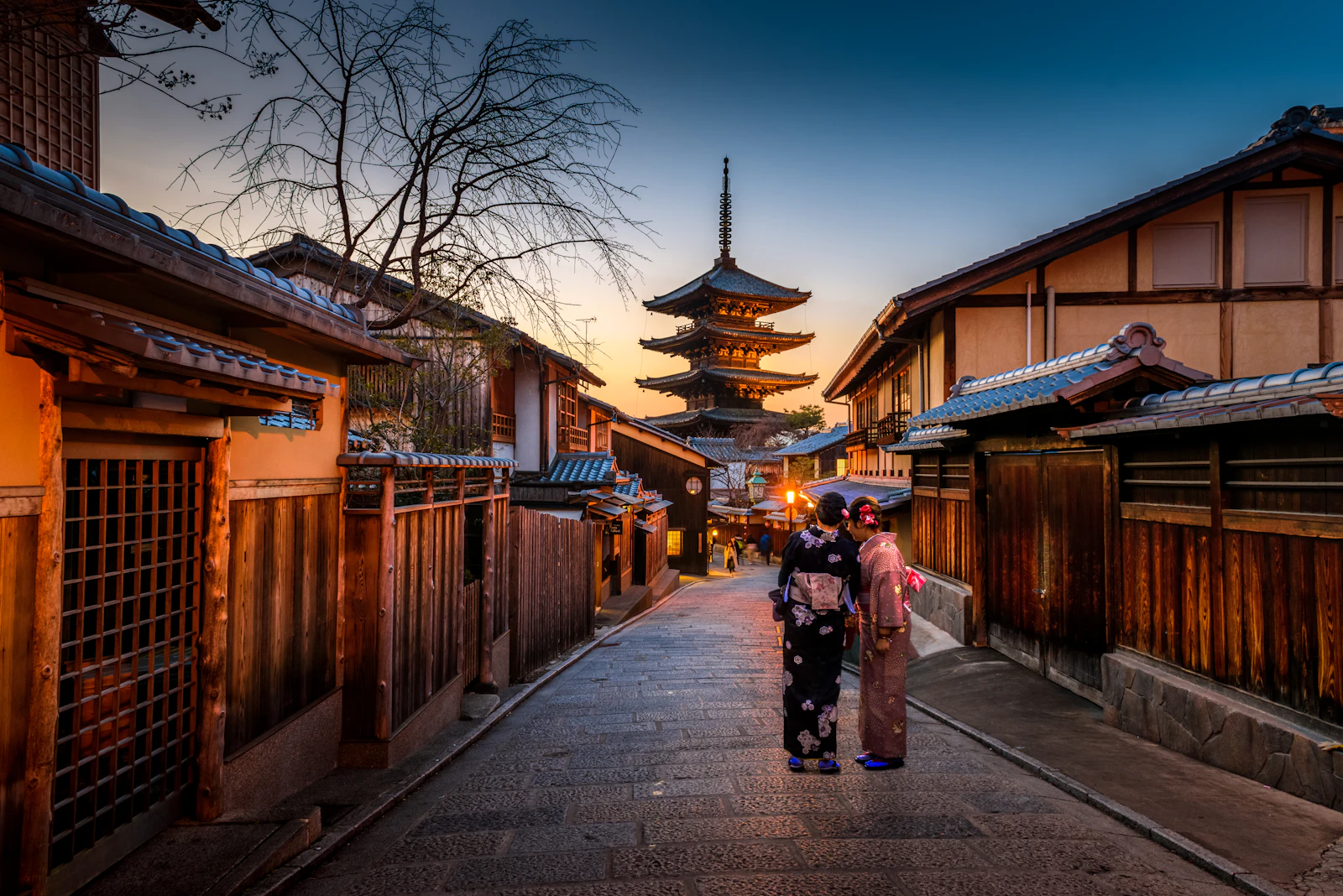
The morning bath, a Japanese breakfast of grilled fish, rice, miso and pickles, and a slow morning at the Hakone Open-Air Museum, where Henry Moore and Picasso sit in a mountain valley. The bus to Odawara and the Shinkansen to Kyoto, two hours along the coast with Fuji in the window if the sky allows. Your suitcases are in your room. The first evening in Kyoto is Gion: the stone lanes of Hanamikoji at dusk, a glimpse of a maiko on her way to an engagement, and dinner at an obanzai counter where Kyoto home cooking is served in small dishes.

Day 7: Eastern Kyoto: Fushimi Inari, Kiyomizu, the Philosopher’s Path
Fushimi Inari at dawn, because ten thousand vermilion gates are a different place at 6.30 am than at eleven. Then the eastern hills in order: Kiyomizu-dera’s wooden stage over the valley, the Ninenzaka and Sannenzaka lanes, Kodai-ji’s gardens, Maruyama Park, Chion-in, the Philosopher’s Path along its canal to Ginkaku-ji, the Silver Pavilion. A guide joins you for the morning — the day this route is built around — and by three you are in a tea house on the Kamo river with the temples done and the crowds arriving behind you. Dinner in Pontocho alley, on a riverside terrace in summer. The guide is a licensed Kyoto interpreter-guide, not a bus escort: she chooses the order by the day’s crowds, walks you through the back gate of Kodai-ji, explains why the Philosopher’s Path is named for Nishida Kitaro, and leaves you at three with the afternoon your own.
Day 8: Western Kyoto: Arashiyama and the Golden Pavilion
Arashiyama’s bamboo grove at opening, Tenryu-ji’s garden with the mountain borrowed into it, the Togetsukyo bridge, and the Okochi Sanso villa garden that most visitors walk past. A rickshaw if you like; the Sagano scenic railway through the gorge if the season is blossom or colour. The afternoon in the north-west: Kinkaku-ji, the Golden Pavilion on its pond; Ryoan-ji’s fifteen stones; Ninna-ji’s late cherries in April. Nishiki Market on the way back — five blocks of pickles, tofu skin, knives and matcha — and a kaiseki dinner tonight, booked weeks ahead, at a house with a garden. A dozen small courses follow the season: a clear soup with a single petal in April, hamo eel in July, matsutake in October, crab in December. It is the meal the trip is remembered by and the reason we book it before the flights.

Day 9: Nara
The train to Nara takes 45 minutes and the day writes itself: the deer in the park bowing for crackers, Todai-ji’s Great Buddha in the largest wooden building on earth, the lanterns of Kasuga Taisha under the trees, the Isuien garden, lunch in Naramachi’s merchant lanes. Back in Kyoto by four for a last afternoon — a kimono rental, the Nishijin textile district, a sake tasting in Fushimi — and a final dinner at a yakitori or tempura counter.
Day 10: Osaka
Twenty minutes on the express to Osaka. The castle park in the morning (the castle is a reconstruction; the park is one of Japan’s great blossom spots), Kuromon Market for a lunch of sea urchin and wagyu skewers eaten standing, an afternoon in the Shinsekai district with its kushikatsu skewers and the Tsutenkaku tower, and the evening in Dotonbori: takoyaki from the stand with the giant octopus, okonomiyaki at Mizuno, the Glico man, and the canal at night. If Universal Studios is in the plan, this is the day and the evening moves to day eleven.
Day 11: Depart from Kansai
A last Osaka morning — the Umeda Sky Building, a depachika at Hankyu for omiyage to take home — and the Rapi:t or Haruka express to Kansai Airport, 50 minutes, for the evening flight to Australia. You land the next morning with a suitcase heavier than it left and a second trip already forming. The Kansai departure is the reason the route runs Tokyo-first: the Osaka morning is a soft last day rather than a dash back across the country, the airport express leaves from the hotel district, and the open-jaw ticket costs no more than a plain return. If the party is continuing to Korea, day eleven becomes a two-hour flight to Seoul instead.
Variations and extensions
Twelve or thirteen days with Hiroshima and Miyajima: the most common extension. After Nara, the Shinkansen to Hiroshima (1 h 40 min): the Peace Memorial Park and Museum in the morning, the ferry to Miyajima for the floating torii at dusk, a night on the island, and back to Osaka the next afternoon. Fourteen days with Kanazawa and the Alps: Tokyo to Kanazawa on the Hokuriku Shinkansen, Shirakawa-go and Takayama by bus, then Kyoto by the Thunderbird express — the route on our Japanese Alps page, joined to this one. Nine days: drop Hakone and Osaka, three nights Tokyo and four Kyoto, out via Kansai. With children: a Tokyo Disney day replaces Nikko, Universal Studios takes day ten, apartment hotels throughout, and Nara stays because the deer are the thing they remember. Unhurried: two nights in Hakone, Green Car rail, a private car from Odawara, and the guided mornings extended to full days — the pace on our unhurried Japan page. In blossom or colour season: Kyoto booked nine to twelve months ahead, the middle days kept flexible, and the order adjusted when the forecast firms; see our blossom timing guide.
Eating on this route
Breakfast is included at the hotels and is superb at the ryokan; the rest is yours, and Japan is the best country on earth to be left to choose. In Tokyo: a Tsukiji or Toyosu sushi breakfast, Tokyo Ramen Street under the station, yakitori under the Yurakucho tracks, a tempura counter in Ginza, a tonkatsu at Maisen, the depachika at Isetan for a picnic in Shinjuku Gyoen. In Hakone: the kaiseki, and the Japanese breakfast of grilled fish and rice that converts people. In Kyoto: the kaiseki dinner we book on day eight, yudofu at Nanzen-ji, an obanzai counter in Gion, Nishiki Market, matcha in Uji if there is time. In Nara: kakinoha-zushi. In Osaka: everything — takoyaki, okonomiyaki, kushikatsu, Kuromon’s uni, a final yakiniku with the best wagyu you can afford. Lunch sets everywhere at AUD 12–18; convenience-store breakfasts that beat most hotel buffets; and no tipping, anywhere. Our Japan food guide goes city by city; vegetarian, gluten-free and allergy cards are provided in Japanese and the restaurant bookings are made accordingly.
What is included
- Return economy airfare from Sydney, Melbourne or Brisbane (open-jaw where the route allows), with premium economy and business on request
- Airport transfers at both ends by rail express or private car according to the party
- All Shinkansen and express-train seats reserved, Green Car on request
- Accommodation as described, with breakfast at hotels and dinner and breakfast at ryokan
- Luggage forwarding between cities so you travel with a day bag
- A Suica card loaded for each traveller, or set up in your phone wallet before departure
- Pre-booked entries and experiences named in the itinerary
- A detailed day-by-day document with maps, train times and restaurant suggestions
- Australian consumer-law protection and a Cooee contact in Brisbane throughout
- Hakone Free Pass covering the mountain loop
- A half-day private guide in eastern Kyoto on day seven
- teamLab and a Kyoto kaiseki dinner reserved
- A Nikko or Kamakura day trip on day four with train tickets and entries
- Visit Japan Web and medication-rule checks for every traveller before departure
- Restaurant bookings for the meals we name, with addresses in Japanese
- Dietary cards in Japanese for vegetarian, vegan, gluten-free and allergy travellers
Not included
- Lunches and most dinners (Japan is the best country in the world to eat out in, and we would rather you chose)
- Travel insurance (required)
- Personal spending, optional experiences not named, and tips (there are none in Japan)
- Japan Rail Pass (only included where the route makes it pay)
- Universal Studios or Tokyo Disney tickets (added on request)
- Kimono rental, tea ceremony, sumo seats, Ghibli Museum and other optional experiences, which we book on request at cost
Where you stay
Tokyo: a four-star hotel in Shinjuku or by Tokyo Station — Hotel Gracery, Mitsui Garden, the Keio Plaza or the Tokyu tier — or a Mimaru apartment hotel for families; upgrades to the Park Hyatt, the Andaz or the Aman on request. Hakone: a ryokan in Gora or Sengokuhara with a communal onsen and a private bath to book, dinner and breakfast included; the well-known houses (Gora Kadan, Hakone Ginyu) on request and booked six months ahead. Kyoto: a hotel in Higashiyama or near the station — the Mitsui Garden Sanjo, Hotel Kanra, the Cross Hotel — or a licensed machiya townhouse for a group; the Ritz-Carlton or Aman Kyoto at the top. In blossom and colour weeks we sleep in Osaka for the Kyoto days when Kyoto is gone, which costs 30–40 per cent less for the same standard and puts the sights fifteen minutes away by train. Osaka: Namba or Umeda, the Cross Hotel or the Swissotel Nankai above the station for the airport train.
Two rules govern every choice. The hotel sits where the day starts, not where the rate is lowest: a Shinjuku hotel two minutes from the Yamanote line saves an hour a day over a cheaper one three stops out. And the room sleeps the party as it actually is: Japanese doubles are 14–18 square metres, twins are scarcer than doubles and must be booked early, triples are rare, and families of four are in apartment hotels or connecting rooms or they are unhappy. We confirm the bed configuration in writing on every booking, because “family room” is not a standard in Japan.
What it costs
Eleven days, two people, flights included, in a mid-range hotel and a good ryokan in late May or early October is the version most people book; the same trip in the first week of April costs a third more. We do not publish a from-price for this itinerary because two factors move it by thousands: the season (cherry blossom and autumn colour cost 30–40 per cent more than late May or early October on flights and hotels combined) and the accommodation tier (a business hotel and a good ryokan against a five-star and a top-tier ryokan). We quote every departure individually in Australian dollars with everything above included, so the figure you see is the figure you pay. The Japan costs guide sets out the underlying numbers line by line so you can see how the quote is built.
Practical notes
Entry: Australians do not need a visa for Japan for stays under 90 days; complete Visit Japan Web before you fly. Some Australian medicines are prohibited or need a permit — see our entry guide. Money: cards work in cities; carry cash for small restaurants and temples; no tipping. Fitness: a normal Japan day is 15,000–20,000 steps; the itinerary can be paced down. Luggage: forwarded between cities; travel with a day bag. Etiquette: shoes off in ryokan and temples, quiet on trains, wash before the bath. Children and older travellers: both adjust easily; apartment hotels and Green Car rail are the usual changes. Day four’s choice between Nikko and Kamakura is made at booking; day ten can become a Universal Studios day with the Osaka evening moved to day eleven. Before you go: we send a pre-departure pack six weeks out with the Visit Japan Web link, the Suica set-up instructions, the medication checklist, a packing list built for shoes-off days and aggressive air-conditioning, restaurant bookings with their addresses in Japanese, and the phone number that answers in Brisbane. On the ground: the trains leave to the second and we time the connections generously; luggage goes ahead by takkyubin the morning you leave each city and is in the next room when you arrive; the ryokan dinner hour is fixed and we build the Hakone day around it; and the guide on day seven meets you at the hotel at eight with the temples opening as you reach them. Weather: a folding umbrella in every season, layers for April and November mornings, a light shirt for the trains in summer, and a coat for the January version, which has the clearest views of Fuji in the year.
How to book
Send us your preferred dates, your departure city and the names and ages of the party through the enquiry form or on 0409 661 342. We check the season against the route, confirm availability at the hotels and inns that matter, and send an itinerary and a quote in Australian dollars within two working days. A deposit holds the booking; the balance is due before departure under our booking conditions. Travel insurance is required and we can recommend a policy.
Frequently asked questions
How many days is the Classic Japan itinerary?
Eleven days and ten nights. It can be shortened or extended; the day-by-day above is the shape we start from.
When is the best time to do the Classic Japan itinerary?
Any month works for this route. April–May and October–November have the best weather and the blossom or colour; late May and early October give the same weather at a third less; January–February is cold, clear and empty. Avoid moving between cities in Golden Week (29 April–5 May) and Obon (mid-August).
Is this a group tour or a private itinerary?
A private itinerary built for your party and your dates, not a fixed-departure group. Guides join for the days named; the rest is independent travel with everything pre-booked.
Are flights included?
Yes: return economy from Sydney, Melbourne or Brisbane, open-jaw where the route allows, with premium economy and business on request. Other Australian cities connect via those three.
Do I need a Japan Rail Pass?
Only where the route makes it pay, in which case we include it. For most routes individual reserved tickets are cheaper since the 2023 repricing, and we book them.
Who is this itinerary for?
First-time visitors to Japan of any age, couples, families with children from about six, and groups of friends. It is the route we recommend to anyone who has not been before, and the foundation the other Japan itineraries build on.
What happens if the cherry blossom or autumn colour shifts?
We keep the middle of the trip on flexible bookings and adjust the order of cities when the forecasts firm up in mid-March or October. Our blossom guide explains the method.
How much does it cost?
Quoted per departure in Australian dollars with flights, rail, accommodation, transfers, luggage forwarding and named experiences included. Season and accommodation tier move the total; the Japan costs guide shows the underlying numbers.
Related
Tours convert; things to do informs. If you are still choosing, the things-to-do page is the step before this one.