

Asia is where the world eats best and cheapest, and the secret is not the restaurants but the street. This guide goes cuisine by cuisine through the ten Australians travel for, with the dishes, the places, the manners and the practical rules of safety, spice and dietary needs.
Asia is where the world eats best and cheapest, and the reason is not the restaurants but the street: the noodle stall that has made one dish for forty years, the market that sells breakfast at six, the night market that is the town’s living room. A traveller who understands how each country’s food culture works — where the locals eat, at what hour, how to order, what is safe and what is merely unfamiliar — eats better for AUD 10 a day than a tourist eating for AUD 100. This guide goes cuisine by cuisine through the ten that Australians travel for, with the dishes, the places and the practical rules of safety, spice, dietary needs and manners. Country-level food articles go deeper: the Japan food guide is the first.
The ten cuisines
Japanese
Restraint, seasonality, and the best AUD 12 lunch on earth.
Japan has more Michelin stars than any country and a street-food culture that barely exists, because the cheap food is served sitting down at a counter by someone who has done nothing else for decades. Restaurants specialise — a ramen shop makes ramen — and the lunch set is the value play. Convenience stores are a legitimate meal. No tipping; no eating while walking; slurp the noodles.
The dishes
- Sushi and sashimi — at a counter, one piece at a time; lunch omakase is half the dinner price
- Ramen — four broths, regional variations, AUD 9–16, eat it fast
- Tempura, tonkatsu, yakitori, unagi — each at its own specialist
- Kaiseki — the multi-course seasonal cuisine of Kyoto and the ryokan
- Okonomiyaki and takoyaki — Osaka’s street food, sitting down
- Wagyu — yakiniku or teppanyaki; A5 in 100-gram portions
Where to eat it
Tokyo for everything, Osaka for value and fun, Kyoto for kaiseki and tofu, Sapporo for seafood and miso ramen, Fukuoka for tonkotsu and the yatai stalls. The full Japan food guide goes city by city.
Thai
Sweet, sour, salty, hot, in one bowl, from a stall.
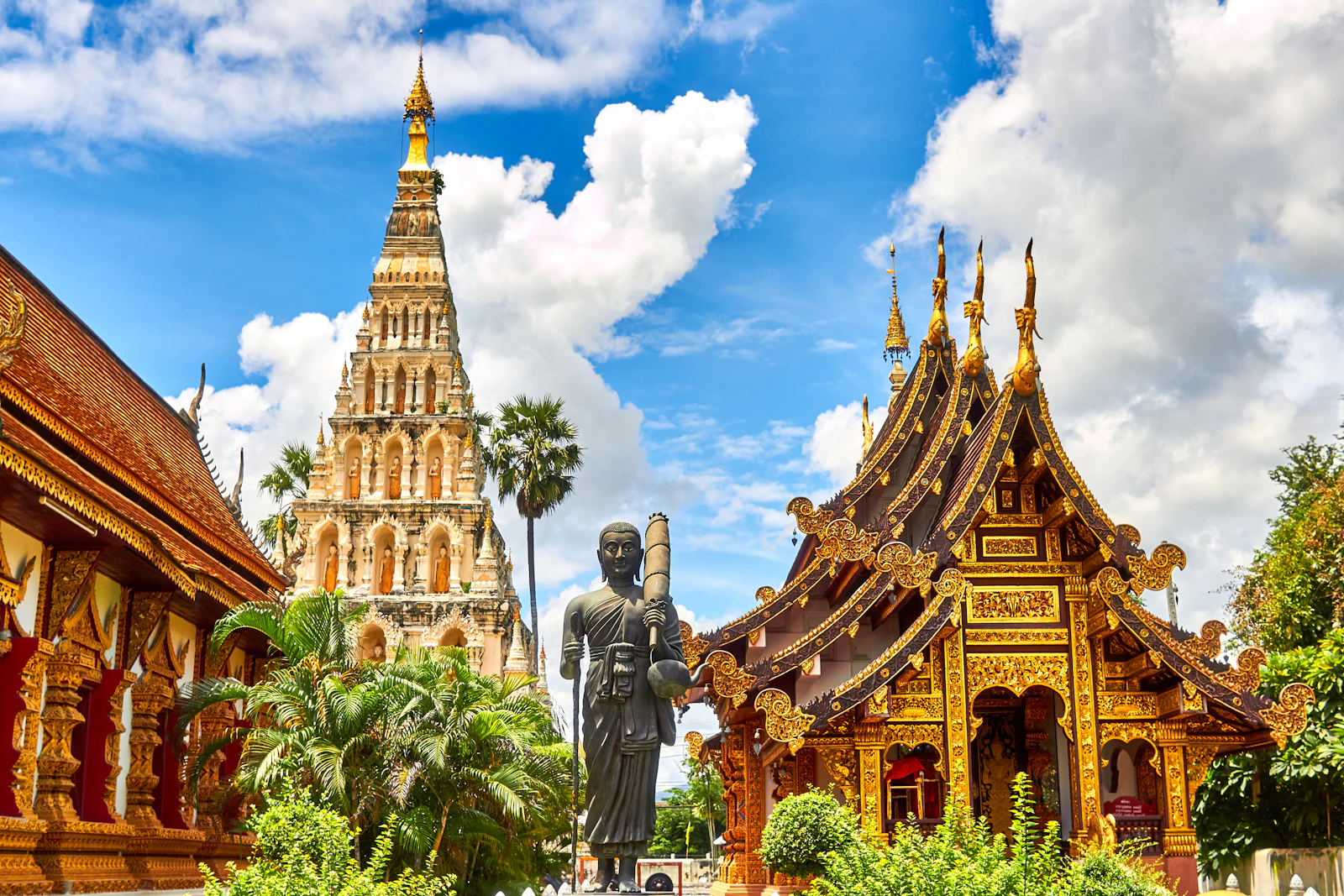
Thailand is the region’s great street-food country and eating at a plastic table on the pavement is how the whole nation dines. Regional differences matter: the north (Chiang Mai) is milder with Burmese and Lao influence; Isaan in the north-east is fierce with chilli and fermented fish; the south is coconut-rich and hottest of all; Bangkok has everything and the royal cuisine besides.
The dishes
- Pad thai, pad see ew, pad kra pao — the stir-fry staples
- Tom yum and tom kha — the soups
- Green, red, massaman, panang curries — ordered mild if you must
- Som tam — green papaya salad, Isaan’s gift, hot
- Khao soi — Chiang Mai’s curry noodle, lunch only
- Boat noodles, kuay teow — the AUD 3 bowl
- Mango sticky rice — April to June for the best mangoes
Where to eat it
Bangkok’s Chinatown (Yaowarat) at night, the Or Tor Kor market, Chiang Mai’s Sunday walking street and its khao soi shops, the Isaan stalls in every city, the seafood on every coast. The Thailand things to do page has the regions.
Vietnamese
Fresh herbs, French bread and the world’s best breakfast.
Lighter than Thai, built on herbs, rice noodles, fish sauce and the French legacy of bread and coffee. Three regions: Hanoi’s restrained north (pho was born here), Hue’s imperial and spicy centre, Saigon’s sweeter, busier south. Eating on tiny plastic stools at 6 am is the national habit and the best meal of the day.
The dishes
- Pho — beef or chicken noodle soup, breakfast, AUD 3
- Banh mi — the baguette, from a cart
- Bun cha — Hanoi’s grilled pork with noodles, lunch
- Cao lau and white rose — Hoi An’s own dishes
- Bun bo Hue — the centre’s spicy beef noodle
- Goi cuon and cha gio — fresh and fried rolls
- Ca phe sua da, egg coffee — the coffee culture
Where to eat it
Hanoi’s old quarter, Hoi An’s market, Saigon’s Ben Thanh and the alleys of District 1 and 3. A street-food walk with a local guide in Hanoi or Saigon is the best AUD 40 of the trip. The Vietnam guide covers the route.
Korean
Communal, fermented, spicy, and the table is the point.
The main dish arrives with banchan — a spread of side dishes, refilled free — and the meal is shared. Korean barbecue grilled at the table, stews from one pot, fried chicken with beer, and kimchi with everything. Spice is real but the barbecue is not spicy and most stews can be ordered mild. Korea drinks more coffee per head than almost anywhere.
The dishes
- Samgyeopsal and galbi — barbecue, wrapped in lettuce with ssamjang
- Bibimbap — best in Jeonju
- Kimchi jjigae, sundubu, samgyetang — the stews and soups
- Korean fried chicken — chimaek, with beer
- Tteokbokki, hotteok, gimbap — the street snacks
- Naengmyeon — cold noodles for summer
- Hoe — raw fish at Busan’s Jagalchi
Where to eat it
Seoul’s Gwangjang Market, the barbecue streets of Mapo and Jongno, Busan’s Jagalchi and the Gukje market, Jeonju for bibimbap. The South Korea guide has the food section.
Chinese
Eight cuisines, each larger than most countries’.
There is no Chinese food; there is Cantonese (dim sum, roast meats, steamed fish), Sichuan (the numbing chilli of hotpot and mapo tofu), Beijing (duck, dumplings, wheat), Shanghai (sweet-and-soy braising, xiaolongbao), Xi’an (hand-pulled noodles, lamb, the Muslim Quarter), Yunnan, Hunan, Fujian. Taiwan and Singapore have their own Chinese-derived cuisines and the best access for a visitor. Menus are photographs; ordering is pointing; tea is free.
The dishes
- Peking duck — at Da Dong or Siji Minfu in Beijing
- Dim sum — Cantonese, in Hong Kong, Guangzhou or Singapore
- Sichuan hotpot — in Chengdu or Chongqing, numbing
- Xiaolongbao — Shanghai’s soup dumplings; Din Tai Fung began in Taipei
- Biang biang noodles and roujiamo — Xi’an
- Beef noodle soup, stinky tofu, oyster omelette — Taiwan’s night markets
- Hainanese chicken rice, laksa, chilli crab — Singapore’s hawker centres
Where to eat it
Taipei’s Shilin and Raohe night markets, Singapore’s Maxwell and Old Airport Road hawker centres, Hong Kong’s dai pai dong, Chengdu’s hotpot streets, Beijing’s Ghost Street, Xi’an’s Muslim Quarter.

Malaysian and Singaporean
Three cuisines in one street, and the best hawker food on earth.
Malay, Chinese and Indian cooking side by side, plus the Peranakan (Nyonya) fusion of the Straits and the Indian-Muslim mamak stalls open all night. Penang’s George Town is the street-food capital of the region; Singapore’s hawker centres are the same tradition made orderly and UNESCO-listed. Halal by default in Malaysia, everything in Singapore.
The dishes
- Char kway teow — Penang’s wok-fried noodles
- Laksa — assam in Penang, curry in KL and Singapore
- Nasi lemak — the coconut-rice breakfast
- Roti canai and teh tarik — the mamak staples
- Hainanese chicken rice — Singapore’s national dish
- Chilli crab and satay — Singapore’s evening
- Nyonya kueh and cendol — the sweets
Where to eat it
Penang’s Gurney Drive, Chulia Street and Kimberley Street; KL’s Jalan Alor and the mamak stalls; Singapore’s Maxwell, Lau Pa Sat, Old Airport Road and Tiong Bahru hawker centres, and Katong for Peranakan.
Indonesian and Balinese
Spice pastes, sambal, and the warung.
A cuisine of spice pastes (bumbu), sambal chilli relish, coconut, peanuts and rice, eaten at warungs — the family-run eating houses that are Indonesia’s restaurants. Bali adds its own Hindu dishes, notably babi guling roast pork. The tourist coast has a good international scene; the food that matters is in the warungs a street back.
The dishes
- Nasi goreng and mie goreng — fried rice and noodles, breakfast to midnight
- Satay — with peanut sauce, from a cart
- Rendang — the slow-cooked beef of Padang cooking
- Babi guling — Bali’s roast suckling pig, lunch, at Ibu Oka or a village warung
- Bebek betutu — Balinese slow-roast duck
- Gado-gado — the peanut-sauce salad
- Nasi campur — the mixed-rice plate, the default lunch
Where to eat it
Ubud’s warungs, the Gianyar night market, Jimbaran’s seafood on the sand, the Padang restaurants everywhere for rendang, Yogyakarta’s gudeg. The Bali things to do page has the food section.
Indian and Sri Lankan
A subcontinent of cuisines, most of them vegetarian.
North Indian (the tandoor, naan, butter chicken, dal makhani, the Mughal legacy) is what Australians know; south Indian (dosa, idli, sambar, coconut, rice) is what Indians mostly eat. Kerala’s fish curries, Goa’s Portuguese vindaloo, Rajasthan’s dal-baati-churma, Bengal’s sweets and fish, Punjab’s bread and dairy, and the street food of Delhi and Mumbai. Sri Lanka’s rice and curry, hoppers and kottu are their own tradition. Much of India is vegetarian and it is the easiest place in Asia to be one.
The dishes
- Thali — the everything-on-a-plate lunch, refilled
- Dosa and idli — south Indian breakfast
- Biryani — Hyderabad’s or Lucknow’s
- Chaat — the street snacks of Delhi and Mumbai
- Kerala fish curry — on a banana leaf
- Hoppers, kottu, rice and curry — Sri Lanka
- Chai — everywhere, always
Where to eat it
Delhi’s Old City and Karim’s, Mumbai’s Mohammed Ali Road and Chowpatty, Amritsar’s dhabas, Kochi’s fish, Colombo’s Galle Face Green at night. Eat at busy places, hot food, and see the safety section.

Lao and Khmer
The quiet cuisines of the Mekong.
Lao food is sticky rice, larb (minced meat salad with herbs and lime), grilled fish, tam mak hoong (the papaya salad Thailand borrowed), jeow dips and Beerlao. Khmer food is milder: fish amok steamed in banana leaf, lok lak beef, Kampot pepper, prahok fermented fish, the Mekong’s freshwater fish, and a French-colonial bread and coffee culture in the towns.
The dishes
- Larb and sticky rice — Laos’s national plate
- Or lam — Luang Prabang’s stew
- Khao soi (Lao version) — different from Chiang Mai’s
- Fish amok — Cambodia’s signature
- Lok lak — peppery stir-fried beef
- Kampot pepper crab — at Kep
- Num pang — the Khmer baguette
Where to eat it
Luang Prabang’s night market and the morning market by the palace, Vientiane’s riverside, Siem Reap’s Old Market and the restaurants off Pub Street, Phnom Penh’s Russian Market, Kep’s crab market.
Taiwanese
The night-market culture that invented bubble tea.
Chinese heritage with Japanese colonial and indigenous influences, served in night markets that have no equal: Shilin and Raohe in Taipei, Fengjia in Taichung, the Tainan flower night market. Mild by Asian standards, sweet-leaning, with a large Buddhist vegetarian tradition and a vegetarian restaurant in every neighbourhood.
The dishes
- Beef noodle soup — the national dish
- Xiaolongbao — at the original Din Tai Fung
- Oyster omelette, stinky tofu, gua bao — the night-market trinity
- Bubble tea — invented in Taichung in the 1980s
- Danzai noodles, coffin bread, milkfish — Tainan
- Pineapple cake — the omiyage
- High-mountain oolong — from Alishan
Where to eat it
Any night market from 6 pm; Yongkang Street in Taipei; Tainan for a full day of eating; the Taiwan things to do page has the food-and-night-market section.
How eating works, country by country
| Where locals eat | Hours | Tipping | Cards or cash | Spice | |
|---|---|---|---|---|---|
| Japan | Counters, specialist shops, konbini | Lunch 11.30–2, dinner 6–9; kitchens close early | Never | Cash still common | Almost none |
| Thailand | Street stalls, shophouses | All day; night markets 6–11 | 10% at restaurants with no service charge; coins at stalls | Cash at stalls | High; ask for mai phet |
| Vietnam | Plastic stools, family shops | Breakfast 6–9 is the main meal out; dinner early | Small | Cash | Moderate; chilli on the side |
| Korea | Barbecue houses, markets, pojangmacha tents | Late; restaurants busy to midnight | Never | Cards everywhere | Moderate to high; barbecue is mild |
| China | Everything, everywhere | Lunch 11.30–1.30; dinner 6–8 | Never | Alipay/WeChat; cash rare | By region: Sichuan high |
| Malaysia/Singapore | Hawker centres, mamak stalls, kopitiams | All day; mamak all night | Not expected | Cash at hawkers | Moderate |
| Indonesia | Warungs | Lunch 12–2; dinner early | 10% at restaurants | Cash at warungs | Sambal on the side |
| India | Dhabas, thali houses, street carts | Late lunch, late dinner (8–10 pm) | 10% | Cash and UPI | High; ask for less |
| Laos/Cambodia | Markets, riverside stalls | Early; towns quiet by 9 | Small | Cash; US dollars in Cambodia | Lao high, Khmer mild |
Manners at the table
Chopsticks never upright in rice and never used to pass food (both funeral gestures across East Asia); the right hand only in India, Malaysia and Indonesia; shoes off at floor seating in Japan, Korea and much of South-East Asia; pour for others before yourself in Korea and Japan; do not finish every dish in China, where an empty table implies the host under-ordered; do finish your rice in Japan; slurp noodles in Japan, not in Korea; wait for the eldest to start in Korea; say the grace words in Japan (itadakimasu, gochisousama); and everywhere, the host orders, the guest praises, and nobody argues over the bill in public.
Food safety, honestly
The rule that works everywhere is turnover: a busy stall with a queue of locals serves food that has not sat around, and a quiet restaurant with a long menu is where the risk lives. Hot, freshly cooked food is safe almost everywhere in Asia; the hazards are water, ice, raw vegetables washed in it, cut fruit that has been sitting, and shellfish in the wet season. Bottled or filtered water outside Japan, Korea, Taiwan and Singapore; ice in hotels and good restaurants is factory-made and fine, and increasingly so at street stalls too. Peel your own fruit. Hand sanitiser before eating. In India, add: no raw salads, no chutneys at street carts, hot chai only, and a travel doctor’s kit with rehydration salts and antibiotics. Most travellers get one mild upset in a fortnight and most of those come from a hotel buffet, not a stall. Hepatitis A and typhoid vaccinations cover the serious end.
Vegetarian, vegan, gluten-free, halal, allergies
Vegetarians and vegans eat best in India (half the population), Taiwan (Buddhist vegetarian restaurants everywhere), Sri Lanka, and the temple cuisines of Japan (shojin ryori) and Korea. Thailand, Vietnam and Indonesia are workable with a phrase — jay in Thai, chay in Vietnamese, vegetarian is understood in Bali — and a watch for fish sauce and shrimp paste, which are in most things. Korea is hardest. Gluten-free is difficult where soy sauce is wheat-based (Japan, Korea, China) and easy in rice-based South and South-East Asia; carry tamari and a card in the language. Halal is the default in Malaysia, Indonesia and the Maldives, easy in Singapore and India, and available in the tourist areas of everywhere else. Allergies, especially peanut and shellfish, are common in the region’s cooking and need a card in the local language and restaurants chosen in advance; we provide the cards and choose the restaurants.
Food experiences worth booking
A market walk with a guide in Hanoi, Bangkok, Penang, Delhi or Kyoto: AUD 40–80 and the best introduction to any cuisine. A cooking class with the market visit first, in Chiang Mai (the best in the region), Hoi An, Ubud, Kyoto, Kochi or Seoul: AUD 60–150 for a half day. A street-food night tour by scooter in Saigon or on foot in Bangkok’s Chinatown. A hawker-centre crawl in Singapore. A sushi or kaiseki counter in Japan, booked a month ahead. A ryokan or hanok dinner. A tea ceremony in Kyoto or a tea-plantation stay in Alishan or Ella. A sake, soju, whisky or arak tasting. A durian, once, in season, in Malaysia. And an evening at a night market in Taipei with an empty stomach and small notes.
Drinks
Tea is the continent’s drink: Japanese sencha and matcha, Chinese oolong and pu-erh, Taiwanese high-mountain oolong, Indian chai, Sri Lankan Ceylon, Thai iced tea, Malaysian teh tarik, and Vietnam’s tea served free with every meal. Coffee is strongest in Vietnam (the world’s second producer; ca phe sua da and egg coffee), Indonesia (kopi and civet-coffee nonsense to avoid), Korea (more cafes per head than anywhere) and Japan’s kissaten; Singapore and Malaysia have the kopitiam. Beer is the traveller’s drink everywhere — Asahi, Tiger, Singha, Bia Hoi at 40 cents a glass in Hanoi, Beerlao, Bintang, Kingfisher — and craft scenes are growing in every capital. Spirits: sake and shochu in Japan, soju in Korea, baijiu in China (approach with caution), arak in Bali, feni in Goa, lao-lao in Laos, Japanese whisky now among the world’s most collected. Wine is imported, taxed and expensive across the region except in Japan and Singapore; Australians should not expect their own labels at their own prices. Alcohol is restricted in Malaysia outside non-Muslim venues, in the Maldives outside resorts, in parts of India (Gujarat and Bihar are dry; Kerala restricts) and during Ramadan and Nyepi. Bali’s methanol-poisoning cases from counterfeit spirits are real: drink beer, wine or spirits from a reputable bar and never a cheap cocktail from a beach shack.
Sweets and fruit
Asian desserts are less sweet and more textural than Western ones and are eaten as snacks rather than after dinner: Japanese wagashi with tea, Thai mango sticky rice and coconut custard, Vietnamese che, Malaysian cendol and kueh, Indonesian klepon, Indian gulab jamun and kulfi, Taiwanese shaved ice and bubble tea, Korean bingsu and hotteok. The fruit is the revelation: mangoes in Thailand and the Philippines from March to June, mangosteens, rambutans, longans, dragonfruit, jackfruit, the durian that hotels ban and Malaysians revere, and Japan’s cultivated strawberries, melons and grapes sold individually in the depachika at prices that make sense only when you taste them.
What it costs
A street or market meal is AUD 2–6 in Vietnam, Thailand, Indonesia, India, Laos and Cambodia, AUD 5–8 in Malaysia, Singapore’s hawkers and Taiwan, AUD 9–16 in Japan and Korea. A good restaurant dinner is AUD 15–40 in South-East Asia, AUD 45–90 in Japan and Korea, AUD 60–120 in Singapore. Fine dining exists in every capital at AUD 150–400 and is, in Bangkok, Tokyo, Singapore and Seoul, among the best in the world. A food-led traveller eating one special meal a day spends AUD 60–100 a day in South-East Asia and AUD 120–200 in Japan; a traveller happy with the ordinary spends a third of that and eats magnificently.
A food route across Asia
For the traveller with three weeks and one priority: Tokyo and Osaka (5), fly to Seoul (3), fly to Taipei (3), fly to Penang via KL (3), then Bangkok (3) and Hanoi or Saigon (3). Six of the world’s great eating cultures, two hours apart at each step, and a different breakfast every morning. The Asia itineraries page has the routes; the things to do in Asia page has everything else.
Frequently asked questions
Which Asian country has the best food?
Every traveller answers differently: Japan for quality at every price, Thailand for street food, Vietnam for freshness and value, Korea for the communal table, Malaysia and Singapore for three cuisines in one street, India for a subcontinent of vegetarian cooking. The honest answer is that they are different rather than ranked.
Is street food in Asia safe to eat?
Generally yes, and often safer than a quiet restaurant. Choose busy stalls with high turnover, eat hot freshly cooked food, avoid raw vegetables and cut fruit washed in tap water, and drink bottled or filtered water outside Japan, Korea, Taiwan and Singapore.
Can vegetarians eat well in Asia?
Very well in India, Taiwan, Sri Lanka and at the temple cuisines of Japan and Korea; well with a phrase and a watch for fish sauce in Thailand, Vietnam and Indonesia; with difficulty in Korea. Buddhist vegetarian restaurants exist in every Chinese-heritage city.
Is Asian food very spicy?
It varies enormously. Japan, Taiwan, Cambodia and most of China are mild; Korea, Thailand’s Isaan and south, Sichuan, Laos and much of India are hot. Almost everywhere will reduce the chilli on request, and the barbecue, noodle and rice staples are mild by default.
Do you tip in Asian restaurants?
Not in Japan, Korea, China or Taiwan, where it can cause confusion. Ten per cent at restaurants without a service charge in Thailand, Indonesia and India; small change at stalls; not expected in Malaysia and Singapore, where a service charge is added.
How much should I budget for food in Asia?
AUD 20–40 a day eating well at local places in South-East Asia and India, AUD 50–80 with a nice dinner each night; AUD 45–60 and AUD 90–140 in Japan and Korea; more in Singapore. Fine dining is AUD 150–400 in every capital.
Where is the best street food in Asia?
Penang’s George Town, Bangkok’s Chinatown, Hanoi’s old quarter, Taipei’s night markets, Singapore’s hawker centres and Osaka’s Dotonbori are the six most cited. Delhi and Mumbai for those who have done the vaccinations.
What is a cooking class like in Asia and is it worth it?
Half a day, usually starting with a market visit, cooking four to six dishes and eating them, AUD 60–150. Chiang Mai, Hoi An, Ubud and Kyoto run the best. Worth it for anyone who cooks at home; the market visit alone justifies it.
Where this leads
Travel guide informs; things to do helps you choose; tours convert.