🇲🇦 Morocco · Al-Mamlaka al-Maghribiyya · The Kingdom of the West

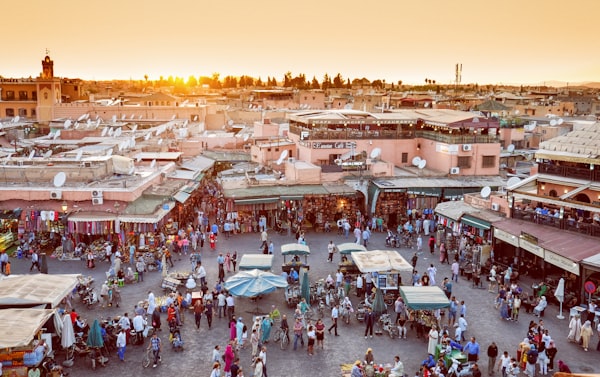
The Medina.
The Dunes.
The Mint Tea.

A square that becomes an entirely different city after sunset. A tannery that has been processing leather with the same plant-based dyes since the 11th century — the process unchanged because it cannot be improved cheaply. Dunes 150 metres high at the edge of the Sahara, reached on camelback at dusk. The world’s oldest university, still teaching, in a city whose streets have not materially changed in a thousand years. Morocco is the country where the distance between the medieval and the modern is the length of a riad doorway.

859 CE
Al-Qarawiyyin · World’s Oldest University · Fez
150m
Erg Chebbi Dunes · Sahara Desert · Merzouga
4,167m
Jebel Toubkal · Highest Peak · North Africa
~13 hrs
Sydney to Casablanca · via Dubai or Doha
Visa Free
Australians · 90 Days · No Application Required
🇲🇦 Morocco
Kingdom of Morocco · 710,850 km² · 37 Million People · Africa’s Northwest Corner

Morocco — Africa, Arabia,
Andalusia, and the Sahara
in a Single Country

Morocco (Al-Mamlaka al-Maghribiyya — “The Kingdom of the West” in Arabic — the Maghreb (the Arabic word for “west” or “sunset” — the regional term for North Africa west of Egypt) — 710,850 km² in northwest Africa at the intersection of the Atlantic Ocean and the Mediterranean Sea — 37 million people — the only African country bordering both the Atlantic and the Mediterranean — separated from Spain by the 14km Strait of Gibraltar — bordered by Algeria to the east and the disputed territory of Western Sahara to the south — the Atlas Mountains running diagonally across the country from the Atlantic northeast coast to the Sahara in the southeast — the Rif Mountains in the north) is the country that most visitors describe as the most disorienting they have ever visited in the sense that the disorientation is pleasant — the experience of arriving in a medina (the Arabic word for “city” — the old urban core of a Moroccan city, typically UNESCO-listed, typically walled, and typically arranged in a way that makes orientation impossible for anyone who has not navigated it before) for the first time and discovering that the city is organised by a logic that is not European and not quite anything the visitor has experienced before.

Morocco’s four anchor regions: The Imperial Cities (Fez, Meknès, Marrakech, and Rabat — the four cities that have served as Morocco’s royal capitals at various periods — each with its own medina, its own character, and its own relationship to Moroccan history). The Sahara (the Draa Valley and the Erg Chebbi dunes at Merzouga — the 150m-high orange sand dunes — the camel trek at dusk — the overnight Berber camp — the silence — the dawn from the dune crest). The Atlas Mountains (the High Atlas — the Toubkal trek (4,167m — the highest peak in North Africa) — the Berber (Amazigh) villages of the Imlil Valley — the route through the Tizi n’Tichka pass to Marrakech). The Atlantic and Mediterranean coast (Essaouira (the UNESCO-listed Atlantic port — the Wind City — the Gnawa music), Chefchaouen (the Blue City in the Rif Mountains), Tangier, and the dramatic Rif coast).

✅ Morocco Practical Essentials
  • Visa: Australian passport holders do NOT require a visa for Morocco. Australian citizens can enter Morocco visa-free for up to 90 days. No pre-application is required — present the Australian passport at immigration and the stamp is issued on arrival. This is one of the most straightforward entry arrangements for Australians travelling to Africa or the Middle East. The 90-day limit is per entry — a brief exit to Spain (via the Ceuta/Melilla border or the Tarifa–Tangier ferry) and re-entry resets the 90-day clock, though this is not a mechanism Cooee Tours endorses for extended stays beyond the original tourist intent.
  • Getting there: Sydney to Casablanca Mohammed V International Airport (CMN) via Dubai (Emirates — approximately 14 hours Sydney to Dubai, approximately 7 hours Dubai to Casablanca — total approximately 24–25 hours) or via Doha (Qatar Airways — similar time). Casablanca to Marrakech by the Al Boraq high-speed train (the TGV-standard service — Casablanca to Marrakech in 2 hours 45 minutes — the guide arranges the connection at Casa Voyageurs station). Direct flights from Casablanca to Fez, Marrakech, Agadir, and other Moroccan cities (Royal Air Maroc — typically 1 hour). Marrakech Menara Airport (RAK) also receives direct European services (Ryanair, EasyJet, and Air Arabia from European hubs) and is an alternative entry point for visitors beginning in Marrakech.
  • Currency: Morocco uses the Moroccan Dirham (MAD — approximately MAD 6 = AUD$1 in 2026). The Dirham is a controlled currency — it cannot be purchased outside Morocco and cannot (legally) be taken out of Morocco in large quantities. ATMs (“guichets automatiques”) are widely available in all major cities — the guide recommends arriving with AUD$100–200 changed to Euros (the Euro is widely accepted at hotels, major restaurants, and larger shops — the change is given in Dirhams) and withdrawing Dirhams from ATMs for day-to-day souk and medina purchases. The souks are a cash economy — carry small Dirham bills (MAD 10–50 denominations) for souk purchases, mint tea, and the hammam entry fee.
  • Bargaining in the souks: the price stated by the vendor in the souk is the starting price, not the selling price. This is not unique to Morocco — it is the standard commercial convention of most North African and Middle Eastern traditional markets. The guide’s briefing on bargaining: “make a counter-offer of approximately 40–50% of the opening price — be pleasant — the vendor is not insulted by a low offer — the vendor is insulted by rudeness or a dramatically unrealistic offer (say, 5% of the opening price) — meet somewhere in the middle — if you buy something, it was worth what you paid — if you don’t buy anything, the interaction was not a failure — mint tea during bargaining is not a transaction cost, it is hospitality — drink the tea regardless of whether you buy anything”.
  • The riad: the standard accommodation in Morocco’s medinas is the riad (from the Arabic “ryad” — meaning “garden” — the traditional Moroccan courtyard house whose architectural principle is inward-facing — the exterior presents a plain, often undecorated wall to the narrow medina street — the interior opens to a central courtyard garden (the giardino — the oranges, the roses, the fountain) around which the rooms are arranged. The riad is the architectural expression of a cultural value: that beauty is private, not public — that the street does not require decoration but the home does. The guide’s observation: the first time a visitor passes through a riad door from the street, the contrast is so complete that most guests stand in the courtyard for a moment before speaking. This is the correct response.
Eight Essential Destinations

Morocco’s Cities, Mountains, and Desert

Morocco rewards visitors who understand the country as a sequence of distinct environments: the imperial city medinas, the Saharan desert edge, the High Atlas, and the Atlantic coast — each with its own logic and its own pace.
Marrakech Morocco medina Djemaa el-Fna Koutoubia mosque souks riad
Marrakech
🏠 Djemaa el-Fna · Medina UNESCO · Majorelle · Souks

Marrakech (the “Red City” — the rose-red sandstone and clay used throughout the medina buildings — the colour most visible from the air and at dawn when the city’s wall catches the low light — the city founded by the Almoravid dynasty in 1062 CE — the medina declared a UNESCO World Heritage Site in 1985 — a city of approximately 900,000 people of whom the majority live in the medina and its peripheral quartiers) is the entry point for most Australian visitors to Morocco and the city that consistently generates the response “nothing could have prepared me for this” — not a negative response — a response to sensory density. The Djemaa el-Fna (the main square of the Marrakech medina — declared a UNESCO Masterpiece of the Oral and Intangible Heritage of Humanity in 2001 — the first such designation in the world for a cultural space rather than a specific site or tradition — the square is the delivery mechanism for a performance tradition (the storyteller (halqa), the acrobat, the water seller, the snake charmer (the guide’s briefing before the square: “you can photograph the performers but they will expect payment — MAD 20–50 per photograph — do not photograph without acknowledging this — it is their workplace”) — the square during the day is occupied primarily by the orange juice vendors and the henna artists — the square after sunset becomes the largest open-air restaurant in Africa — the smoke from the food stalls — the kerosene lanterns — the storytellers who draw circles of listeners who may or may not understand the Darija (Moroccan Arabic) and who stay anyway — the guide takes the group to the Djemaa el-Fna at two times: 11am (to see the day version) and 8pm (to see the night version — these are different places)). The Jardin Majorelle (the 1-hectare botanical garden designed by the French painter Jacques Majorelle from 1924 — the specific Majorelle Blue (the intense cobalt blue that Majorelle used on the garden structures and later patented as a colour — the guide notes the patent — a French painter patenting a colour in Morocco in the 1930s is a specific historical moment — the garden purchased by Yves Saint Laurent and Pierre Bergé in 1980 when it faced demolition — restored and opened to the public — the YSL memorial in the garden — the Islamic Arts Museum of Marrakech within the garden structures). The souks (the market districts of the Marrakech medina — organised by trade (the dyers’ souk, the leather souk, the carpet souk, the spice souk, the brass souk — the organisation reflects a medieval commercial city plan that has not fundamentally changed since the 12th century — the guide navigates — the group does not split up — the guide is willing to answer “are we lost?” in the affirmative without concern — the medina navigation is a skill of decades)).

  • Djemaa el-Fna · UNESCO 2001 · first intangible heritage space in the world
  • Souks · 12th-century plan · navigate with guide · do not split up
  • Jardin Majorelle · Majorelle Blue · YSL · purchased 1980 from demolition
  • Bahia Palace · 19th-century · 160 rooms · carved stucco + zellige
  • Djemaa at 8pm · different city from the 11am version · the guide times both
Fez Morocco medina tannery Chouara Bou Inania madrasa Al-Qarawiyyin souks
Fez — The Living Medieval City
🏛 859 CE University · Chouara Tannery · World’s Largest Medina

Fez (Fes — the ancient capital of Morocco — founded in 789 CE by Idris I on the right bank of the Fez River, expanded on the left bank in 809 CE by Idris II — the combined medina (Fes el-Bali) declared a UNESCO World Heritage Site in 1981 — the largest pedestrian urban area in the world — approximately 9,400 streets and alleys within the medina walls — the street that the guide uses is approximately 50cm wide at its narrowest point — the guide’s instruction for this section: “flatten against the wall when the donkey is coming — the donkey always has right of way — the donkey has always had right of way in this street”) is the city that most Morocco specialists consider the most significant single destination in the country — not the most beautiful (Marrakech), not the most dramatic (the Sahara), but the most complete — the place where the medieval Islamic urban form survived intact and continues to function as a living city rather than a heritage display. The Al-Qarawiyyin University and Mosque (founded in 859 CE by Fatima al-Fihri — a woman — the daughter of a wealthy Tunisian merchant family who emigrated to Fez — the Al-Qarawiyyin is recognised by UNESCO and Guinness World Records as the oldest continuously operating university in the world (the university that invented the concept of the academic degree — the “ijaza” — the certificate of learning — from which the Western degree tradition derives through Andalusian Islamic scholarship) — the university was a centre of Islamic scholarship, mathematics, astronomy, and grammar for over 1,000 years — the library (now the Al-Qarawiyyin Library — one of the oldest libraries in the world) was restored and reopened to researchers in 2016 — the mosque is not open to non-Muslims but the adjacent courtyard views are accessible and the guide explains the full Al-Qarawiyyin story from outside). The Chouara Tannery (the leather tannery in the northeastern quarter of the Fes el-Bali medina — the largest and oldest of three tanneries in Fez — operating continuously since the 11th century — the dyeing vats (the circular pits dug into the tannery floor — filled with saffron (for yellow — the guide notes that the saffron in the tanning vat is not culinary-grade saffron — the visitor should not be impressed by this — it is the dried stigmas of the Crocus sativus pressed into the tanning liquor as a mordant dye), poppy (for red), mint (for green), indigo (for blue), and henna (for orange) — the white vats at the perimeter are filled with a mixture of cow urine, pigeon dung, salt, water, and limestone — the organic solution that softens the hide before dyeing — the guide provides each visitor with a sprig of mint at the tannery terrace (the aromatic offset for the ammonia from the white vats — the guide holds the mint under their own nose for a moment before distributing it — the action is so practised it is automatic)). The Bou Inania Madrasa (the 14th-century Quranic school built by the Marinid sultan Bou Inan — the finest surviving example of Marinid architecture in Morocco — the zellige tilework on the lower third of every interior surface, the carved stucco (plaster) in the middle register, and the cedarwood carved screens and stalactite ceilings (muqarnas) at the top — the three-register architectural system of the Moroccan Islamic interior — the guide explains each register’s symbolic programme before entering (the earthly, the transitional, the divine) — this explanation takes 8 minutes — the group’s experience of the interior is different having had it)).

  • Al-Qarawiyyin · founded 859 CE · oldest university in the world · Fatima al-Fihri founder
  • Chouara Tannery · 11th century · pigeon dung + plant dyes · the mint sprig
  • Bou Inania Madrasa · zellige + stucco + muqarnas · three-register programme
  • 9,400 streets · largest pedestrian urban area · 50cm at its narrowest
  • Donkey has right of way · always · in this street since 1000 years
Sahara Desert Morocco Merzouga Erg Chebbi sand dunes camel sunset orange
The Sahara — Erg Chebbi & Merzouga
🏦 150m Dunes · Camel Trek · Overnight Camp · Draa Valley

The Merzouga dunes (Erg Chebbi — the ergs (the Arabic word for a field of sand dunes — a sand sea — as distinct from the hamada (the flat rocky desert) and the reg (the gravel plain) — the three landscape types of the Sahara that most visitors do not know have specific names until the guide explains them on the road through the Draa Valley) at Merzouga in the Tafilalet region of southeastern Morocco — the dunes rising to approximately 150m at their highest point — the orange-red colour of the Erg Chebbi sand (the colour produced by the iron oxide content of the Saharan sand — the orange is most intense at dawn and dusk when the low-angle light maximises the red spectrum — the guide’s instruction on the camel to the dune crest: “the dune crest is approximately 150m above the desert floor — the walk from the base of the dune to the crest takes approximately 25 minutes — the sand is very loose — for every two steps forward, you will slide back one — this is correct — continue”) are the Saharan component of the Moroccan itinerary that most visitors describe as the most unexpectedly affecting part of the country. The camel trek (the departure from the Merzouga village at approximately 3:30pm — the guide leads the camel line into the dunes — the camels are dromedaries (Camelus dromedarius — the single-humped Arabian camel — the guide distinguishes from the Bactrian camel (two humps — Central Asian — better at cold) — the dromedary preferred in the Sahara for its specific adaptation to extreme heat and water conservation). The overnight camp (the Berber camp at the base of the dunes — the goat hair tents (the traditional nomadic tent — the woven goat hair provides both shade in the day and warmth at night — the guide notes the weaving technique — the nomadic Berber tent can be assembled and disassembled by one person in approximately 20 minutes) — the dinner (the tagine prepared by the camp cook — the lamb shoulder with preserved lemon and olives — the mint tea poured from height at the camp fire — the guide’s specific instruction before the mint tea pour: “do not touch the glass immediately — the glass is very hot — hold it at the top — wait 30 seconds”)). The Draa Valley route (the road from Marrakech to Merzouga via the Tizi n’Tichka mountain pass (2,260m — the highest road pass in Morocco — the guide stops at the pass for the view — the Atlas range visible to the north and the pre-Saharan plateau to the south — the line between green and desert visible at a single glance) and Ouarzazate (the “Door of the Desert” — the film production city — Lawrence of Arabia, Gladiator, Game of Thrones, The Mummy, and hundreds of other productions filmed at the Atlas Studios adjacent to Ouarzazate) and Aït Benhaddou (the UNESCO ksar — addressed in the dedicated section)).

  • Erg Chebbi · 150m dunes · orange-red iron oxide · most intense at dawn and dusk
  • Camel trek · 3:30pm departure · 25 min to dune crest · two forward one back
  • Overnight Berber camp · goat hair tent · tagine at the fire · mint tea poured from height
  • Draa Valley route · Tizi n’Tichka 2,260m · green to desert visible in one glance
  • Merzouga village · the correct base · 3 hours by vehicle from Ouarzazate
Chefchaouen blue city Morocco Rif mountains blue white medina streets
Chefchaouen — The Blue City
🏠 Blue Medina · Rif Mountains · 1471 CE · Photography

Chefchaouen (the “Blue City” — the medina and residential quartiers of Chefchaouen (the name derived from the Berber “isha’uan” — meaning “look at the horns” — a reference to the twin peaks of the Rif Mountains visible above the city) in the Rif Mountains of northern Morocco — founded in 1471 CE by the Andalusian exile Ali ibn Rashid to serve as a base for Moroccan resistance to the Portuguese expansion along the Atlantic coast — the blue colour: the origin of the Chefchaouen blue is the subject of multiple competing theories (the guide presents all three — the Jewish community who fled the Spanish Reconquista in the 15th century and painted their buildings blue as a symbolic representation of heaven — the mosquitoes repelling properties of the indigo dye — the aesthetic choice of the mid-20th century in an attempt to attract tourism — the guide’s position: “the historical record supports the first and third theories approximately equally and the mosquito theory not at all — the guide chooses the first theory when asked to choose one, with the caveat that the city is beautiful regardless of which theory is correct”) is consistently one of the most photographed cities in Africa — every alley in the medina is painted in shades of blue from powder blue to indigo to near-violet — the blue applied annually (the guide walks past the painting in April — the plasterers and painters who maintain the blue — the guide photographed this maintenance process for the first time in 2017 and has photographed it on approximately 50% of subsequent April visits). The medina of Chefchaouen (smaller and more navigable than Fez or Marrakech — the guide allows the group to navigate independently for 2 hours in the afternoon (the guide provides a mobile number and a landmark — the guide station is the blue steps at the corner of Rue Sidi Mohammed el-Abed — the meeting point — the group returns — no one has been lost in 12 years of independent navigation periods — the guide notes this without pride — the medina is genuinely not that large). The Spanish Mosque (the 15-minute walk above the medina — the ruined mosque on the hillside above Chefchaouen — the view of the blue medina below — the guide times the arrival for the late afternoon (4:30pm in summer, 3:30pm in winter — the angle of the light on the blue city from the hillside above is the photograph that appears on every Chefchaouen website and is genuinely accurate to the experience)).

  • Blue medina · painted annually · the guide photographs the painters in April
  • Founded 1471 CE · Andalusian exile · Jewish community blue-painting tradition
  • Spanish Mosque hillside · 4:30pm · the photograph · accurate to the experience
  • Independent navigation · 2 hours · blue steps meeting point · no one lost in 12 years
  • Rif Mountains · “look at the horns” · the twin peaks above the city
Aït Benhaddou Morocco UNESCO ksar kasbah Draa Valley Ouarzazate film location
Aït Benhaddou
🏛 UNESCO · Earthen Ksar · Gladiator · Game of Thrones · Film Capital

Aït Benhaddou (the ksar — the Arabic/Berber word for a fortified earthen village — the agadir (the communal granary) at the summit of the hill — the earthen towers — the UNESCO World Heritage site since 1987 — located on the Draa Valley route between Marrakech and Ouarzazate — on the left bank of the Ounila River — the crossing to the ksar either by the footbridge or by wading the shallow river (the guide wades — the group wades or crosses the bridge — the guide notes that wading was the only crossing option until the bridge was built in the 2000s and that the river has been crossed on foot at this point for approximately 800 years)) is the most intact surviving example of southern Moroccan earthen architecture (the pisé — the compressed earth construction technique — the earthen walls mixed with straw and clay and compressed in wooden formwork — the technique that built the kasbahs, the ksour (plural of ksar), and the medina walls throughout the pre-Saharan south of Morocco). The film location history: the ksar’s dramatic silhouette (the earthen towers rising from the desert river bank against the Atlas Mountains) has made it the most filmed location in Morocco — the productions include: “Lawrence of Arabia” (1962), “Jesus of Nazareth” (1977), “The Last Temptation of Christ” (1988), “Gladiator” (2000 — the city of Zucchabar — the guide identifies the specific towers visible in the film), “Alexander” (2004), “Babel” (2006), “Prince of Persia” (2010), and “Game of Thrones” (multiple seasons — Yunkai — the guide identifies the specific wall section). The guide’s position on the film history: “the films found Aït Benhaddou because it is genuinely extraordinary — the films are a testament to the site, not a reason for it”. The earthen architecture: the guide explains the construction technique (the pisé — the compressed earth mixed with straw and chopped reed — the wooden formwork — the annual mud re-coating that maintains the surface against rain erosion — the guide points to the specific sections where the maintenance coat has been freshly applied and where it has eroded — a building in constant dialogue with the weather — an architecture that is never finished and never static).

  • UNESCO 1987 · intact earthen ksar · 800 years of river crossings
  • Film locations · Gladiator, GoT, Lawrence of Arabia · guide identifies specific walls
  • Pisé earthen construction · straw + clay + compressed · annual mud re-coat
  • Guide wades the river · group chooses · the bridge is also there
  • On the Marrakech–Merzouga route · correct stopping point · 30km from Ouarzazate
Essaouira Morocco Atlantic coast ramparts medina fishing port blue white boats
Essaouira
🌊 Atlantic · UNESCO · Gnawa Music · Wind City · 2.5 hrs from Marrakech

Essaouira (the “beautifully designed” in Arabic — the Atlantic port city 2.5 hours from Marrakech — UNESCO World Heritage since 2001 for its medina and 18th-century Portuguese-influenced ramparts — the city known historically as Mogador (the Portuguese name — the Phoenician and Carthaginian trading post — the Roman “Purpuraria” — the island of Iles Purpuraires 2km offshore where the Romans manufactured Tyrian purple dye from murex snails — the purple that was literally more valuable than gold in the Roman world — the guide recounts this fact while standing on the Essaouira ramparts looking at the islands)) is the counterpoint to Marrakech’s intensity — the city that Australian visitors consistently say they stayed in longer than planned. The Gnawa music (the musical tradition of the Gnawa people — the descendants of sub-Saharan African slaves brought to Morocco through the trans-Saharan slave trade — the music (the guembri — the three-string bass lute — the qraqebs — the iron castanets — the percussion) used in trance ceremonies (lila) to communicate with spirits and heal illness — now a recognized UNESCO Intangible Cultural Heritage and a significant musical export (the Gnawa World Music Festival in Essaouira — the largest music festival in Morocco — typically held in June — drawing 400,000+ visitors)). The Atlantic wind (the city’s nickname is “The Wind City of Africa” — the persistent Atlantic trade wind (the alizée) that makes Essaouira the kite-surfing and windsurfing capital of Morocco and the Moroccan city with the most pleasant summer temperatures (22–26°C when Marrakech is at 40°C — the guide recommends Essaouira specifically in July–August for this reason)). The medina and fish port (the blue-and-white medina (the blue-painted fishing boats in the port visible from the ramparts — the colour-coding: blue = fishing boat — the specific blue used by the Essaouira fishermen distinct from the Chefchaouen blue and from the sea) — the port fish market (the morning market — the freshly landed sardines, bream, and sea bass sold directly from the boat — the guide negotiates with the fisherman — the group selects the fish — the fish is grilled by the portside grill operators within 15 minutes — this is the correct lunch in Essaouira)).

  • UNESCO 2001 · Atlantic ramparts · Roman purple dye islands 2km offshore
  • Gnawa music · guembri + qraqebs · UNESCO intangible heritage · June festival 400,000+
  • Wind City · 22–26°C in July · the summer alternative to Marrakech at 40°C
  • Port fish market · guide negotiates · fisherman → grill → plate in 15 minutes
  • 2.5 hours from Marrakech · correct day trip or 2-night stay · do not rush it
Atlas Mountains Morocco Toubkal Imlil Berber village trekking High Atlas snow
The High Atlas — Toubkal & Imlil
🏔 4,167m · North Africa’s Highest Peak · Berber Villages · Trekking

The High Atlas Mountains (the range that runs diagonally across Morocco from the Atlantic coast in the northeast to the Sahara in the southeast — the highest range in North Africa — Jebel Toubkal (4,167m) at the apex — the range separating the Atlantic-facing northern slopes (the Mediterranean climate — oak, cedar, juniper — the traditional Berber (Amazigh) agricultural terraces cultivating wheat, barley, walnut, and saffron) from the semi-arid pre-Saharan plateau of the south) is accessible from Marrakech in 1.5 hours by road to the Imlil valley — the base village for the Toubkal trek. The Imlil valley (the village of Imlil (1,740m — the terraced fields and the walnut trees — the guide’s note on the Imlil walnut: “the Moroccan walnut (Juglans regia) from the High Atlas is the finest walnut in the world — a statement that the guide has made to 200+ groups and that has never been disputed by anyone who has eaten the walnut at the source”) and the Berber (Amazigh) villages (the “Imazighen” — “free people” in the Amazigh language — the indigenous people of North Africa who predate the Arab conquest of the 7th century CE — the Amazigh language (Tamazight) — a distinct Afro-Asiatic language unrelated to Arabic — now co-official with Arabic in Morocco since the 2011 constitution — the guide speaks conversational Tamazight as well as Darija (Moroccan Arabic), French, and English — the guide uses Tamazight in the village and this changes the reception)). The Toubkal trek (the 2-day ascent of Jebel Toubkal — North Africa’s highest peak at 4,167m — Day 1: Imlil to the Toubkal Refuge (3,207m — approximately 5 hours — the route past the village of Aroumd (1,850m), the shrine of Sidi Chamarouch (2,310m — the sacred site — the guide explains the Berber saint veneration tradition — the interface between Berber indigenous belief and Moroccan Sunni Islam), the rocky upper valley) — Day 2: summit attempt at dawn (the corrie — the steep scree gully — the south cwm — the summit at approximately 6–7 hours return from the refuge — no technical equipment required in summer (June–September) — crampons and an ice axe required in winter (November–April)). The view from the Toubkal summit: the Sahara visible to the south on a clear day (the guide has seen it on approximately 60% of clear-day summit days and regards it as the most disproportionately affecting geographical confirmation available in Morocco).

  • Jebel Toubkal · 4,167m · North Africa’s highest peak · 1.5 hours from Marrakech
  • Imlil valley · Berber (Amazigh) villages · guide speaks Tamazight · different reception
  • Toubkal trek · 2 days · Refuge at 3,207m · no technical gear needed Jun–Sep
  • Sahara visible from summit on clear days · guide’s 60% rate · the most disproportionate view
  • Atlas walnut · “finest in the world” · never disputed by anyone who eats it at the source
Meknes Morocco imperial city Bab Mansour gate medina Moulay Ismail Volubilis
Meknès, Volubilis & Rabat
🏛 Imperial · Moulay Ismail · Roman Ruins · Capital

The northern Morocco imperial circuit — Meknès and Volubilis completed in a single day between Fez and Rabat or Chefchaouen. Meknès (the imperial capital built by Sultan Moulay Ismail (1672–1727 — the Alaoui sultan who built Meknès as the “Moroccan Versailles” — the comparison not made modestly — Moulay Ismail and Louis XIV were contemporaries and Ismail was aware of the Versailles project — the guide notes that the two rulers corresponded and that Moulay Ismail specifically requested the hand of Louis’ daughter in marriage, was refused, and built the palace complex anyway — the guide considers this the correct response to the situation — the UNESCO medina since 1996 — the Bab Mansour gate (the monumental ceremonial gate at the medina entrance — the most photographed gate in Morocco — the green and white geometric tilework (zellige) at the scale of a triumphal arch — the guide photographs every group here — the gate is the guide’s wallpaper). Volubilis (the Roman city (Walili in Berber — the name preserved through the Arabic “Oualili”) — UNESCO World Heritage since 1997 — 40km from Meknès — the capital of the Roman province of Mauretania Tingitana — at its peak in the 2nd–3rd centuries CE — the best-preserved Roman mosaics in Morocco (the Labours of Hercules, the Orpheus mosaic, the marine creatures) — the wild storks nesting in the Capitoline temple columns — the guide on the storks: “they have been nesting here since before the Romans arrived and will be here after we leave”). Rabat (the capital of Morocco since 1912 — the Hassan Tower (the unfinished minaret of the Hassan Mosque — begun in 1195 CE by the Almohad sultan Yacoub el-Mansour — intended to be the largest mosque in the world — construction stopped at the sultan’s death in 1199 CE — the tower standing at 44m of a planned 86m — the 200 columns of the unfinished prayer hall visible on the platform surrounding the tower), the Mohammed V Mausoleum, and the medieval Chellah necropolis).

  • Meknès · Moroccan Versailles · Moulay Ismail + Louis XIV contemporaries · Bab Mansour gate
  • Volubilis · Roman city · UNESCO · finest mosaics in Morocco · storks in the columns
  • Rabat · Hassan Tower · unfinished 1199 CE · 44m of 86m · sultan died mid-construction
  • Full-day circuit · Fez–Meknès–Volubilis–Rabat or Chefchaouen · correct order
  • Moulay Ismail’s response to being refused Louis XIV’s daughter · the guide considers it correct
💡 INSIDER TIP — The Riad — Why It Changes Everything About Morocco

The riad (the traditional Moroccan courtyard house — the standard accommodation in the medinas of Marrakech, Fez, and other Moroccan cities) is not simply a hotel with a courtyard. It is the physical expression of the dominant Moroccan architectural value: that beauty is private, not public. The street-facing wall of a riad is typically plain, undecorated, and gives no indication of what is behind it. The door — often a studded wooden door that would not look out of place in the 15th century — opens to a central courtyard garden with an orange tree or a rose bush and a tiled fountain and the carved plasterwork of the interior walls visible above. The guide’s observation: “every guest who enters a riad for the first time stops in the courtyard before speaking — the contrast between the street and the interior is so complete that the brain needs a moment to adjust its model of where it is.” Cooee Tours accommodates all Moroccan programmes in riads specifically — the riad experience is not incidental to the Morocco tour — it is part of the cultural curriculum. A four-star riad in Marrakech costs approximately AUD$200–400/night — comparable to or less than a four-star hotel in the same city — and provides access to the courtyard breakfast (the argan oil, the olive oil, the amlou (the Moroccan almond, argan oil, and honey paste — the guide describes it as “the only thing that makes leaving the riad in the morning feel like a reasonable decision”)).

💡 INSIDER TIP — The Hammam — The Correct Introduction

The hammam (the traditional Moroccan bathhouse — from the Arabic “hammam” — “spreader of warmth”) is the neighbourhood bathhouse that Moroccan families have been using for daily washing and weekly ritual bathing since the Islamic cities of Morocco were first built. The traditional neighbourhood hammam (the guide distinguishes from the tourist hammam) costs MAD 10–20 for entry (approximately AUD$0.20–0.40) and requires a bucket, a kessa (the rough-textured exfoliating mitt — the guide brings one for each group member — it is included in the programme), some savon beldi (the traditional black Moroccan soap — made from pressed olives — darker and softer than European soap — the guide buys this from the souk — the group buys their own supply), and the understanding that the hammam is gender-segregated (separate times or separate rooms). The sequence: the warm room, the hot room, the steam room, the scrub (the guide demonstrates the kessa technique — the long strokes — the dead skin that rolls off — this is specific — the guide describes it as “the most efficient cleaning available to the human body outside of a medical facility”). The tourist hammam (the upgraded version at most riads and dedicated hammam spas — MAD 200–400 — with the gommage (the full-body scrub performed by a masseur), the ghassoul clay mask, and the argan oil massage — the guide recommends this for visitors who want the experience without the neighbourhood authenticity and notes without judgment that approximately 40% of the group prefers this version).

Moroccan Craft — The Living Architecture of the Medina

What Morocco Makes — The Craft Traditions

Morocco’s craft traditions (the zellige, the stucco, the leatherwork, the carpet weaving, the metalwork) are not tourist products — they are the medium through which Moroccan Islamic culture has expressed itself architecturally and domestically for a thousand years.

🧸
Zellige — The Geometric Tile Art
Islamic geometry · hand-cut · Fez origin · every mosque

Zellige (from the Arabic “zulayj” — “polished stone” — the geometric mosaic tilework that covers the lower third of the walls in Moroccan mosques, madrasas, palaces, and riads — the tiles cut by hand from a fired terracotta base with a glaze applied in a single colour — the individual tiles (the furmah — the geometric unit — typically a star, polygon, or interlocking shape) cut with a chisel from larger glazed tiles — the cutting performed face-down so the cut edge is unglazed and can be embedded in the cement matrix) is the most technically demanding decorative art in the Moroccan craft tradition and the one most completely produced in Fez (the zellige workshops in the Fes el-Bali — the hammering of the chisel — the sound audible from the street — the guide takes the group to a zellige workshop before visiting the Bou Inania Madrasa so the context (the human production time behind each tile) is present during the visit). The geometric patterns (the Islamic prohibition on figurative representation in sacred architecture — the mathematical response: the development of geometric patterns of extraordinary complexity based on regular polygons — the 8-pointed star, the 10-pointed star, the 12-pointed star — the patterns that tile a surface without repetition — the guide’s most repeated fact about zellige: the Penrose tiling (the mathematical concept of an aperiodic tiling — the discovery credited to Roger Penrose in 1974) exists in some Moroccan zellige panels from the 13th century — the guide shows the specific panel at the Bou Inania — the group does not always believe the date until the guide shows the mathematical confirmation).

💐
Moroccan Leather — The Fez Tannery Tradition
11th century · plant dyes · pigeon dung · the souk

Moroccan leather (the babouche (the traditional pointed Moroccan slipper — worn by both men and women — yellow for men (the guide’s note: “yellow babouche for men is a 1,000-year tradition — the yellow dye comes from saffron in the Chouara tannery — the guide does not apologise for the saffron used in this context because the alternative is telling the visitor that their babouche were coloured with pigeon dung tannin, which is also true but less useful at the point of purchase”) — the leather bags (the colour range determined by the plant dyes — the pomegranate rind (for black), the saffron (for yellow), the indigo (for blue), the henna (for orange), the poppy (for red)), the cushion covers, and the leather-bound notebooks (the guide’s notebook — the guide has bought a new one in the Fez souk at the beginning of each Morocco season for 11 years — the guide writes in it every evening — the guide has a shelf of them at home)) is the product category most commonly purchased in the Moroccan souks and the one most directly connected to the specific tannery process the group has already witnessed. The guide’s souk routing for leather: the tannery terrace (the viewing platform above the Chouara tannery — where the mint sprig is distributed — the leather being processed visible below) → the nearby leather souk (the shops immediately around the tannery — the leather products made from the hides visible from the terrace above — the guide negotiates the entry into the souk without entering the guide’s “commission shop” — the guide’s explanation of the commission system: “every guide in Morocco is offered a commission by certain shops in return for bringing groups — Cooee Tours guides do not take commissions — this means the price you pay is the souk price and not the elevated price that finances the commission”).

💧
Argan Oil — Liquid Gold
Argania spinosa · endemic to Morocco · UNESCO biosphere · Berber women’s cooperatives

Argan oil (the oil pressed from the nuts of the argan tree (Argania spinosa — the tree endemic to the Sous-Massa region of southwestern Morocco — found nowhere else in the world in its natural form — the UNESCO Biosphere Reserve designated in 1998 specifically to protect the argan ecosystem)) is the most globally traded Moroccan product and the one the guide uses as the primary lens for explaining the Moroccan Berber women’s cooperative economy. The argan tree (the gnarled, thorny tree that grows in the semi-arid Sous Valley — tolerant of drought and poor soil — the goats that climb the argan trees (a genuine fact — not a tourist performance — the goats climb to eat the argan fruit in autumn — the guide photographs the goats in the trees and has been doing so for 10 years — the photograph is still unreasonably delightful to the group every time)). The production process (the argan nuts — the hard-shelled kernel within the fruit — cracked by hand by the women of the cooperatives (the cracking requires a specific stone technique — the women who work in the cooperatives can crack 60 nuts per minute — the guide’s visitors attempt this — the guide has never observed a visitor reach more than 4 nuts per minute on their first attempt) — the kernels roasted (for culinary argan oil — the toasted, nutty oil used in Moroccan cooking and as the base for amlou) or left raw (for cosmetic argan oil — the beauty product that reached global markets in the 2000s — the guide notes with transparent irritation the gap between the price of argan oil in a Moroccan cooperative shop (MAD 200–400 per litre) and the price in an Australian department store (AUD$150 for 100ml))).

🌞
The Moroccan Carpet
Berber handwoven · Middle Atlas · the carpet buying ritual · the tea

The Moroccan carpet (the woven textile tradition of the Berber (Amazigh) communities of the Middle Atlas Mountains (Beni Ouarain, Mrirt, Zayane, Boucherouite — each region producing a distinct weaving tradition with specific patterns, knotting techniques, and colour conventions — the guide can identify the region of origin of a carpet from the pattern before looking at the tag — the guide has done this incorrectly on two occasions in 12 years and still thinks about both occasions)) is the product category with the most elaborate commercial ritual in the souk — and the one where the guide’s role is most important. The carpet shop visit (the guide takes the group to a cooperative or workshop rather than a commission shop — the difference is the price and the quality — the sequence: the group is seated — the mint tea arrives — the carpet merchant begins showing carpets (the carpets folded rather than rolled — the folding reveals the colour, the pile height, and the knotting density simultaneously — the guide notes the knotting density (the number of knots per square centimetre — the higher the density, the longer the weaving time, the greater the value) and translates this for the group without price commentary — the group buys or does not buy — the tea has been consumed regardless and this is the correct outcome). The Beni Ouarain (the white-ground black-pattern carpet from the Beni Ouarain tribe of the Middle Atlas — the carpet that became a global design phenomenon in the 2010s and 2020s — the guide’s note: “the carpet that is now in every interior design magazine was in a Berber tent in 1950 — the Beni Ouarain weavers are pleased about the global recognition and would prefer the price to reflect it more accurately”).

What Morocco Does to Time

Morocco is the country that most consistently produces in visitors the specific disorientation of not knowing what century they are in — not as a tourist performance but as a genuine architectural and social reality. The Chouara tannery in Fez has been processing leather with the same plant-based dyes and the same organic softening agents since the 11th century. The street pattern of the Fes el-Bali medina is approximately 1,000 years old. The Al-Qarawiyyin mosque and university, founded in 859 CE by a woman whose name is known and whose descendants still live in Fez, is still operating as a centre of Islamic scholarship. The Djemaa el-Fna in Marrakech has been a market, a performance space, a place of public gathering, and the social centre of the southern Moroccan city for at least 1,000 years.

“The mint tea comes in three pours. The first is too hot to drink. The second is drinkable. The third is perfect. The guide pours all three from 30cm above the glass to aerate the tea. He has done this 10,000 times. His hands do not shake. The arc of the tea is exactly the same each time. This is what a thousand years of mint tea looks like when you are watching it live.”

Morocco is also a country of extraordinary geographical variety compressed into a relatively small area: the Saharan dunes at the Algerian border, the 4,167m snow-capped Atlas peaks, the Atlantic coast with its Roman-era purple dye islands, the Mediterranean Rif coast, the walled medinas of the imperial cities — all accessible within a single 10-day itinerary by anyone with a vehicle and a guide who knows the correct routes. Morocco is the country that most consistently overdelivers on the promise that its photographs make — and the photographs already promise too much to be easily believed.

Moroccan Food — The Art of the Slow Cook

What to Eat in Morocco

Moroccan cuisine is the most complex in Africa and one of the most sophisticated in the world — built on the Berber, Arab, Moorish, and Jewish culinary traditions that met in the kitchens of the imperial cities.

🍳
The Tagine — Morocco’s Defining Dish
🏩 Clay pot · slow cook · preserved lemon · olives · ras el hanout

The tagine (the conical clay cooking vessel — and by extension, the slow-cooked stew prepared within it — the name applies to both the pot and the dish) is the defining preparation of Moroccan cuisine — a cooking method that uses steam condensation to keep moisture within a sealed clay cone above the stew, producing a concentrated, intensely flavoured braise from relatively modest ingredients. The key varieties: tagine of lamb with preserved lemon and olives (the guide’s preferred tagine — the lamb shoulder slow-cooked for 3–4 hours with onion, garlic, preserved lemon (the lemon preserved in salt for 4–6 weeks — the guide explains the preservation — “the salt removes the bitterness from the rind — what remains is the aromatic intensity without the acid — it is a different ingredient from fresh lemon — it is not a substitute and should not be treated as one”), olives (the Moroccan olive — specifically the violet-purple olive of Meknès — the olive capital of Morocco), saffron, and ginger). Tagine of kefta (the spiced minced lamb meatballs in a tomato and cumin sauce — an egg cracked into the sauce in the final 5 minutes — the egg poached in the tomato sauce — eaten by breaking the egg into the sauce with the bread — the guide’s instruction: “use only the right hand and the bread — no utensils — the tagine is a communal dish — it is served in the centre of the table — everyone eats from the same pot — the bread is the spoon”). The ras el hanout (the spice blend — “top of the shop” in Arabic — the master blended spice of the Moroccan kitchen — no fixed recipe — each spice merchant blends their own — the guide’s spice merchant in Fez has 36 spices in his current blend — the guide does not know the full list — this is the point).

🍼
Couscous — The Friday Ritual
🏩 Friday lunch · semolina · seven vegetables · Amazigh origin

Couscous (the steamed semolina dish — the basis of the Friday family lunch throughout Morocco — the dish that Moroccan families return home from the mosque to eat together — the correct social context is as important to understanding couscous as the ingredients) is a Berber (Amazigh) dish with a history predating the Arab conquest of North Africa — the semolina (crushed durum wheat) hand-rolled into tiny pellets (the correct couscous is not the instant couscous of the supermarket — the guide makes this distinction sharply — the correct couscous is steamed twice over the stew in a couscoussière (the two-tiered pot — the stew in the lower chamber — the semolina in the steamer basket above — the steam from the stew cooking the couscous while the stew flavours penetrate the grain). The seven-vegetable couscous (the traditional version — the seven vegetables varying by region and season but typically including: pumpkin, turnip, carrot, courgette, potato, chickpeas, and either onion or cabbage — the vegetables cooked in a spiced broth and arranged over the couscous mound — the broth poured at the table). The tfaya (the caramelised onion and raisin garnish — slow-cooked onions with raisins, sugar, cinnamon, and butter until deeply caramelised and almost jam-like — placed on top of the couscous — the sweet-savoury combination — the guide describes tfaya as “the argument that Moroccan cuisine makes for complexity over simplicity and wins”).

🍳
Bastilla — The Imperial Pie
🏩 Pigeon (or chicken) · almond · cinnamon · icing sugar · Andalusian origin

Bastilla (also written “pastilla” or “bisteeya” — the warqa pastry pie — the Moroccan imperial dish that most visitors to Morocco do not know exists before the guide orders it for the group at the first imperial city dinner — and that most visitors describe as the most surprising flavour combination they have encountered in the country). The construction: the outer layer is warqa pastry (the Moroccan paper-thin pastry — hand-made — the technique requires pressing a wet dough ball rapidly against a hot copper pan and lifting it before the dough cooks through — the resulting pastry is thinner than filo and more delicate) — the filling: braised pigeon (or chicken in the contemporary version) with preserved lemon and charmoula (the spiced herb marinade), combined with a sweet-spiced almond cream (ground almonds, cinnamon, sugar, orange flower water) — the whole assembled in layers and baked — finished with icing sugar and ground cinnamon on the top. The guide’s description of bastilla: “if you told an Australian what was in it before serving it, approximately 80% would hesitate — if you serve it first and explain afterward, approximately 100% request the recipe”. The Andalusian origin (the bastilla came to Morocco with the Moorish refugees expelled from Andalusia in 1492 CE — the dish is a survivor of the Granada court cuisine — the guide describes ordering bastilla in Fez as eating a dish that arrived in Morocco with people fleeing the Spanish Reconquista more than 500 years ago).

Mint Tea — The Moroccan Ceremony
🏩 Gunpowder green tea · nana mint · three pours · hospitality

Moroccan mint tea (“atay b’naanaa” — the tea of hospitality — the drink served at every point of social contact in Morocco: at the riad reception, during carpet shop negotiations, after the hammam, at the start of any prolonged conversation, and at every meal) is prepared from Chinese gunpowder green tea (the pellet-form green tea that unfurls in hot water — the guide notes that Moroccan tea culture is built on Chinese green tea because that is what the Saharan trade routes delivered in the 19th century — the commercial rather than cultural origin — the culture that subsequently formed around it is entirely Moroccan) and fresh nana mint (the Moroccan spearmint — Mentha spicata — grown in the High Atlas and the fertile valleys — the peppermint substitution is not correct — the guide will not drink mint tea made with dried mint and considers this a position worth maintaining). The preparation: the tea pot filled with gunpowder green (1 tablespoon), boiling water, the first pour discarded (this removes the bitterness from the first infusion), fresh mint packed into the pot, substantial sugar (the guide’s instruction: “the Moroccan tea is very sweet by Australian standards — this is correct — do not reduce the sugar — the sweetness is structural to the drink — reducing it changes the relationship between the mint tannin and the tea body in a way that is technically describable and experientially obvious”) — the tea poured from 30cm above the glass to aerate it (“giving it life” — “lcha nefes” in Darija) — three pours into the pot and back — serve. The guide’s three-pour description: “the first glass is as gentle as life — the second is as strong as love — the third is as bitter as death” — a Moroccan proverb — the guide notes the proverb is sweeter than the chemistry warrants.

🥘
Harira — The Ramadan Soup
🏩 Tomato · chickpea · lentil · cinnamon · lemon · the Iftar bowl

Harira (the spiced Moroccan soup — the soup eaten to break the Ramadan fast at Iftar — the most important meal of the Moroccan day during the holy month — and the soup available year-round as the correct lunch at street food stalls and modest restaurants throughout Morocco) is the bowl of soup that the guide consistently orders for the group at the first market lunch in both Marrakech and Fez — and the dish that most visitors initially approach with uncertainty and finish with the request for a second bowl. The ingredients: a tomato and onion base, chickpeas, lentils, vermicelli, fresh coriander and parsley, cinnamon, ginger, saffron, and the final thickening with a flour-and-water slurry (the “tedouira” — stirred into the soup as it simmers — producing a slightly thick, velvety texture). The “chebakia” (the sesame and honey fried pastry served alongside harira during Ramadan — the combination of the savoury, spiced soup and the sticky-sweet fried pastry is specific to Morocco and specific to Ramadan — served together regardless of logic — the guide’s explanation: “the chebakia restores the blood sugar after the day’s fast — the harira provides the protein — the combination was designed for a specific physiological state and eating it outside Ramadan is eating it for pleasure — this is also correct”). The street harira (the roadside stall — the earthenware bowl — the plastic spoon — MAD 8–15 per bowl — the guide’s recommendation: “the harira at the stall is better than the harira at the riad restaurant — this is not an opinion — this is a consistent empirical finding across 12 years of eating both”).

🍒
Msemen & the Moroccan Breakfast
🏩 Semolina flatbread · argan oil · amlou · olive oil · honey

The Moroccan riad breakfast (the meal that, in the guide’s personal assessment, represents the single best argument for staying in a riad rather than a hotel — served in the courtyard at approximately 8am — the fountain, the orange tree, the carved plasterwork above, and the breakfast below) is built around: msemen (the square layered flatbread — the semolina and white flour dough folded with butter into a square package and griddle-cooked — the result: a bread that is simultaneously flaky and chewy — the guide’s comparison: “the closest thing in Australian experience is a paratha crossed with a crepe — neither of those descriptions is adequate — the msemen is its own thing”), amlou (the Moroccan almond butter — toasted almonds blended with argan oil and honey to a paste — the colour of dark peanut butter — the specific combination of the argan oil’s nutty, slightly bitter note with the toasted almond and honey — the guide’s description: “the reason leaving the riad feels like a loss”), batbout (the soft Moroccan pocket bread — baked on the griddle — the bread that fills with steam and puffs open — the guide fills it with amlou at the table and presents the result as the correct first food of the Morocco trip), fresh olive oil from the Meknès region, the Moroccan cheese (the “jben” — the fresh white cheese with mint), and the boiled egg (always present — always the correct temperature — the riad cook has timed this egg correctly every morning for 20 years).

9 Curated Morocco Experiences

Morocco Tours from Australia

From a 5-day Marrakech and Sahara focus to the full 12-day Morocco grand circuit — designed around the correct seasons, the riad experience, and the craft and cultural context that the country rewards.

🏠 Marrakech · 4 Days
Marrakech Medina Immersion — 4 Days
⏱ 4 days / 3 nights · Marrakech★ 5.0(2,640 reviews)

Marrakech in 4 days — the medina at full depth. Day 1: arrive · riad check-in (the courtyard · the orange tree · the guide’s instruction on the silence of the courtyard from the street · the riad briefing). Djemaa el-Fna at 11am (the day version · the orange juice · the snake charmers · the guide’s photography briefing (MAD 20–50 per performer · pay before not after)). Day 2: souks (the guide’s routing · the dyers souk · the spice souk · the carpet souk · the brass souk · the guide notes which souk uses commission shops and navigates accordingly). Bahia Palace afternoon (160 rooms · carved stucco · zellige · the explanation of the three-register system before entry). Djemaa el-Fna at 8pm (the night version · different city). Day 3: Jardin Majorelle (7am opening · before the crowd · Majorelle Blue · YSL memorial). Traditional hammam afternoon (the kessa · the guide’s technique demonstration · the savon beldi · the guide’s assessment: most efficient cleaning available). Day 4: Essaouira day trip (2.5 hours · the Atlantic · the ramparts · the port fish market · guide negotiates · 15 minutes fish to plate).

Includes
3 nights riad (breakfast)Medina guided routingJardin Majorelle entryTraditional hammamEssaouira day trip
🏛 Fez · 3 Days
Fez — The Living Medieval City · 3 Days
⏱ 3 days / 2 nights · Fez★ 5.0(2,180 reviews)

Fez in 3 days — the city that requires more time than most itineraries give it. Day 1: arrival · the riad · the guide’s Fes el-Bali orientation walk (the 9,400 streets · the 50cm-wide section · the donkey right of way · the guide establishes the group’s spatial confidence before the deep medina routing). Bou Inania Madrasa (the three-register explanation before entry · zellige · stucco · muqarnas · the guide’s 8-minute pre-entry talk · the group’s experience of the interior is different). Zellige workshop (the hammering · the chisel technique · the human production time · the pre-Penrose Penrose tiling in the 13th-century panel — the guide shows the photograph). Day 2: Chouara Tannery (the mint sprig · the mint sprig distribution is automatic · the pigeon dung softening vats · the saffron dye · the leather souk routing with no commission stops — the guide’s explanation of the commission system). Al-Qarawiyyin (the 859 CE founding · Fatima al-Fihri · the courtyard views · the ijaza — the world’s first academic degree — from which the Western degree derives). Day 3: Fes el-Jdid (the Jewish quarter (Mellah) · the art deco cemetery · the Royal Palace gates (the most lavishly zellige-covered facades in Morocco)) · drive to Chefchaouen or Meknès.

Includes
2 nights riad Fes el-BaliBou Inania Madrasa (three-register brief)Zellige workshop visitChouara Tannery terraceAl-Qarawiyyin courtyard
🏦 Sahara · 3 Days
Merzouga Sahara Desert — Camel & Camp · 3 Days
⏱ 3 days · Merzouga · Erg Chebbi★ 5.0(1,880 reviews)

The Merzouga Sahara — the Erg Chebbi dunes at dusk and dawn. Drive from Marrakech via the Tizi n’Tichka pass (2,260m · the guide stops at the pass · Atlas Mountains to the north · pre-Saharan plateau to the south · the line between green and desert in a single glance). Aït Benhaddou stop (the UNESCO ksar · the guide wades the river · the group chooses · Gladiator wall identification). Ouarzazate (the Atlas Studios · Game of Thrones, Lawrence of Arabia, Gladiator · the guide’s position on the film history). Draa Valley (the oases · the date palms · the palmeries · the kasbahs). Merzouga arrival late afternoon · 3:30pm camel departure (the guide leads the camel line · the 25-minute dune crest ascent · two steps forward one back · the 150m summit at sunset). Overnight Berber camp (the goat hair tent · the tagine · the mint tea from height · the guide’s instruction on the glass temperature). Dawn at the dune crest (the guide wakes the group at 5:30am · the 25-minute ascent again · the sun on the orange dunes · the Algerian Sahara visible to the south). Return Marrakech Day 3.

Includes
2 nights (Ouarzazate + Merzouga camp)Camel trek (dusk + dawn)Overnight Berber camp (full board)Aït Benhaddou guidedTizi n’Tichka pass stop
🏔 Toubkal · 2 Days
Jebel Toubkal Trek — North Africa’s Summit · 2 Days
⏱ 2 days · Imlil to Toubkal 4,167m★ 5.0(980 reviews)

Jebel Toubkal — 4,167m — the highest peak in North Africa — from Marrakech in 2 days. Day 1: drive Marrakech to Imlil (1,740m · 1.5 hours) · the Imlil walnut (the guide’s claim · the group eats the walnut · no one disputes the claim) · the mule station (the guide arranges the mule for the group’s packs — the guide’s instruction: “your pack on the mule — your water on you — the mule has done this 5,000 times — the mule is more competent than you at this terrain — let the mule navigate”) · 5-hour ascent via Aroumd village (1,850m) · Sidi Chamarouch shrine (2,310m · the guide explains the Berber saint tradition · the interface with Islam) · Toubkal Refuge (3,207m · the club alpin français mountain hut · the guide’s dinner: soup · tagine · bread). Day 2: 5:30am summit departure (the rocky south cwm · the corrie · the summit scree · the view — the Atlas range · the Anti-Atlas · the Sahara on clear days (guide’s 60% rate) · the guide’s position: “the summit of Toubkal is the only place in Morocco where the full geography of the country is visible simultaneously”). Descent to Imlil · return Marrakech.

Includes
1 night Toubkal RefugeCertified mountain guide (AMI)Mule for pack carryAll meals (refuge dinner + breakfast)Transport Marrakech–Imlil return
🏟 Chefchaouen · 2 Days
Chefchaouen Blue City — 2 Days
⏱ 2 days / 1 night · Chefchaouen★ 5.0(1,640 reviews)

Chefchaouen in 2 days — the Blue City of the Rif Mountains with time to actually be in it rather than photograph it. Arrive from Fez (2 hours) or Tangier (2.5 hours). Day 1 afternoon: the medina orientation walk with the guide (the blue lanes · the annual painting · the guide photographs the painters in April) · the Place Uta el-Hammam (the main square · the 15th-century kasbah · the shade of the cedar tree · the mint tea · the guide explains the three-pour proverb — the group already knows the tea is sweet — the guide orders sweet). Sunset at the Spanish Mosque (the 15-minute walk above the medina · the 4:30pm arrival · the blue city below · the photograph · accurate to the experience). Day 2: independent navigation (the guide distributes the group · 2 hours · blue steps meeting point · the guide at the meeting point from 9am · the group returns · no one has been lost in 12 years) · the Ras el-Maa waterfall (the spring above the city · the women doing laundry · the guide’s instruction: do not photograph the women without permission · do not photograph without asking · asking is easy · “mumkin surah?”). Hike in the Rif Mountains above the city (the cedar forest · the view of the city from above · the silence of the mountain · the guide in Tamazight to the Berber shepherd · the shepherd offers cheese · the group eats the cheese · the guide does not translate the shepherd’s price for the cheese until after · it is never more than MAD 20).

Includes
1 night Chefchaouen riadMedina guided walkSpanish Mosque sunsetRif Mountains hikeIndependent navigation period
🏛 Imperial Circuit · 7 Days
The Four Imperial Cities — 7 Days
⏱ 7 days · Marrakech + Meknès + Fez + Chefchaouen★ 5.0(1,480 reviews)

The imperial cities circuit — Marrakech, Meknès, Fez, and Chefchaouen in 7 days. Days 1–2: Marrakech (Djemaa el-Fna at 11am and 8pm · souks · Bahia Palace · Jardin Majorelle · hammam). Day 3: Marrakech to Meknès (train or road · 3.5 hours). Meknès (Bab Mansour gate · the Moroccan Versailles context · Moulay Ismail’s letter to Louis XIV · the Medina). Volubilis afternoon (Roman mosaics · Labours of Hercules · Orpheus · the storks in the Capitoline columns · the guide on the storks). Day 4: Fez (arrival · riad · orientation walk · Bou Inania Madrasa · the three-register explanation). Day 5: Fez deep (Chouara Tannery · mint sprig · leather souk with no commission routing · Al-Qarawiyyin · Fatima al-Fihri · the ijaza · Zellige workshop · the Penrose panel). Day 6: Fez to Chefchaouen (2 hours · blue medina · Spanish Mosque sunset). Day 7: Chefchaouen morning (independent navigation · Rif mountain hike) · drive to Tangier or fly Casablanca home.

Includes
6 nights riads (all cities)All guided medina toursVolubilis Roman ruinsTraditional hammam (Marrakech)All riad breakfasts
🏖 Imlil · Berber Village
High Atlas Berber Village Trek — 2 Days
⏱ 2 days · Imlil valley villages★ 5.0(840 reviews)

The Imlil valley — the Berber (Amazigh) villages of the High Atlas — without attempting the Toubkal summit. For visitors who want the Atlas Mountains, the Berber cultural encounter, and the walnut — but not the 4,167m exertion. Day 1: drive Marrakech to Imlil (1.5 hours). The guide meets the local Amazigh guide in Tamazight (the reception is different — the group observes this) · the mule for the packs · the guided walk through the villages of the Imlil valley (Aroumd, Amsouzart, and the upper terraces) · the walnut grove (the guide’s claim · the walnut · the unanimous verdict) · the village guesthouse (the dar — the traditional rural courtyard house — the couscous dinner · the seven vegetables · the tfaya · the group eats communally from the platter · the right hand · the bread) · the overnight. Day 2: the upper valley (the saffron fields (in October — the purple crocus flowers at peak — the guide harvests a stigma with the group) · the traditional bread oven · the oven-baked Amazigh bread · the argan cooperative if the valley route passes one). Return Marrakech afternoon.

Includes
1 night village guesthouse (full board)Amazigh local guide (Tamazight-speaking)Mule for packsVillage couscous dinner (communal)Transport Marrakech–Imlil return
🌊 Essaouira · 2 Days
Essaouira Atlantic Coast — Wind, Gnawa & Fish · 2 Days
⏱ 2 days / 1 night · Essaouira★ 5.0(1,240 reviews)

Essaouira — the Atlantic counterpoint to Marrakech’s intensity — in 2 days. Drive from Marrakech 2.5 hours · the argan forest on the Essaouira road (the goats in the trees · the guide photographs this · still unreasonably delightful · the guide acknowledges this). Arrival Essaouira · the ramparts (the UNESCO fortifications · the view of the Iles Purpuraires (the Roman purple-dye islands 2km offshore) · the guide: “the purple that was more valuable than gold in the Roman world · made from murex snails · on islands you can see from where you are standing”). Port fish market (the guide negotiates · the group selects · the grill operator · 15 minutes to plate · this is the correct lunch). Day 2: the medina (smaller than Marrakech · the blue-and-white colour scheme · the marquetry woodworking workshops (the thuya wood — the root burl of the Atlas cypress — the guide identifies the wood grain before it is carved — the master marquetry artisan demonstrates the compass-and-rule geometric pattern technique — the group attempts — the artisan is patient)). Gnawa music workshop (the guembri · the qraqebs · the music history (the sub-Saharan African origin · the trans-Saharan slave trade · the guide presents this history fully) · the group plays the qraqebs · the guide does not play the qraqebs · the guide watches).

Includes
1 night Essaouira riadRamparts + Iles Purpuraires historyPort fish market lunch (guide negotiates)Thuya marquetry workshopGnawa music workshop
🇲🇦 Morocco Grand · 12 Days
Morocco Grand Circuit — 12 Days
⏱ 12 days · Full Morocco Circuit★ 5.0(880 reviews)

The complete Morocco in 12 days — the imperial cities, the Sahara, the Atlantic coast, and the Blue City. Days 1–3: Marrakech (Djemaa el-Fna ×2 (day and night) · souks · Jardin Majorelle · Bahia Palace · hammam · the riad breakfast and the amlou (the reason leaving feels like a loss)). Days 4–6: Sahara circuit (Tizi n’Tichka 2,260m · Aït Benhaddou (UNESCO ksar · the river · the Gladiator wall) · Draa Valley · Merzouga (camel trek · overnight Berber camp · dawn dune crest)). Day 7: Meknès (Bab Mansour · Moulay Ismail · the letter to Louis XIV) + Volubilis (the mosaics · the storks). Days 8–9: Fez (Bou Inania · Chouara tannery with mint sprig · Al-Qarawiyyin · zellige workshop · Penrose panel · the 50cm street · the donkey · the leather souk with no commission). Day 10: Chefchaouen (the blue lanes · Spanish Mosque sunset). Day 11: Essaouira (the ramparts · the port fish market · the Gnawa workshop). Day 12: return Marrakech · fly home. All 11 nights in riads · all entries · hammam · Berber camp full board.

Includes
11 nights all riads + Berber campSahara camel + overnight campAll city-guided medina toursVolubilis Roman ruinsAll riad breakfasts + hammam
When to Go

Morocco’s Seasons — Spring and Autumn Are the Answer

Morocco is a year-round destination with four distinct experiences — spring and autumn are the consensus best, summer is viable on the coast, and winter in the mountains is snowbound and beautiful.

🌼
Spring — March to May (Best)
Mar – May · 18–28°C · Wildflowers · Perfect

March through May is the guide’s first choice and the consensus best season for Morocco — the wildflower bloom in the Atlas Mountains (the pink Judas trees, the almond blossom, the poppy fields), the comfortable temperatures across all destinations (Marrakech 22–28°C, Fez 20–25°C, Merzouga 25–32°C — warm but not the summer extreme), and the pre-summer crowd levels (the Easter peak (typically April) is the busiest two weeks of the spring — the guide recommends avoiding the specific Easter week if the itinerary is flexible). March–April: the saffron crocus has flowered in the Taliouine region — the almond blossom is on the Atlas slopes — the Imlil valley is green. April: in Chefchaouen, the annual painting (the guide photographs the painters — this specific April activity is the guide’s most consistently rewarding seasonal observation). May: the roses of the M’Goun Valley (the “Valley of Roses” — east of Ouarzazate — the Damask rose harvest — the rose water and rose oil production — the rose festival (the Kelaa M’Gouna Rose Festival — the largest flower festival in Morocco) — the guide considers a May circuit deviation via the M’Goun Valley obligatory if the timing permits).

Summer — June to August
Jun – Aug · 35–45°C inland · Essaouira 22°C · Hot

June through August is the peak summer — and the guide’s strongest seasonal advisory: avoid Marrakech, Fez, and the Sahara in July and August unless the visit is specifically for the summer experience of those places. Marrakech in July reaches 40°C — the medina souks are hot, dark, and crowded — the guide restructures the programme around the pre-10am morning and the post-6pm evening. Merzouga in July reaches 45°C — the camel trek is physically dangerous in the early afternoon — the guide moves the trek to 5pm. The coastal exception: Essaouira (22–26°C in summer — the Atlantic trade wind — the guide’s recommendation for summer Morocco is “Essaouira and the Atlantic coast — the interior is too hot for most Australian visitors to find pleasurable”). Chefchaouen in summer (the Rif Mountain altitude provides natural cooling — 25–30°C — comfortable — the guide considers Chefchaouen the second viable summer destination after Essaouira). The Toubkal summit in summer: June–September is the best trekking window (no snow or ice above the refuge — no technical equipment required — the guide recommends a 5am summit start to be back at the refuge by noon before the afternoon heat at altitude).

🍂
Autumn — September to November (Best)
Sep – Nov · 20–30°C · Saffron · Perfect

September through November is the guide’s equal-first seasonal choice alongside spring — and the season with the specific advantage of the saffron harvest. September: the summer heat is ending — Marrakech at 28–32°C — warm but manageable — the Sahara at 30–35°C — the dune colours in September are at their most saturated (the summer haze clears — the orange-red iron oxide at its most intense). October: the saffron harvest in the Taliouine region (south of Taroudant — 3 hours from Agadir — the Crocus sativus flowers for approximately 3 weeks in October — the specific window is narrow — the guide monitors the bloom date and adjusts the itinerary — the harvest is at dawn (the crocus closes in heat — the stigmas must be removed while the flower is open — the workers in the field at 5am — the guide is among them)), and the date harvest in the Draa Valley (the Medjool and Boufeggous varieties — the guide buys a kilogram at the Merzouga market — the group eats from the bag throughout the Sahara drive). November: the Atlas Mountains may receive the first snowfall (the fresh snow on the peaks above Imlil — the guide photographs this from the Marrakech direction — the snow on the Atlas visible from the city in winter — the combination of the medina and the snowy mountains in the same view is the guide’s most consistently surprising visual for visitors who did not expect snow in Morocco).

Winter — December to February
Dec – Feb · 12–20°C · Snow Atlas · Quiet

December through February is Morocco’s winter — the quietest season for tourism and the season with the most dramatic Atlas Mountain conditions. Marrakech in winter (12–18°C — cool and sometimes cold at night — the medina in winter is quieter, the riad courtyard requires a blanket in the morning, and the guide says the Djemaa el-Fna in winter rain is the most atmospheric version of the square — “the steam from the food stalls in the rain — the performers who have been here for 1,000 years and who do not go inside because of rain”). Fez in winter (10–16°C — the medina quieter than spring — the zellige workshops operating — the guide’s position: “Fez in winter is the version of Fez where you can hear the city rather than the tourists in the city”). The Sahara in winter: Merzouga in December–January (15–20°C daytime — cold at night (0–5°C) — the Berber camp requires the wool blanket — the guide provides these — the night sky at Merzouga in winter is the darkest available in Morocco — the Milky Way visible with the naked eye from the dune crest). The Toubkal in winter: December–April requires crampons and an ice axe (the guide carries both — rental available in Imlil — the winter Toubkal summit is a serious mountaineering objective — not recommended without prior winter mountaineering experience).

Before You Go

Planning Your Morocco Tour

Getting to Morocco
Sydney to Casablanca Mohammed V International Airport (CMN) via Dubai (Emirates — approximately 24–25 hours total) or via Doha (Qatar Airways — similar time). Casablanca to Marrakech by the Al Boraq high-speed train (2 hours 45 minutes — the guide arranges the connection at Casa Voyageurs station — the train is significantly more comfortable and faster than the road for this specific journey). Marrakech Menara Airport (RAK) also receives direct European charter services — some Australian itineraries fly via London or Paris and take the connecting service to RAK directly. No visa required for Australian passport holders. The guide meets the group at Casablanca or Marrakech airport. Australians should register at Smartraveller.gov.au before departure.
🏠
The Riad — How to Find a Good One
The riad market in Marrakech and Fez has expanded significantly since the early 2000s renovation wave — there are approximately 500 riads in Marrakech alone, ranging from authentic Moroccan courtyard houses managed by Moroccan families to European-renovated boutique hotels that use the “riad” label for marketing purposes. The distinction matters. A family-managed riad in the deep medina (not on the tourist circuit) provides a genuinely different experience from a boutique riad on the medina periphery. Cooee Tours selects riads based on three criteria: the courtyard quality (the original architecture — the original fountain — the original trees), the riad family’s relationship with the surrounding community (measured by who eats the breakfast with the guests), and the breakfast itself (specifically the presence of fresh amlou and msemen). These are the guide’s criteria and they have not changed in 12 years.
👜
What to Pack for Morocco
The medina clothing rule: covered shoulders and knees for both men and women in all medina areas, traditional markets, mosques, and religious sites. At beach resorts and in modern city areas, standard resort attire is appropriate. A lightweight cotton scarf (the guide recommends one regardless of gender — multifunctional — the dust in the souks, the sun on the Atlas trek, the hammam wrap) is the single most useful item in the Morocco packing list. Comfortable walking shoes that can be slipped on and off (mosques and many riads require shoe removal at the door — lace-up boots are the guide’s least favourite footwear to observe at a mosque entrance). Sun protection is essential even in cooler seasons — the Moroccan light at altitude and in the Sahara is extreme. The Toubkal trek requires standard hiking boots and layers (the temperature range from Imlil (1,740m) to the summit (4,167m) spans approximately 20°C — the guide specifies the layer list in the pre-trek briefing).
💰
Money, Tipping & Bargaining
Carry EUR or USD to exchange in Morocco (the best rates are at bank bureaux de change in the medinas — not at the airport — the guide locates the correct bureau on Day 1). ATMs dispense MAD — Visa is more reliable than Mastercard at Moroccan ATMs. Small MAD denominations (MAD 10–50) are essential for souk purchases, mint tea, and hammam entry. The tipping context: the guide (MAD 100–200/person/day for a local city guide — the correct acknowledgment for a full guided day), the riad staff (MAD 50–100/person at checkout), the camel handler (MAD 100/person for the trek), and the Berber camp team (MAD 100/person). The bargaining rule: 40–50% of the opening price is the starting counter-offer — be pleasant — drink the mint tea regardless of the purchase outcome — the guide can advise on price ranges for specific product categories before entering the souk.
Day by Day

Morocco Itineraries

Three structures — from the 7-day imperial cities and Sahara circuit to the full 12-day Morocco grand tour.

⌛ 7 Days · Marrakech + Sahara + Fez
Morocco Essential Circuit
Medina · Desert · Tannery · Aït Benhaddou
Days 1–2
Marrakech. Riad · amlou at breakfast (the reason leaving feels like a loss) · Djemaa el-Fna at 11am + 8pm (two different cities) · souks (guide’s routing · no commission stops) · Jardin Majorelle · Bahia Palace (three-register explanation before entry) · hammam (kessa · savon beldi · the guide’s technique).
Days 3–4
Sahara circuit. Day 3: Tizi n’Tichka 2,260m · Aït Benhaddou (river · Gladiator wall) · Ouarzazate (Atlas Studios) · Draa Valley. Day 4: Merzouga · 3:30pm camel trek · 25 min dune ascent · Berber camp · tagine at the fire · mint tea from height · the glass temperature instruction.
Days 5–6
To Fez. Day 5: dawn dune crest (5:30am · the orange dunes · the Algerian Sahara) · drive north · Todra Gorge (the 300m vertical limestone walls · the guide walks the gorge floor · the group looks up). Day 6: Fez arrival · Bou Inania Madrasa (8-minute three-register brief) · Chouara Tannery (mint sprig · automatic · pigeon dung vats) · Al-Qarawiyyin (Fatima al-Fihri · 859 CE).
Day 7
Fez departure. Zellige workshop (the Penrose panel · 13th century · the group does not believe the date) · leather souk (no commission stops · the guide’s explanation of the commission system to the group before entry) · fly Fez to Casablanca or transfer.
Book This Itinerary →
⌛ 10 Days · Marrakech + Atlas + Sahara + Fez + Chefchaouen
Morocco Full North–South
Summit · Dunes · Tannery · Blue City
Days 1–2
Marrakech + Atlas. Day 1: Marrakech · riad · Djemaa el-Fna ×2. Day 2: Imlil (1.5 hrs) · Toubkal Refuge 3,207m (5 hrs) · summit night briefing at 9pm (the soup · the guide’s instruction).
Day 3
Toubkal summit. 5:30am departure · 4,167m · Atlas + Anti-Atlas + Sahara (60% chance) · descent · return Marrakech · riad · hammam · the guide’s verdict on the day: “the mint tea after Toubkal is the best mint tea in Morocco”.
Days 4–5
Sahara circuit. Tizi n’Tichka · Aït Benhaddou · Draa Valley · Merzouga camel + camp · dawn dune crest · Todra Gorge on return.
Days 6–7
Fez. Bou Inania Madrasa · Chouara Tannery · Al-Qarawiyyin · Zellige workshop · leather souk (no commission) · the 50cm street · the donkey · the guide turns sideways.
Days 8–10
Chefchaouen. Blue medina · Spanish Mosque sunset · independent navigation (2 hours · blue steps · no one lost in 12 years) · Rif hike · shepherd cheese · the guide does not translate the price until after. Return to Tangier or Casablanca.
Book This Itinerary →
⌛ 12 Days · Grand Circuit
Complete Morocco
All Destinations · Summit · Dunes · Atlantic · Blue City
Days 1–3
Marrakech (3 days). Djemaa el-Fna ×2 · souks (full routing) · Majorelle · Bahia Palace · hammam · Essaouira day trip (goats in trees · Roman purple islands · port fish market · Gnawa workshop) · the riad breakfast daily (amlou · msemen · the boiled egg that is always the correct temperature).
Days 4–6
Sahara. Tizi n’Tichka · Aït Benhaddou · Draa Valley dates · Merzouga (camel 3:30pm · Berber camp · the tagine · the Milky Way · dawn 5:30am dune crest · Todra Gorge 300m walls on return).
Days 7–8
Meknès + Fez. Meknès (Bab Mansour · Moulay Ismail · the letter to Louis XIV · the palace anyway) · Volubilis (Roman mosaics · storks in columns). Fez arrival · first night in the riad that the guide has stayed in for 12 seasons.
Days 9–12
Fez + Chefchaouen. Fez deep (Bou Inania · Tannery · Al-Qarawiyyin · Zellige · leather souk). Chefchaouen (blue lanes · Spanish Mosque sunset · Rif Mountains hike · shepherd cheese). Fly Casablanca home. The guide’s final word: “the mint tea was good. Come back.”
Book This Itinerary →

The square after sunset.
The mint sprig at the tannery.
The dune crest at dawn.

Our Morocco specialists know that the Djemaa el-Fna is a different place at 11am and at 8pm and that the tour should include both, that the mint sprig at the Chouara Tannery is distributed automatically and that the guide holds one under their own nose before distributing it, that the Al-Qarawiyyin was founded in 859 CE by a woman named Fatima al-Fihri whose descendants still live in Fez, that the bastilla should be served before it is described, that the 13th-century Moroccan zellige panel contains a geometric tiling pattern that Roger Penrose re-derived in 1974, that the amlou at the riad breakfast is the reason leaving the riad in the morning feels like a loss, that the camel to the Erg Chebbi dune crest takes 25 minutes and involves two steps forward and one back (the guide’s instruction is “continue”), and that the mint tea is always sweet and this is always correct. Call us and we will begin with the riad. Everything else follows from the courtyard.

Plan My Morocco Tour → Call 0409 661 342

50,000+ Australian travellers · ATAS Accredited · 35+ Years