

Kyoto holds a thousand years of Japan in a working city of 1.4 million, and the difference between seeing it and queuing for it is the hour and the order. This page is the city district by district, then by interest, then the practical layer.
Kyoto was Japan’s capital for a thousand years, was spared the bombing that flattened the other cities, and holds the country’s past in a way nowhere else does: 1,600 Buddhist temples, 400 Shinto shrines, seventeen World Heritage sites, the geisha districts, the gardens, the cuisine that grew out of the tea ceremony. It is also a working city of 1.4 million with a station, a subway and a traffic problem, and the world’s most-visited temples at eleven in the morning in April. This page is Kyoto district by district — what is in each, the hour to be there, how the districts join — then by interest, then the practical layer of getting around, where to sleep and what a Kyoto day should look like. Four nights is the number most people wish they had given it.
Kyoto at a glance: the districts
| District | What is there | Best hour | Time needed |
|---|---|---|---|
| Higashiyama (eastern hills, south) | Kiyomizu-dera, the Ninenzaka and Sannenzaka lanes, Kodai-ji, Maruyama Park, Yasaka Shrine, Gion | 8 am opening; dusk for Gion | A full morning, an evening |
| Higashiyama (eastern hills, north) | Nanzen-ji, the Philosopher’s Path, Honen-in, Ginkaku-ji, Eikan-do | Early morning; November afternoons for Eikan-do | A morning |
| Fushimi | Fushimi Inari’s ten thousand torii, the sake district | 6–7 am, or after 5 pm | Two hours, plus the sake |
| Arashiyama (west) | The bamboo grove, Tenryu-ji, the Togetsukyo bridge, Okochi Sanso, the monkey park, the Sagano railway | Opening, 8–9 am | A morning, or a day with the railway |
| The north-west | Kinkaku-ji (the Golden Pavilion), Ryoan-ji, Ninna-ji, Daitoku-ji, Kitano Tenmangu | Afternoon, after Arashiyama | An afternoon |
| Central | Nijo Castle, Nishiki Market, the Imperial Palace park, Pontocho, Kawaramachi, the Kamo river | Nishiki 10 am–5 pm; Pontocho at night | Half a day, several evenings |
| The hills (Ohara, Kurama, Kibune, Takao) | Sanzen-in, Jakko-in, Kurama-dera, Kibune’s river terraces, Jingo-ji | Any hour; they are never crowded | A day each, or half |
Southern Higashiyama: Kiyomizu, the lanes and Gion
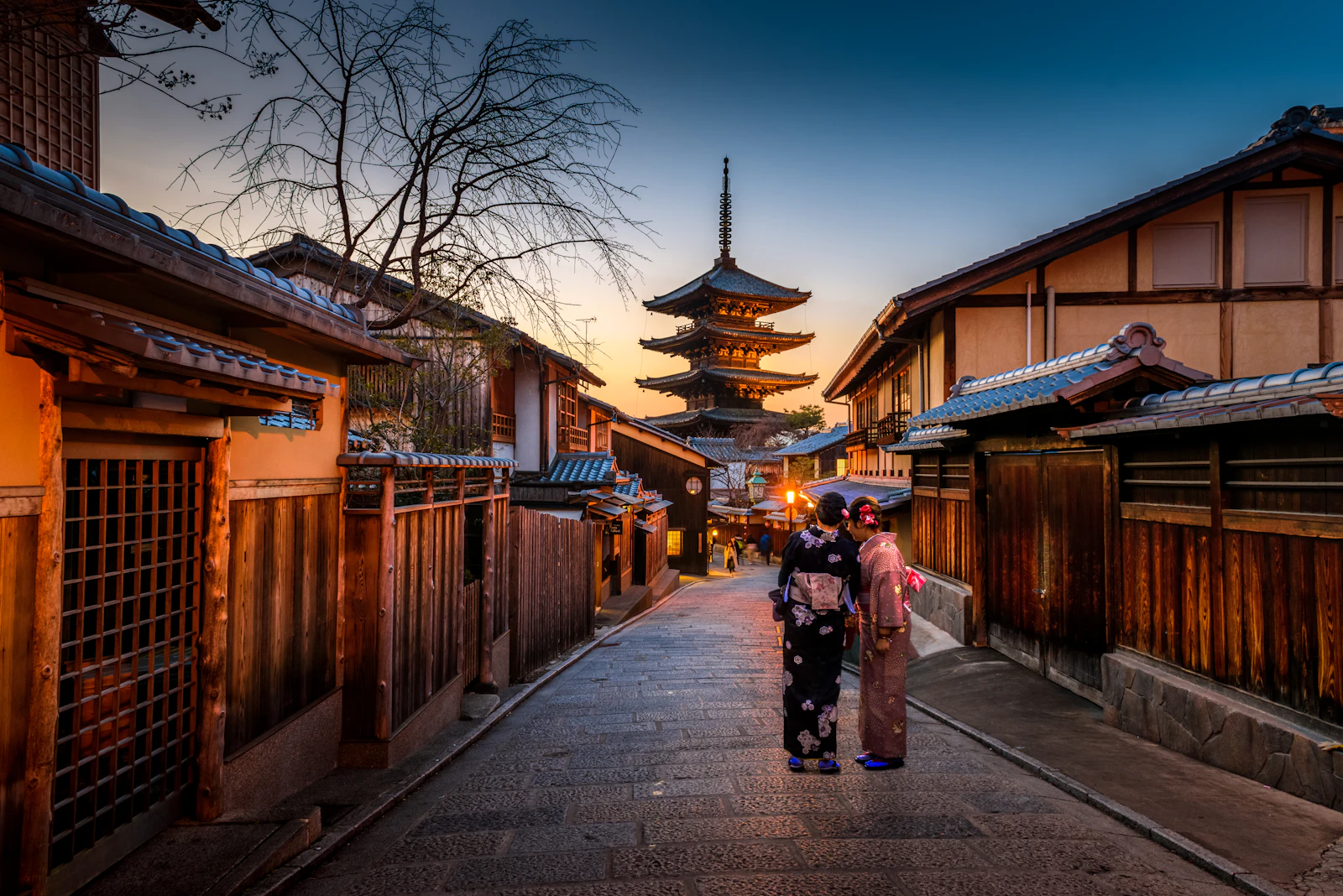
The most-visited square kilometre in Japan and the one to do first, at eight. Kiyomizu-dera’s wooden stage stands over a valley of maples on 168 pillars without a nail, and from its veranda the whole city lies west; the Otowa waterfall below has three streams for long life, love and study, and the queue for them is the only queue at eight. Down the hill the Ninenzaka and Sannenzaka lanes are the preserved Kyoto of tea houses, pottery shops and the Yasaka pagoda in the gap between the roofs; Kodai-ji, off the lanes, has a garden by Kobori Enshu, a bamboo path and evening illuminations in April and November; Maruyama Park has the great weeping cherry; Yasaka Shrine is lit at night and free; and Gion, across Shijo, is the geisha district of Hanamikoji’s stone lanes and the Shirakawa canal, where at dusk a maiko in full dress may cross from a teahouse to an engagement and the photographers are asked, by signs and by decency, to let her. Done in that order it is a morning; done at eleven it is a queue.
Fushimi Inari and the sake district
Ten thousand vermilion torii gates climb a wooded mountain south of the city in tunnels that the photographs do not prepare you for, each donated by a business and inscribed on the back, and the shrine is free, open all hours and reached by a five-minute train from Kyoto Station. At 6.30 in the morning there is nobody in them; at eleven there is a procession. Most visitors reach the Yotsutsuji viewpoint, forty minutes up, and turn back; the full loop to the summit is two hours of gates, fox statues and small shrines with almost nobody past the first hour. Below the shrine the Fushimi district is the sake capital of Japan — Gekkeikan’s museum, the Kizakura brewery, the Fushimi Yumehyakushu cafe, the canal with the old boats — and a tasting in the afternoon pairs with the dawn on the mountain.
Northern Higashiyama: Nanzen-ji, the Philosopher’s Path, Ginkaku-ji
Nanzen-ji’s great gate, the Meiji-era brick aqueduct that runs through its grounds, the Hojo garden, and the sub-temples with their own gardens (Konchi-in, Tenju-an); then the Philosopher’s Path, two kilometres of canal under cherry trees from Nanzen-ji to Ginkaku-ji, named for Nishida Kitaro who walked it daily, with Honen-in’s moss gate and Eikan-do’s looking-back Buddha off it; and at the far end the Silver Pavilion, which was never silvered and is the more beautiful for it, with its sand cone and its moss garden and its path up the hill for the view. The path is best at 7.30 in blossom or colour and lovely in any month; Eikan-do’s maples in November are the most illuminated in the city and the queue is the price. A morning, walking north, with lunch at a tofu restaurant near Nanzen-ji.
Arashiyama: the bamboo, the river and the railway
The western hills, thirty minutes from the centre, and the second-most-visited place after Kiyomizu. The bamboo grove is a 500-metre path between stems ten metres tall, extraordinary at opening and a corridor of selfie-sticks by ten; Tenryu-ji beside it is a World Heritage Zen temple with a pond garden that borrows the mountain; the Togetsukyo bridge crosses the Katsura river below the hills; the Okochi Sanso villa, an actor’s garden estate up the hill, is the place most visitors walk past and the best garden in the district; the monkey park across the river is a climb and a view; and the Sagano scenic railway runs seven kilometres up the Hozu gorge in open carriages, with the boat back down the rapids for the party with a day. In blossom and colour the riverbank and the hillside are the reason; in any season the grove at 8 am is.

The north-west: the Golden Pavilion and the rock garden
Kinkaku-ji is the pavilion covered in gold leaf on its pond, rebuilt in 1955 after a monk burned the original, and the single image of Kyoto; the circuit of the pond is twenty minutes and the crowd is constant, so the afternoon light on the gold is the reason to come then. Ryoan-ji, ten minutes away, is the rock garden — fifteen stones in raked gravel, of which fourteen can be seen from any point on the veranda — and the temple’s pond garden behind it is the one most people miss. Ninna-ji has the late Omuro cherries in mid-April and a five-storey pagoda; Daitoku-ji is a walled complex of two dozen Zen sub-temples of which a few open, with gardens as fine as Ryoan-ji’s and a tenth of the visitors; Kitano Tenmangu has the plum blossom in February and a flea market on the 25th of every month. An afternoon after Arashiyama, by bus or taxi.
Central Kyoto: the castle, the market, the palace and the river
Nijo Castle is the shogun’s Kyoto residence with the nightingale floors that squeak to warn of intruders and the painted screens of the Ninomaru; the Imperial Palace sits in a park that is Kyoto’s largest green space and is open without booking; Nishiki Market is five blocks of pickles, tofu skin, matcha, knives, dried fish and tasting, from ten to five, the city’s pantry for 400 years; Kawaramachi and Teramachi are the shopping arcades; Pontocho is the alley of restaurants along the Kamo river, with the riverside terraces (kawayuka) from May to September; and the Kamo river itself, walked north from Shijo past Demachiyanagi, is where the city sits in the evening. The centre is where the hotels are and where the evenings happen.
The hills: Ohara, Kurama, Kibune and Takao
Forty minutes north by bus, Ohara is a farming valley with two temples that would headline any other city: Sanzen-in’s moss garden with its small stone Buddhas and its Amida hall, and Jakko-in, the convent where an empress retired after the Genpei war. Kurama, forty minutes north by the Eizan railway, is the mountain temple of the tengu goblins with a cable car and a hike over the ridge to Kibune, the shrine village on a river where the restaurants build platforms over the water in summer; Kurama Onsen’s open-air bath looks up into cedars. Takao, in the north-west, has Jingo-ji up 400 steps with the finest maples in the region in early November and clay discs thrown from the cliff for luck. Each is a half-day or a day with almost nobody in it, and in the peak weeks they are the answer to the crowds.

Beyond the city: Nara, Uji, Fushimi and Osaka
Nara is 45 minutes and the classic day: the deer bowing for crackers, Todai-ji’s Great Buddha in the largest wooden building on earth, Kasuga Taisha’s three thousand lanterns. Uji is twenty minutes south for Byodo-in’s Phoenix Hall on the ten-yen coin and the tea houses where Japan’s green tea is grown. Osaka is fifteen minutes by Shinkansen or half an hour by the Hankyu and is the evening city for the party sleeping in Kyoto and the sleeping city for the party who could not get a Kyoto room in April. Himeji’s white castle is an hour; Kobe forty minutes; Lake Biwa ten. The things to do in Japan page has the country around it.
By interest
Temples and gardens, chosen
Seventeen World Heritage sites and 1,600 temples means choosing. For a first visit: Kiyomizu, Fushimi Inari, Kinkaku-ji, Ryoan-ji, Tenryu-ji, Ginkaku-ji and Nanzen-ji. For gardens: Ryoan-ji, Tenryu-ji, Saiho-ji (the moss temple, by reservation), Katsura Imperial Villa (by booking, the finest garden in Japan), Shugaku-in, Tofuku-ji’s modern checkerboard by Shigemori Mirei, Daitoku-ji’s sub-temples. For the quiet: Honen-in, Shisen-do, the Ohara and Takao temples. For the illuminations in April and November: Kiyomizu, Kodai-ji, Eikan-do, the Kitano plums.
Geisha and the arts
Gion and Pontocho are the two districts where geiko and maiko still work; the dusk walk on Hanamikoji is the sight; a private dinner with a maiko is arranged by introduction and is not cheap; the spring and autumn dances (Miyako Odori in April, Kamogawa Odori in May, Gion Odori in November) are the public performances and are booked. Gion Corner does the tourist version. The Kyoto Museum of Traditional Crafts, the Nishijin textile district and its kimono workshops, a tea ceremony at a machiya, a calligraphy or an ikebana class, and the Kyoto National Museum are the arts beyond the geisha.
Food
Kaiseki is Kyoto’s gift: the multi-course seasonal cuisine from the tea ceremony, at Kikunoi, Hyotei, Kitcho and dozens of superb lesser-known houses, AUD 150–400 at dinner and half at lunch, booked weeks ahead. Shojin ryori, the temple vegetarian cuisine, at Tenryu-ji’s Shigetsu and the temple restaurants. Yudofu at Nanzen-ji. Obanzai home cooking at counters in Gion’s backstreets. Nishiki Market. Matcha and the sweets at Uji. Pontocho’s riverside in summer. The Japan food guide has the Kyoto section in full.
Families
Nara’s deer are the day the children remember; Fushimi Inari’s tunnels are a game; the Arashiyama monkey park and the Sagano railway are a morning; a kimono rental in Gion is the photographs; the Toei Kyoto Studio Park is the samurai theme park; Nishiki Market is the snacks; and the bicycles along the Kamo river are the afternoon. Two temples a day, not five, and a machiya rental for the room problem.
The seasons
Cherry blossom in the first week of April and autumn colour from mid-November to early December are the seasons the whole world books, and the hotels double; late May, early October and the winter are the same temples without the queues. The blossom timing guide and the month-by-month guide have the calendar.

Kyoto in three days, day by day
Day one: Fushimi Inari at 6.30, back for breakfast, then southern Higashiyama with a guide — Kiyomizu at opening, the lanes, Kodai-ji, Maruyama, Yasaka — lunch, Nishiki Market in the afternoon, Gion at dusk, dinner in Pontocho. Day two: Arashiyama at eight — the grove, Tenryu-ji, Okochi Sanso, the bridge — lunch in the village, the north-west in the afternoon (Kinkaku-ji, Ryoan-ji, Daitoku-ji), the kaiseki dinner. Day three: northern Higashiyama at 7.30 — Nanzen-ji, the Philosopher’s Path, Ginkaku-ji — tofu lunch, then Nara for the afternoon or Nijo Castle and the palace park, and a last counter dinner in Gion. With a fourth day: Ohara or Kurama and Kibune, or Uji and the sake district, or nothing planned, which after three days of temples is a legitimate choice.
The second visit
People who have done the three days above come back for the things the first visit could not hold: Katsura and Shugaku-in, the imperial villas by application, which are the finest gardens in the country; Saiho-ji’s moss by reservation; Daitoku-ji’s sub-temples one at a time; Tofuku-ji in November; the Nishijin weavers; a full day in Ohara; Kurama to Kibune on foot; the sake district; Uji’s tea; a machiya rental for a week and a bicycle. Kyoto is the city in Japan that rewards the fourth trip as much as the first, and most of our guests who have been three times are planning the fourth, usually in a month they have not yet seen the city in.
Temple and shrine etiquette
At a shrine: bow at the torii, rinse hands and mouth at the basin, a coin in the box, two bows, two claps, one bow. At a temple: no clapping; hands together; shoes off where there is a step up; quiet; no photographs of the interior where signed, and most are. Hats off indoors. Do not sit on the veranda edges that are roped. Incense is offered, not lit for a photograph. The sub-temple gardens are viewed from the veranda, not walked. Geisha are not photographed at close range or stopped. Kyoto has a set of published visitor rules for Gion and its lanes, with fines for the worst offences, and the city means them.
Costs and timings
Temple entries are AUD 3–10; the imperial villas and Saiho-ji AUD 10–40; the illuminations AUD 6–10; a guided morning AUD 300–500 for the party; kaiseki AUD 150–400 at dinner and AUD 60–150 at lunch; a tea ceremony AUD 30–80; a kimono rental AUD 40–80; the buses AUD 2.50 flat and the day pass AUD 11; a taxi across the city AUD 15–25. Most temples open at 8 or 9 and close at 5, an hour earlier in winter; the illuminations run to 9; Nishiki closes at 5; kitchens close at 9. The Japan costs guide has the rest of the budget.
Kyoto in the rain, the heat and the cold
June’s rainy season and a wet day in any month suit the moss gardens (Saiho-ji, Sanzen-in, Gio-ji), the covered arcades of Teramachi, Nishiki, the museums and a long lunch; the temples are emptier and the stone is dark and beautiful. July and August are 35°C and the day is opening-time temples, a midday museum or the hotel, and Kibune’s river platforms or the Kamo bank in the evening; Gion Matsuri fills the whole month. January and February are cold, clear and empty, with the temples to yourself, the winter illuminations and, occasionally, Kinkaku-ji under snow, which is the photograph of the decade. The city works in every month; the itinerary changes shape.
Getting around
Kyoto runs on buses, which are slow and gridlocked in peak weeks, and on two subway lines and two private railways (the Keihan along the river, the Hankyu to Arashiyama and Osaka), which are not. The Keihan reaches Fushimi Inari, Gion-Shijo and Demachiyanagi for the hills; the Hankyu and the JR Sagano line reach Arashiyama; the subway reaches Nijo, the palace and the north; taxis are honest and the right answer for three or four people between temples; bicycles are the Kyoto way for the flat centre and the river. A Suica or ICOCA card covers all of it. Kyoto Station is the hub for the Shinkansen (Tokyo 2 h 15 min, Osaka 15 min) and the Haruka express to Kansai Airport (75 min). Luggage forwarding to the next city is the norm and every hotel does it.
Where to stay
Higashiyama for the temples on foot and the atmosphere (Hotel Kanra, the Hyatt Regency, the Four Seasons, the Sowaka machiya hotel); near Kyoto Station for the trains and the value (the Mitsui Garden, the Granvia above the platforms); Gion for a ryokan or a machiya rental (Tawaraya and Hiiragiya are the famous inns; the licensed machiya rentals suit a group); the centre around Karasuma for the subway and the market. In blossom and colour weeks Kyoto sells out nine to twelve months ahead and Osaka, Otsu and Nara are the bases, with Osaka fifteen minutes away at a third less. The where to stay in Asia page has the tiers.
What a Kyoto day looks like
Fushimi Inari or the eastern hills at opening; the famous temple before ten; a tofu or soba lunch near it; the second district in the early afternoon; a tea house or the market as the crowds peak; the hotel or the bath by four; Pontocho or Gion from dusk; dinner at seven, because Kyoto kitchens close early; the river afterward. Two districts a day, three temples at most, one loose afternoon in every three days, and a guide for the first morning in the eastern hills, which is the one hour of expertise that changes the whole visit. Four nights is the number; three is the minimum; five is not too many, and nobody has ever complained of a sixth. The Classic Japan itinerary gives it four and the unhurried route gives it four with a car.
Frequently asked questions
How many days do you need in Kyoto?
Four nights is the number most people wish they had given it; three is the minimum for the eastern hills, Arashiyama and Fushimi Inari with a Nara day; five allows the hills to the north. Kyoto rewards length more than any Japanese city.
What is the best time to visit Kyoto?
Late March to mid-April for cherry blossom and mid-November to early December for autumn colour, at double the hotel rates; late May, early October and the winter for the same temples without the queues. Book the peak weeks nine to twelve months out.
How do I avoid the crowds in Kyoto?
Be at the famous temples at 8 am opening (Fushimi Inari at 6.30), use the hills to the north (Ohara, Kurama, Takao) in the afternoons, go mid-week, and treat the second-tier temples — Honen-in, Daitoku-ji, Shisen-do — as the first tier, which they are.
Is Kyoto or Osaka better to stay in?
Kyoto for the atmosphere and the early starts; Osaka for the value (a third less), the nightlife and the food, with Kyoto fifteen minutes away by Shinkansen. In peak weeks when Kyoto is sold out, Osaka is the base.
Can I see a geisha in Kyoto?
Geiko and maiko still work in Gion and Pontocho and are most often seen at dusk on Hanamikoji crossing to an engagement; photograph from a distance and never block a lane. A private dinner is by introduction; the seasonal dances (April, May, November) are the public performances.
What should I book ahead in Kyoto?
Accommodation in peak weeks (a year), a kaiseki dinner (weeks), the Katsura and Shugaku-in imperial villas and Saiho-ji moss temple (by application), the seasonal geisha dances, the evening illuminations, and a guide for the first morning.
Is Nara worth a day from Kyoto?
Yes: 45 minutes by train, the deer, the Great Buddha at Todai-ji and the lanterns of Kasuga Taisha, back by four. It is the day every child on the trip remembers.
What is kaiseki and where should I try it?
A multi-course seasonal cuisine of a dozen small dishes, developed from the tea ceremony and perfected in Kyoto; at a kaiseki house (lunch is half the dinner price) or a ryokan. Book weeks ahead and ask for a garden seat in the first sitting.
Where this leads
Things to do informs; tours convert.