

Tokyo, a Hakone ryokan and Kyoto with a guide; then a two-hour flight to Seoul for the palaces, the DMZ and the barbecue, the KTX to the old Silla capital at Gyeongju, and Busan on the coast to finish. Japan first for the polish, Korea second for the energy, and the ferry back to Fukuoka for those who cannot choose.
Japan and Korea are two hours apart, share a time zone and a temperate calendar, and are as different as two neighbours can be: Japan restrained, ordered, tradition with modernity layered on; Korea loud, fast, sociable, modernity with tradition woven through. The food is the sharpest contrast — sushi and kaiseki against barbecue and kimchi — and the pleasure of the trip is the change of register at Incheon, when the quiet of a Kyoto morning becomes the volume of a Seoul market by dinner. This route gives each country a week: the Golden Route’s essentials with a ryokan and a guided Kyoto morning, then Seoul, the DMZ, Gyeongju and Busan with a hanok night and the KTX. It is the two-country trip we build most, and our Japan vs South Korea article is the comparison that usually precedes it.
Why this route
Because they are two hours apart and people keep treating them as one trip or the other. Japan alone is the deepest single destination in Asia; Korea alone is the fastest-rising. Together, in a fortnight, they give you the two ways of being modern and ancient at once, side by side, with the contrast doing the work that a third week in either country could not. No visa, one open-jaw ticket, a two-hour hop in the middle, and the ferry option for people who like the idea of arriving by sea. It is the itinerary that, more than any other we build, produces the sentence “we had no idea it would be so different.”
At a glance
| Duration | 15 days / 14 nights |
|---|---|
| Route | Tokyo (3) → Hakone (1) → Kyoto (3) → fly Osaka–Seoul → Seoul (4) → Gyeongju (1) → Busan (2) |
| Fly | Into Tokyo Haneda, home from Seoul Incheon or Busan Gimhae; Osaka–Seoul in between |
| Best months | April–May and late September–November, which both countries share; avoid Golden Week, Obon and the Korean monsoon in July |
| Pace | Moderate: seven bases in fifteen days, one guided morning in each country, one loose day in each |
| Style | Private itinerary; independent travel with everything pre-booked; guides in Kyoto and at the DMZ |
| Suits | Second-time visitors to either country, food-led travellers, families with teenagers, anyone who wants two cultures in one trip |
| Accommodation | City hotels; a Hakone ryokan; a Gyeongju hanok |
| Visas | None for Australians in either country (Korea’s K-ETA waived at the time of writing) |
| Price | Quoted per departure in AUD |
Day by day
Day 1: Arrive Tokyo
The morning arrival at Haneda, a Shinjuku hotel, the Gyoen across the road, and an early yakitori dinner in Omoide Yokocho. Tokyo first because the trip runs from the most polished city in Asia to the most energetic, and that order works.
Day 2: Tokyo: old and new
Senso-ji at eight, the Skytree, Ueno, then across the city to Meiji Shrine, Harajuku and Shibuya at dusk, with teamLab in the evening. One full day for the capital; the Classic route has four, and this trip has Seoul to reach.
Day 3: Tokyo: a day out, or a loose one
Kamakura for the Great Buddha and the beach, Nikko for the shrines, or a Tokyo day of your own — Tsukiji breakfast, Ginza, the Yanaka backstreets. Suitcases forwarded to Kyoto tonight.

Day 4: Hakone
The Romancecar, the mountain loop with Fuji over the lake, and the ryokan: yukata, the bath, kaiseki at six, the futon. The one Japanese night that has no Korean equivalent, and the reason Hakone stays in even the shortest version of this route.
Day 5: Hakone to Kyoto
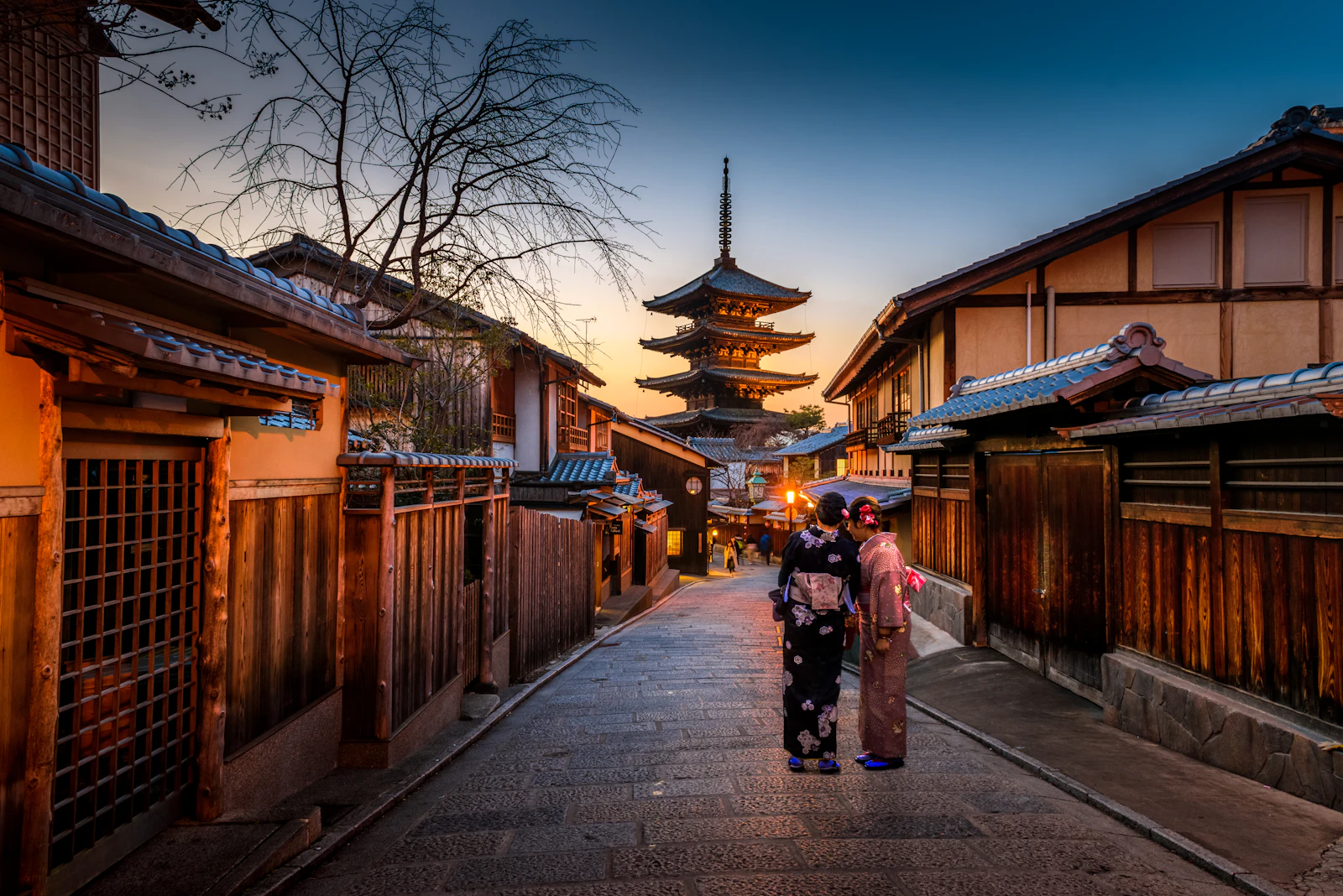
The morning bath, the Open-Air Museum, the Shinkansen from Odawara to Kyoto, and Gion at dusk.
Day 6: Eastern Kyoto with a guide
Fushimi Inari at 6.30, the eastern hills with a licensed guide until two — Kiyomizu, the lanes, Kodai-ji, the Philosopher’s Path, Ginkaku-ji — and the evening in Pontocho.

Day 7: Arashiyama and Nara
Arashiyama at opening, the bamboo and Tenryu-ji, then the train to Nara for the afternoon: the deer, Todai-ji, Kasuga Taisha. Back for the kaiseki dinner we book before the flights.
Day 8: Kyoto to Osaka to Seoul
A last Kyoto morning — Nishiki Market, the Golden Pavilion — the Haruka express to Kansai Airport, and the two-hour flight to Seoul Incheon on Korean Air, Asiana, JAL or Peach. The AREX express or a private car to a Myeongdong hotel by evening, and the first Korean dinner: barbecue at a Jongno alley table, samgyeopsal wrapped in lettuce with garlic and ssamjang, banchan refilled without asking, and a first soju. The change of country is audible within a block: Kyoto’s morning was silent temples and a guide who whispered; Seoul’s evening is a grill at the table, a waiter shouting the order and a neon street that does not sleep. It is the moment the trip is built around.
Day 9: Seoul: the palaces and Bukchon
Gyeongbokgung at nine in a rented hanbok (entry is free in one, and the photographs are the trip’s), the guard change, the National Folk Museum in the grounds, then the hanok lanes of Bukchon on foot, lunch in Samcheong-dong, tea in Insadong, and Changdeokgung’s Secret Garden by the guided tour we book. Dinner at Gwangjang Market: bindaetteok mung-bean pancakes and mayak gimbap at the stalls, with the ajummas who have made them for forty years.

Day 10: Seoul: the DMZ
The morning at the border, ninety minutes north by pre-booked tour with a passport in hand: Imjingak, the Third Tunnel dug by the North under the line, the Dora Observatory looking into a country you cannot enter, Dorasan station with its platform for a train to Pyongyang that has never run. The Joint Security Area at Panmunjom when it is open, which depends on the week. Back by two, quieter than you left; the afternoon at Namsan for the tower and the view; the evening in Hongdae, the student quarter, for fried chicken and beer (chimaek) and the street performers.
Day 11: Seoul: the modern city and a loose evening
Gangnam and COEX, the Bongeunsa temple facing the towers across the road, the Starfield library; or the Dongdaemun Design Plaza and the all-night fashion markets; or a K-pop dance class and the HYBE museum for the fans in the party. A jjimjilbang in the late afternoon — Dragon Hill Spa, the 24-hour bathhouse with saunas of five temperatures, a scrub if you dare, and a bowl of noodles in a robe — and a last Seoul dinner of samgyetang ginseng chicken soup or a Korean fine-dining tasting at Mingles for those who booked it.
Day 12: KTX to Gyeongju
The high-speed train south, two hours to Singyeongju, and the Silla capital: the royal tumuli like green hills in the middle of town, Cheomseongdae’s seventh-century observatory, the Gyeongju National Museum, and at dusk Anapji pond with the pavilions lit and reflected. A hanok guesthouse tonight, with ondol floor heating and a courtyard, the Korean counterpart to the Hakone ryokan.
Day 13: Gyeongju to Busan
Bulguksa temple in the morning, the Silla masterpiece in the hills, and the Seokguram grotto Buddha above it; then the KTX or a car to Busan, 45 minutes. The afternoon at Gamcheon Culture Village, the painted houses stepping down the hillside; the evening at Jagalchi fish market, choosing dinner from the tanks and eating it upstairs, and Gwangalli beach with the bridge lit.
Day 14: Busan
Haedong Yonggungsa, the temple on the rocks above the sea, at opening; Haeundae beach; the Busan Museum of Art or the Spa Land jjimjilbang at Centum City; the Gukje market and its street food; and a last dinner of Busan’s own dishes — dwaeji gukbap pork soup, ssiat hotteok, milmyeon noodles — in the Seomyeon district. Or, for the party continuing back to Japan, the three-hour ferry from Busan to Fukuoka the next morning instead of the flight.
Day 15: Depart
Fly home from Busan’s Gimhae via Seoul or a hub, or the KTX to Seoul for the direct flight, or the ferry to Fukuoka and the Kyushu flight. Fifteen days, two countries, no visa, and an argument on the plane about which was better that will not be settled, because the honest answer — the one most of our guests reach somewhere over the Coral Sea — is that the trip was the contrast, and neither country would have given it alone.
Variations and extensions
Twelve days: Tokyo (3), Kyoto (3) with a Nara afternoon, fly to Seoul (4), KTX to Busan (2), home from Busan or Seoul; no Hakone, no Gyeongju. Eighteen days with Hiroshima and Jeju: Hiroshima and Miyajima between Kyoto and the flight (from Hiroshima airport to Seoul direct), and three nights on Jeju Island after Busan — the volcano, the Olle trail, the haenyeo divers, a hire car — flying home from Jeju via Seoul. By sea: the Alps route or the Classic route to Hiroshima, the Shinkansen to Fukuoka, a night in the yatai stalls, and the ferry to Busan; Korea then runs south to north, ending in Seoul for the direct flight home. Korea first: for parties on a Seoul direct flight, the Korean week then Seoul–Tokyo, and Japan ending in Osaka for the Kansai flight home. Families with teenagers: a Universal Studios day in Osaka before the flight, the K-pop dance class and the HYBE museum in Seoul, Everland theme park as the loose day, and Busan’s beach; the two countries suit teenagers better than almost any pair on the continent. Winter: January in both is cold, clear and cheap; Hokkaido or Pyeongchang skiing can replace Hakone and Gyeongju.
Three countries, three weeks: Taiwan added at the end — Busan or Seoul to Taipei is two and a half hours — for a week of night markets, Taroko and Sun Moon Lake on the Taiwan tours shapes; the only three-country fortnight-plus we build in East Asia, because the flights are short, no visa is needed for any of the three, and each is a week well spent. The East Asia guide compares all three.
Eating on this route
The contrast is the meal plan. Japan: the Hakone kaiseki, the Kyoto kaiseki we book, sushi at a counter, ramen under the station, tempura in Ginza, yakitori in an alley, the depachika — restraint, season, umami, quiet. Korea: barbecue at a Jongno table on the first night, Gwangjang Market’s pancakes and gimbap, chimaek in Hongdae, samgyetang ginseng chicken soup, bibimbap done properly, naengmyeon cold noodles if it is warm, hoe raw fish from the tanks at Jagalchi, Busan’s pork soup and seed hotteok — volume, chilli, fermentation, the shared pot. Both countries have coffee cultures that surprise Australians, Korea’s the more caffeinated. Vegetarians manage well in Japan with a card and less easily in Korea, where fish stock is in most things; bibimbap without egg, temple food and tofu stews are the answers, and we book accordingly. No tipping in either. The Japan food guide and the food section of the Korea guide have the counters and the markets.
What is included
- Return economy airfare from Sydney, Melbourne or Brisbane (open-jaw where the route allows), with premium economy and business on request
- Airport transfers at both ends by rail express or private car according to the party
- All Shinkansen and express-train seats reserved, Green Car on request
- Accommodation as described, with breakfast at hotels and dinner and breakfast at ryokan
- Luggage forwarding between cities so you travel with a day bag
- A Suica card loaded for each traveller, or set up in your phone wallet before departure
- Pre-booked entries and experiences named in the itinerary
- A detailed day-by-day document with maps, train times and restaurant suggestions
- Australian consumer-law protection and a Cooee contact in Brisbane throughout
- The Osaka–Seoul flight (or the Fukuoka–Busan ferry on request)
- KTX seats Seoul–Gyeongju–Busan reserved
- A T-money card loaded for each traveller in Korea
- A half-day licensed guide in Kyoto on day six and the DMZ tour on day ten
- Hanbok rental and the Changdeokgung Secret Garden tour
- A hanok guesthouse night in Gyeongju
- A Kyoto kaiseki dinner and a Seoul barbecue dinner reserved
- Airport transfers at Haneda, Kansai, Incheon and Gimhae or Incheon
Not included
- Lunches and most dinners (Japan is the best country in the world to eat out in, and we would rather you chose)
- Travel insurance (required)
- Personal spending, optional experiences not named, and tips (there are none in Japan)
- Japan Rail Pass (only included where the route makes it pay)
- Korean fine dining (Mingles, Jungsik) and K-pop experiences, booked on request
Where you stay
Japan: as the Classic route — a Shinjuku hotel, a Hakone ryokan with a private bath, a Higashiyama hotel or a machiya in Kyoto. Seoul: Myeongdong or Jung-gu for a first visit (the Lotte City, Shilla Stay or L7 tier; the Shilla or Four Seasons above), or a hanok guesthouse in Bukchon for the atmosphere, minutes from the palaces. Gyeongju: a hanok with ondol heating and a courtyard in the old town, or the Hilton and Lahan hotels by Bomun Lake for those who prefer a bed. Busan: Haeundae for the beach and the view (the Park Hyatt, the Paradise, or a mid-range tower on the front), or Seomyeon for the centre. Korean hotel rooms are larger than Japanese ones for the money, and the family-room problem eases on the second half of the trip. In both countries the hotel sits where the day starts — Myeongdong is ten minutes on foot from Gyeongbokgung and the airport bus stops at the door — and the bed configuration is confirmed in writing, because a Korean “ondol room” is a heated floor with bedding and a “Western room” is what an Australian expects.
What it costs
Two countries in fifteen days cost roughly a Classic Japan trip plus a Korean week, with the Osaka–Seoul flight (AUD 150–350) the only addition a single-country trip would not have; Korea is 15–25 per cent cheaper than Japan on the ground and the second week brings the daily average down. We do not publish a from-price for this itinerary because two factors move it by thousands: the season (cherry blossom and autumn colour cost 30–40 per cent more than late May or early October on flights and hotels combined) and the accommodation tier (a business hotel and a good ryokan against a five-star and a top-tier ryokan). We quote every departure individually in Australian dollars with everything above included, so the figure you see is the figure you pay. The Japan costs guide sets out the underlying numbers line by line so you can see how the quote is built. The open-jaw ticket into Tokyo and home from Seoul is priced by the full-service carriers as a return and is the first thing we check.
Practical notes
Entry: Australians do not need a visa for Japan for stays under 90 days; complete Visit Japan Web before you fly. Some Australian medicines are prohibited or need a permit — see our entry guide. Money: cards work in cities; carry cash for small restaurants and temples; no tipping. Fitness: a normal Japan day is 15,000–20,000 steps; the itinerary can be paced down. Luggage: forwarded between cities; travel with a day bag. Etiquette: shoes off in ryokan and temples, quiet on trains, wash before the bath. Children and older travellers: both adjust easily; apartment hotels and Green Car rail are the usual changes. Order: Japan first and Korea second is our default — the pace rises, the food gets louder, and the Kansai–Incheon flight is well timed — but the reverse works for a party joining Korea from a Seoul direct flight, and the Fukuoka–Busan ferry (three hours, a pleasant crossing) joins the two countries by sea for those with a day to spare. Entry: no visa for Australians in either country; Japan’s Visit Japan Web and the current status of Korea’s K-ETA waiver are checked for every traveller before departure (see our Japan entry guide and the South Korea guide). Money: yen and won, neither worth carrying across; cards work almost everywhere in Korea; cash still matters in Japan. Apps: Google Maps in Japan; Naver Map and Kakao T in Korea, where Google is hobbled; Papago for Korean translation. Transport cards: Suica in the phone for Japan, a T-money card for Korea. Spice: Korean food is spicier than Japanese; the barbecue is mild, most stews can be ordered so, and the banchan gives control. Etiquette: shoes off in both; two hands for cards and glasses in Korea; pour for others, never yourself; no tipping in either. DMZ: passport on the day, a dress code (no ripped jeans, no military-style clothing), and the JSA opens and closes with the security situation — we book the tour that is running. Luggage: forwarded in Japan; carried in Korea, where the KTX has racks and the distances are short; the Osaka–Seoul flight allows 23 kg on the full-service carriers. Health: tap water is drinkable in Japan and treated in Korea; spring air quality in Seoul can be poor on some days and a mask is what locals do; hospitals in both are excellent and insurance is required. Language: English signage covers transport in both; Korean has less spoken English outside Seoul than Japan has outside Tokyo, and Papago closes the gap. Hangul is learnable in an afternoon and worth it for the menus. Power: Japan 100 V two-flat-pin; Korea 220 V European round-pin; a universal adaptor for both. Time: the same zone, no daylight saving, one hour behind Brisbane; jet lag is not a factor on this route.
How to book
Send us your preferred dates, your departure city and the names and ages of the party through the enquiry form or on 0409 661 342. We check the season against the route, confirm availability at the hotels and inns that matter, and send an itinerary and a quote in Australian dollars within two working days. A deposit holds the booking; the balance is due before departure under our booking conditions. Travel insurance is required and we can recommend a policy.
Frequently asked questions
Should I do Japan or Korea first?
Japan first, in our experience: the trip runs from the polished to the energetic and the Kansai–Seoul flight is well timed. The reverse works for a party arriving on a Seoul direct flight, and the Fukuoka–Busan ferry joins the two by sea.
How do I get from Japan to Korea?
Osaka (Kansai) to Seoul (Incheon) is a two-hour flight on Korean Air, Asiana, JAL, Peach or Jeju Air; Tokyo–Seoul is two and a half. The Busan–Fukuoka ferry takes three hours and is the pleasant alternative for a Kyushu-to-Busan join.
Do Australians need visas for Japan and Korea?
No for either: 90 days visa-free in both. Korea’s K-ETA electronic authorisation is temporarily waived for Australians at the time of writing and we check its status before every departure.
When is the best time for a Japan and Korea trip?
April–May (blossom in both, then warm dry days) and late September to November (autumn colour, clear skies). The two countries share a calendar; avoid Japan’s Golden Week and Obon and Korea’s July monsoon and Chuseok travel days.
How many days do you need for both?
Fifteen gives each country a week and the moves between; twelve is the minimum (Tokyo 3, Kyoto 3, Seoul 4, Busan 2); eighteen adds Hiroshima and Jeju.
Is Korea cheaper than Japan?
On the ground, by 15–25 per cent: hotels are larger for the money, food is cheaper, the KTX costs less than the Shinkansen. Flights are similar. The second week of this trip brings the daily average down.
Can I visit the DMZ?
Yes, on a pre-booked guided tour with your passport on the day. Tours visit the Third Tunnel, the Dora Observatory and Imjingak; the Joint Security Area at Panmunjom opens and closes with the security situation and we book whichever is running.
How much does it cost?
Quoted per departure in Australian dollars with the international flights, the Osaka–Seoul sector, all rail, accommodation including the ryokan and hanok nights, transfers, guides and named experiences included. Roughly a Classic Japan trip plus a Korean week; the Japan costs guide and the South Korea guide show the underlying numbers.
Related
Tours convert; things to do informs. If you are still choosing, the things-to-do page is the step before this one.