The Lake Circuit
The full lakeside loop is the garden — bridges, reflections, waterfowl and framed views composed to reveal themselves one turn at a time. Walk it slowly; that's the design's instruction.
One of Australia's largest traditionally designed Japanese gardens — a lake, bridges, stone arrangements and three kilometres of contemplative paths on the UniSQ campus, ten minutes from the CBD.
Ju Raku En — the name speaks of enjoying long life in a tranquil place — was designed in the Japanese tradition and built on the University of Southern Queensland campus, where it has matured into one of the largest traditionally designed Japanese gardens in Australia. A central lake anchors the composition; around it, bridges, stone arrangements, azaleas and sculpted plantings unfold along roughly three kilometres of winding path.
Its role in a Toowoomba visit is contrast. After the massed colour of Queens Park and Laurel Bank, Ju Raku En's restraint is exactly what the eyes want — the same reason our itineraries slot it into the afternoon, when the festival beds are done and the light goes low across the water.
The full lakeside loop is the garden — bridges, reflections, waterfowl and framed views composed to reveal themselves one turn at a time. Walk it slowly; that's the design's instruction.
Spring azaleas and blossom, autumn's turning foliage, winter's bare architecture — a garden built to reward every season, in a city with real seasons to give it.
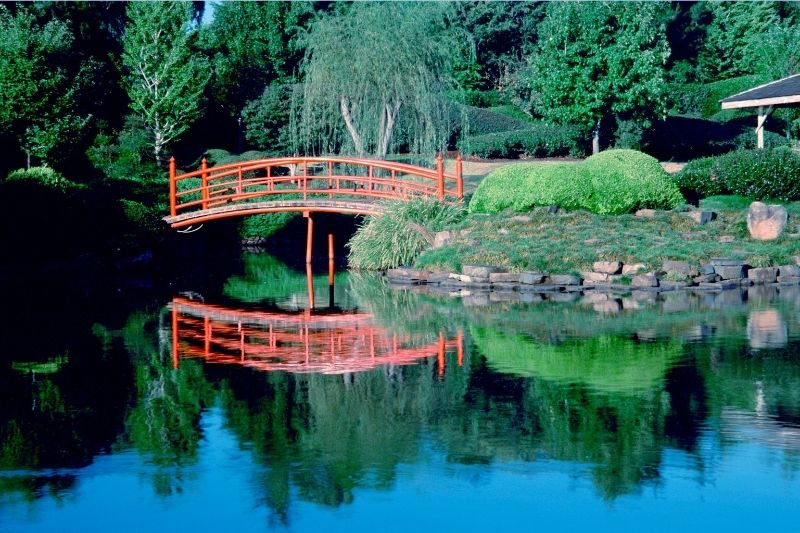
The red bridge and lake reflections are one of Toowoomba's four classic frames. Early morning stillness or late golden light — the water does the rest.
Ju Raku En features on Cooee day-tour afternoons, date depending — the calm after the Carnival colour.
See the Tours| Getting there | UniSQ Toowoomba campus, West Street side — about ten minutes' drive from the CBD, with campus parking nearby. |
|---|---|
| Cost | Free, open daily during daylight hours. |
| Accessibility | Formed paths circle the lake; some sections are gravel — most of the circuit is manageable at an easy pace. |
| Etiquette | It's a contemplative garden on a working campus: stay on paths, keep voices low, and leave the koi and waterfowl to their business. |
Ju Raku En is the improbable sentence made real: one of Australia's largest traditionally designed Japanese gardens, laid out on a university campus on the Darling Downs, in a regional Queensland city better known for tulip beds and escarpment views. The garden belongs to the University of Southern Queensland's Toowoomba campus, and it was conceived the way serious Japanese gardens always are — not as decoration but as a complete designed landscape, where the lake, the stone arrangements, the bridges and every sculpted pine exist in deliberate relationship to one another. The name itself carries the brief: Ju Raku En speaks of enjoying long life in a tranquil place, which is both a blessing and, as it turns out, an accurate description of the visitor experience.
What makes the garden work in Toowoomba, rather than merely existing here, is the climate. At roughly 700 metres above sea level on the Great Dividing Range, the city has genuine seasons — cold winters, crisp autumns, soft springs — and the traditional Japanese planting palette of maples, azaleas, cherries and pines actually behaves as designed. A Japanese garden at sea level in Queensland would be a horticultural argument with the weather; this one is a collaboration. Decades of growth have matured the plantings into their intended forms, and the garden now reads as settled and inevitable, as though the Downs had always been waiting for it.
Ju Raku En rewards a little literacy, and the grammar is learnable in the time it takes to walk the first hundred metres. Traditional Japanese garden design is an art of controlled revelation: paths curve so that views assemble and dissolve as you move, and the garden is experienced as a sequence of composed scenes rather than a single panorama. Nothing you see is accidental. The stone arrangements are placed with the care other cultures reserve for sculpture; the pruned pines are decades-long projects; the lake's edge is shaped so that water, rock and planting meet the way an ink painting says they should. Even the empty spaces are working — restraint is the medium.
The practical instruction that falls out of all this: walk slowly, and follow the path in one direction rather than cutting across. The design assumes a strolling pace and reveals itself at that speed, one framed view per bend, with the bridges acting as both crossings and viewing platforms. Stop on each one. Look back the way you came — Japanese gardens are composed in both directions, and some of the best scenes at Ju Raku En only exist over your shoulder. After the massed, maximalist colour of Toowoomba's carnival beds, this is a different discipline entirely: a garden that whispers where the others sing, and is all the more striking for the contrast.
The garden's spine is its central lake, and the roughly three kilometres of winding path around and beyond it constitute the whole experience — there is no shortcut version worth having. From the entry, the path settles quickly into its rhythm: water on one side, sculpted planting on the other, with the bridges appearing at intervals like punctuation. The red bridge is the celebrated one, and its reflection on a still morning is among the most photographed compositions in Toowoomba. The waterfowl population conducts its business with the unbothered air of residents who understand the garden was, in some sense, built for them; the koi patrol the shallows with similar entitlement.
Give the circuit an hour at minimum, ninety minutes to do it justice. The far side of the lake is where casual visitors thin out and the garden gets quietest — the views back across the water toward the entrance are some of the finest in the design, and the stone arrangements in the further reaches repay unhurried attention. Benches are positioned where the designers wanted you to stop, which is a hint worth taking. On a weekday morning outside festival season you may have whole sections to yourself, sharing the path with nothing but birdsong and the occasional student taking the scenic route to a lecture, and it is frankly difficult to believe the city centre is ten minutes away.
Ju Raku En is Toowoomba's most season-sensitive attraction, and that is a feature rather than a flaw. Spring brings the azaleas — banks of them lighting up along the paths — along with blossom and the freshest greens of the year; it is the garden at its most conventionally pretty, and its busiest. Autumn is the connoisseur's season: the maples and deciduous plantings turn through gold and crimson in April and May, the light goes low and amber, and the garden delivers the classic Japanese autumn scene several thousand kilometres from where you'd expect to find it. This is one of the few places in Queensland where autumn is a genuine event, and locals treat it accordingly.
Winter strips the garden to its architecture — bare branches, stone, pruned evergreen structure and cold clear light — which sounds austere and is actually the purest expression of the design; frosty mornings here are quietly spectacular, and you will have the paths nearly alone. Summer is the green season, lush and shaded, best visited early before the heat settles. And in late October and November, the city around the garden stages its own unofficial festival as the jacarandas flower across Toowoomba's older streets — a purple canopy that makes the drive to the campus part of the outing. There is no wrong month; there are only four different gardens occupying the same ground on a rotating schedule.

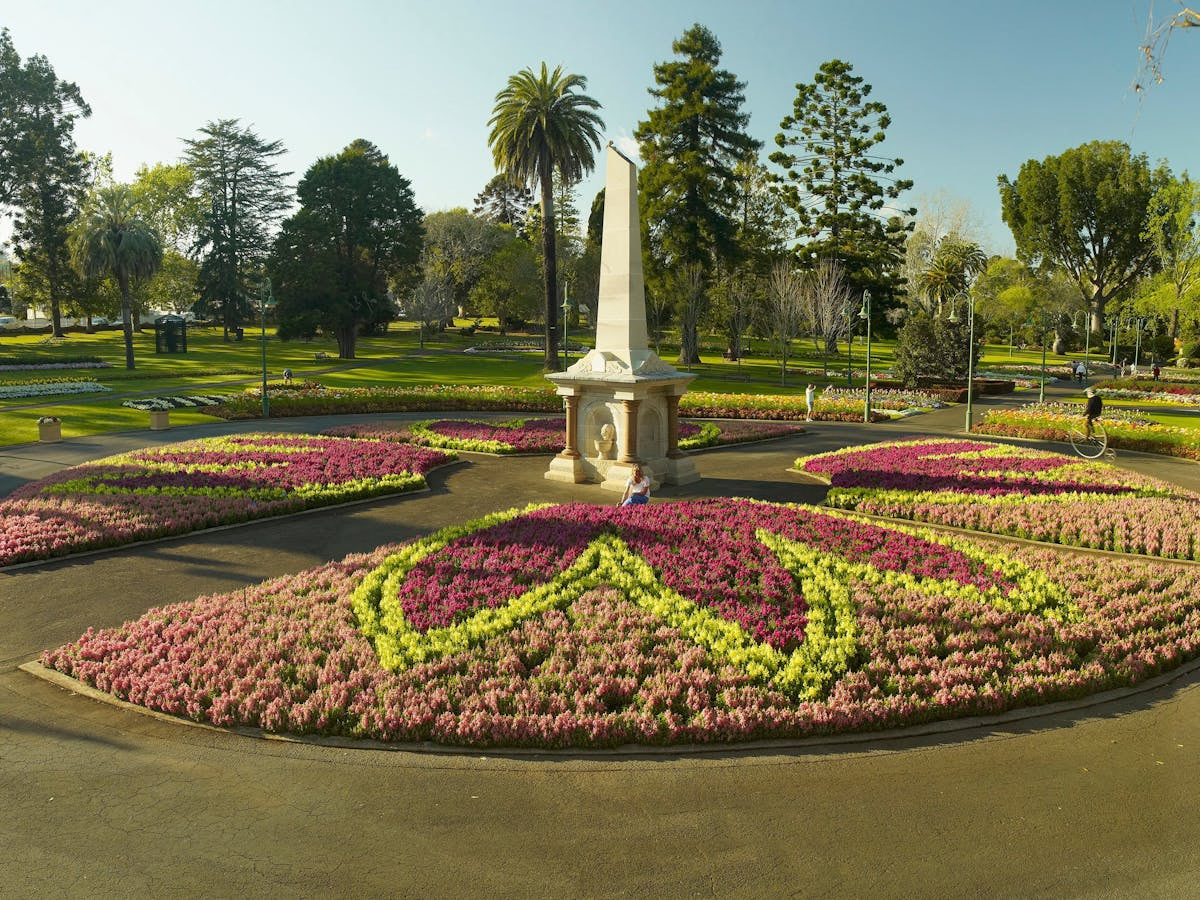
Every September, Toowoomba stages the Carnival of Flowers — 18 September to 5 October in 2026, the festival's 77th year — and Ju Raku En plays a role the program never quite spells out: it is the festival's decompression chamber. The Carnival's headline acts are maximalist by design, massed tulips and annuals in their hundreds of thousands at Queens Park and Laurel Bank, the Grand Central Floral Parade on Saturday 19 September, food crowds at FEASTival on 26–27 September. Ju Raku En offers the opposite register at the same moment: spring azaleas and new growth arranged with restraint, paths where the loudest sound is a duck, and room to let the eyes recover from all that colour.
The tactical advice, refined over many festival seasons, is to sequence the garden into the afternoon. Do the carnival beds in the morning when the light and the crowds both favour it, lunch in the city, then give Ju Raku En the quieter mid-afternoon slot — by which point its calm reads as a luxury rather than an absence. The garden is free, like every major stop on the Toowoomba trail, so the day's economics stay remarkable. If you'd rather have the whole sequence arranged for you, the Carnival of Flowers day tours from Brisbane run from $89 per adult and slot the Japanese garden into exactly this rhythm, date depending.
Ju Raku En sits on a working university campus and functions as a contemplative garden, which sets the behavioural register: this is a place for lowered voices, unhurried walking and staying on the formed paths. The koi and waterfowl are residents, not petting-zoo staff — leave them to their business and they will conduct it photogenically within arm's reach anyway. The garden asks nothing else of you, and gives a great deal back to visitors who accept its terms. Phones work best on silent; the garden's soundtrack of water, wind and birds is part of the design and deserves the same respect as the stonework.
If you have never deliberately done nothing in a garden, this is the place to learn. Pick a bench with a view across the lake, sit for ten full minutes, and let the composition do its work — the changing light on the water, the wind moving through the pines, the slow traffic of ducks. It sounds like wellness-brochure advice; it is actually just how the garden was designed to be used, centuries of tradition having concluded that stillness is the correct viewing speed for this kind of landscape. Visitors who allot forty rushed minutes see a pretty park; visitors who allot ninety unhurried ones understand why the name promises long life in a tranquil place. The difference costs nothing but the time.
The garden's photographic currency is reflection, which makes wind the variable that matters more than light. Early morning is the percentage play — the lake is most reliably glassy in the first hours, the light is soft and directional, and the red bridge doubles itself in the water with the obliging symmetry that has made it one of Toowoomba's four classic frames. Late afternoon is the second window, when low golden light rakes across the pines and the water warms in tone. The middle of a bright day is the least flattering, flattening the subtleties of green-on-green that carry most of the garden's compositions.
Work the framed views the designers built for you: shoot from the bridges, through the deliberate gaps in planting, and along the path's sightlines rather than across them. A longer lens isolates the stone arrangements and the layered plantings; a wide lens on the lake's edge takes in the composed panoramas. Autumn is the obvious jackpot — maples doubling their colour in the water — but winter's bare structure photographs with a graphic elegance that fuller seasons hide, and a frosty morning here is a portfolio day. One etiquette note: tripods and long sessions are fine in spirit, but keep the paths clear and the shutter quiet-adjacent; this remains a contemplative space with an audience of one duck watching everything you do.
Can you bring children to a contemplative Japanese garden? Yes — with calibration. The garden's genuine child-magnets are the koi and the waterfowl, which between them can carry a full circuit's worth of small-person attention, and the bridges, which children treat as a linked series of achievements. The path network is pram-friendly at an easy pace, mostly formed with some gravel sections, and the circuit's length can be shortened naturally by turning back at the lake's midpoint when enthusiasm flags. What the garden does not offer is a playground or running lawns, and it does ask for indoor voices outdoors — a framing that, in our experience, works better the earlier it is announced.
The honest advice is to slot Ju Raku En as the calm middle act of a family day rather than the main event. Pair it with the playgrounds and open lawns of Queens Park in town — energy out first, tranquillity second — and keep the garden visit to the compact version with a promise of ice cream on the far side. Primary-schoolers with a taste for spotting things often surprise their parents here: framed views, stone lanterns, fish, turtles-if-you're-lucky and ducks constitute a respectable treasure hunt. Teenagers, meanwhile, tend to discover the garden is unreasonably photogenic and require no further persuasion. Free entry means an abbreviated visit costs nothing but the drive.
Toowoomba's garden credentials rest on three free set pieces, and they are best understood as a trilogy with three distinct voices. Queens Park is the grand statement — about 26 heritage-listed hectares in the city centre, formal display beds, cathedral trees and the Carnival of Flowers' main stage. Laurel Bank Park is the intimate chapter — around 4.5 hectares of manicured beds, lawn and a scented garden designed to be read with more senses than one. Ju Raku En is the contemplative finale, the largest traditionally designed Japanese garden conversation piece in the country's regional cities. Run in that order — grand, intimate, still — they form a single day's argument for the Garden City title, at a combined entry cost of zero.
The logistics cooperate: Queens Park and Laurel Bank sit in and beside the CBD, Ju Raku En is ten minutes south-west at the UniSQ campus, and the whole triangle fits comfortably between a morning coffee and a golden-hour finish at Picnic Point if you're assembling the full Toowoomba day. During the Carnival, the trilogy becomes the festival's core circuit, with the two town parks carrying the massed colour and the Japanese garden supplying the palate cleanse. Start your planning with our full guide to Queens Park, and leave Ju Raku En for the hour your feet want mercy and your eyes want quiet.
Ju Raku En sits on the University of Southern Queensland's Toowoomba campus on the city's south-western side, on the West Street flank, about ten minutes' drive from the CBD with campus parking nearby. Entry is free and the garden is open daily through daylight hours — there is no gate transaction of any kind, which still feels faintly miraculous for an attraction of this calibre. The paths are formed and mostly gentle; some sections run to gravel, and while the full three-kilometre circuit is manageable at an easy pace for most visitors, wheelchair users and pram-pushers will find the lakeside core the smoothest going. Toilets and other facilities follow campus arrangements, so plan the essentials before arrival.
For visitors coming from Brisbane, the garden slots into the standard day-trip arithmetic: roughly 125 kilometres and about 1.75 hours by coach, up the Toowoomba Range to the crest of the Great Dividing Range, with the city's attractions then sitting minutes apart from one another. Toowoomba's compact geography is the day-tripper's secret weapon — nothing on the classic circuit is more than fifteen minutes from anything else. If you're navigating by public transport or rideshare rather than car, allow extra margin for the campus location, and see our getting around Toowoomba guide for the full local-transport picture. Weekday mornings offer the easiest parking and the emptiest paths, in that order.
Ju Raku En features on Cooee Tours' Toowoomba day-tour afternoons, date depending — the itinerary's deliberate change of key after the morning's carnival colour. The commercial details are simple: Carnival of Flowers day tours run from Brisbane CBD and Chermside from $89 per adult and $69 per child, from the Gold Coast (Helensvale) at $99/$79, and from the Sunshine Coast (Maroochydore and Caboolture) at $109/$89. The deluxe day tour at $159 adds a two-course lunch to the standard program, and the add-on list includes a Spring Picnic Lunch at $22 and Premium Coach Seating in the first four rows for $5 — worth the fiver on the Range climb alone for the forward view.
The coach case for this particular garden is about energy management as much as logistics. A Carnival day is long and colour-saturated, and arriving at Ju Raku En with a driver handling the navigation — rather than having argued with festival parking three times already — materially changes how the quiet hour lands. Travellers who want the unhurried version should look at the 2-day weekend tours from $595 or the 3-day from $880, which spread the garden trilogy across mornings instead of stacking it into one. Browse all Toowoomba tours for the full slate, or call 0409 661 342 with dates — and book September early, because everyone else does.
The candid file first. Ju Raku En is a garden of subtlety, and it will disappoint precisely those visitors who arrive expecting carnival-bed spectacle — calibrate the expectation and the garden over-delivers instead. Wind ruins the reflections, so if the morning is still, go immediately and rearrange the rest of the day around it. The far half of the circuit is the best half; do not turn back at the first bridge like the coach-park hurriers. University semester rhythms mean weekday lunchtimes bring a light traffic of students, which some visitors find charming and none find intrusive. And in autumn, check the foliage gossip locally — the maples' peak fortnight moves with the season, and hitting it is worth a rescheduled trip.
The verdict: Ju Raku En is the most distinctive garden in Toowoomba and one of the most rewarding free hours in Queensland travel — a genuine, mature, traditionally designed Japanese landscape where the climate, for once in this state, is on the design's side. It will not shout for your attention alongside the Carnival's headline acts, and that is precisely its function: every great festival needs a quiet room, and this is Toowoomba's. Walk it slowly, sit longer than feels productive, photograph the red bridge like everyone before you, and leave calmer than you arrived. The name promises long life in a tranquil place; an hour and a half here feels like a modest down payment on both.
Toowoomba is one very good destination out of a very long list. Cooee Tours has been running coaches since 1974 — start with the continent, the country next door, or somewhere further afield.
Every destination below has its own travel guide, things-to-do pages and tour range — built the same way as this one.