
Australian Currency Guide 2026
Everything international travellers need to know about the Australian Dollar (AUD)
Everything international travellers need to know about the Australian Dollar (AUD)
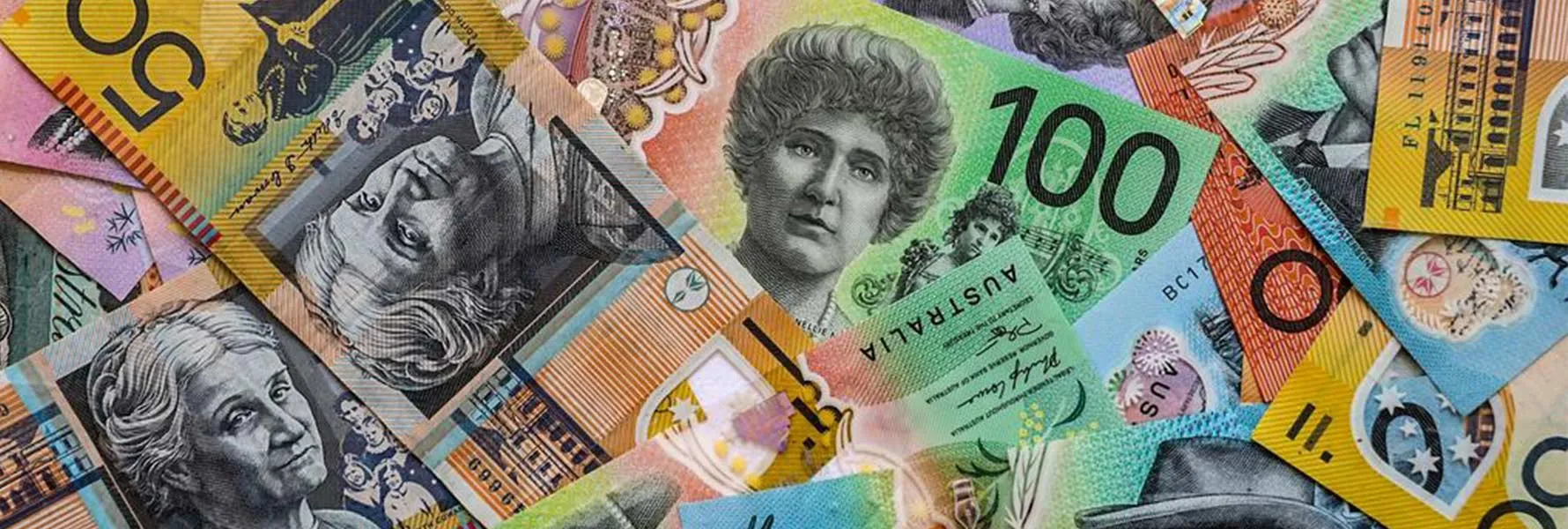
Australia uses the Australian Dollar (AUD), one of the world's most advanced currencies. The nation pioneered polymer (plastic) banknotes in 1988, creating durable, secure, and environmentally friendly currency. Each denomination features unique colours, sizes, and prominent Australian figures, making them easy to distinguish even for first-time visitors.
As of 2026, Australia is progressively introducing new banknote designs featuring King Charles III, replacing the previous series featuring Queen Elizabeth II. Both versions remain legal tender during the transition period.
Multiple convenient options for international travellers
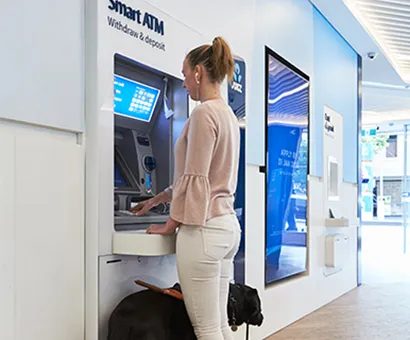
ATMs are ubiquitous in Australia — located at banks, shopping centres, service stations, and convenience stores. Most accept international cards (Visa, Mastercard, Maestro).
Typical Fees: $2–$5 per withdrawal plus your bank's foreign transaction fee (usually 2–3%).
Tip: Withdraw larger amounts less frequently to minimise fees. Bank-owned ATMs generally charge less than standalone machines.
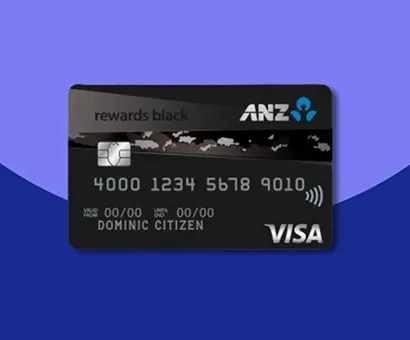
Widely Accepted: Visa and Mastercard are accepted almost everywhere. Contactless "tap-and-go" payments are the norm — most Australians pay this way for everything.
Limited Acceptance: American Express (1–3% merchant surcharge often applies), Diners Club, JCB, and UnionPay at fewer locations.
Digital Wallets: Apple Pay, Google Pay, and Samsung Pay are extremely popular.
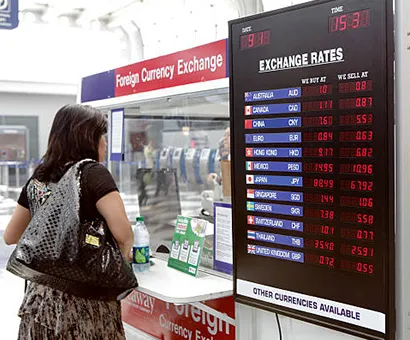
Available at international airports, major banks, and tourist areas. Rates are displayed as "buy" (what they pay you) and "sell" (what you pay them).
Best Rates: Usually found at city exchange bureaus, not airports.
Tip: Compare rates online before exchanging. Some services advertise no commission but offer worse exchange rates — compare the final AUD amount you receive.
Consider getting a travel money card (like Wise or Revolut) before arriving in Australia. These offer competitive exchange rates and lower fees than traditional banks, plus you can lock in exchange rates before you travel.
Australia has a 10% Goods and Services Tax (GST) included in most prices. The Tourist Refund Scheme (TRS) allows you to claim GST refunds on:
How to Claim: Present your goods, passport, tax invoices, and boarding pass at TRS counters at the airport — allow 30+ minutes before departure.
Not Eligible: Accommodation, car rentals, tours, services, or consumed goods.

Australian law requires you to declare if you're carrying physical currency (cash, cheques, money orders) of:
$10,000 AUD or more (or foreign equivalent)
This applies when entering or leaving Australia. Failure to declare can result in fines up to $13,200 or prosecution. This applies to family groups travelling together.
Note: Digital currency and credit/debit cards do not need to be declared.
Not Mandatory: Unlike the United States, tipping is not expected in Australia because workers receive fair minimum wages.
When to Tip:
Payment: Most POS systems don't include tip prompts. Cash tips are most common when tipping.
Choose the best option for your needs
| Method | Typical Fees | Best For | Acceptance |
|---|---|---|---|
| Credit Card (Visa/MC) | 2–3% foreign transaction fee | Everyday purchases | ✅ 95%+ |
| Debit Card | $2–5 + 2–3% per transaction | ATM withdrawals | ✅ ATMs widely available |
| Travel Money Card | 0.5–1% typically | Budget-conscious travellers | ✅ Where Visa/MC accepted |
| Cash (AUD) | Exchange rate margin 3–5% | Small vendors, markets | ✅ Universal |
| Digital Wallets | Same as linked card | Contactless convenience | ✅ 90%+ urban areas |
| American Express | 2–3% + merchant surcharge | High-end establishments | ⚠️ 60–70% |
Most experienced travellers use a combination: a travel money card for everyday purchases, a credit card as backup, and a small amount of cash ($100–200 AUD) for emergencies and small vendors who may be cash-only.
It's wise to exchange $100–300 AUD before arrival for immediate expenses like transport and meals. However, you'll often get better rates by withdrawing from ATMs or using currency exchange services in Australian cities rather than at your home airport. ATMs at international airports are a reasonable option on arrival.
Yes, ATMs in Australia are very safe. Use ATMs attached to banks or in well-lit, busy areas. Cover the keypad when entering your PIN. Independent ATMs (not bank-owned) typically charge higher fees ($3–5 vs $2–3). Skimming is rare but cover your PIN as a precaution.
Most Visa and Mastercard debit/credit cards work in Australia. Before travelling, notify your bank of your travel dates to avoid your card being blocked for suspicious activity. Check if your card has a chip and PIN — magnetic stripe-only cards may not work everywhere. Most cards also support contactless payment which is the standard in Australia.
Yes! Australia has one of the highest contactless payment adoption rates in the world. Apple Pay, Google Pay, and Samsung Pay are widely accepted. Simply add your international card to your digital wallet and tap to pay at most retailers, cafés, transport services, and supermarkets.
No — Australian businesses only accept Australian Dollars (AUD). You must exchange foreign currency at banks, exchange bureaus, or withdraw AUD from ATMs before making purchases. Some high-end hotels may exchange small amounts as a courtesy for guests, but this is not standard practice.
Some merchants charge a surcharge (typically 0.5–3%) for credit card payments, especially for American Express. Debit cards usually have lower surcharges (0.5–1%). The surcharge must be clearly displayed before payment. Many smaller businesses offer a discount for cash payment, particularly in markets and regional areas.
When the First Fleet arrived in Australia in 1788, the colony initially operated without official currency, with rum becoming an informal medium of exchange. The first official coins used in Australia were created in 1813 by Governor Lachlan Macquarie, who addressed a coin shortage by punching the centre out of Spanish dollars — creating two coins: the "Holey Dollar" and the "Dump."
In 1910, nine years after Federation, Australia introduced its own silver coins. The country used pounds, shillings, and pence until 14 February 1966, when decimal currency was introduced, replacing the old system with dollars and cents. This simplified calculations and aligned Australia with international monetary standards.
Australia revolutionised currency production in 1988 by introducing the world's first polymer (plastic) banknotes, beginning with the $10 note to commemorate the Australian Bicentenary. By 1996, all paper notes were replaced with polymer versions. These innovative notes are more durable, harder to counterfeit, and more environmentally sustainable. Many countries worldwide have since adopted Australia's polymer banknote technology.
Each Australian banknote features prominent Australians who made significant contributions to the nation. All notes are printed on durable polymer and include advanced security features. Both the current series and any new King Charles III designs are legal tender.
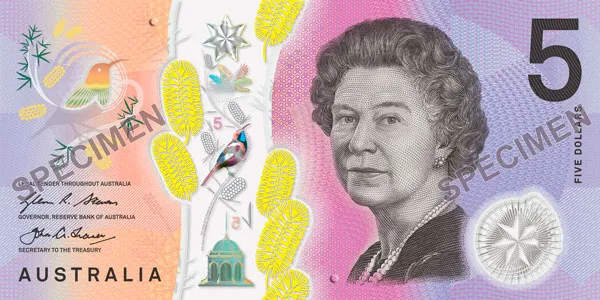
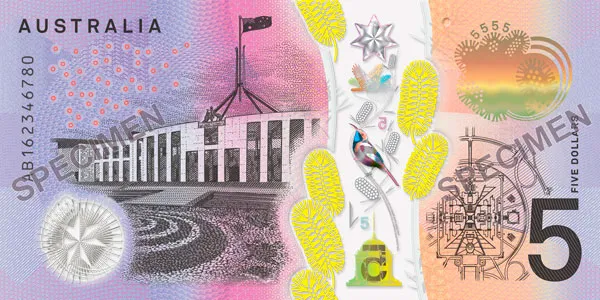
The $5 note is unique as it's the only denomination not featuring two individuals. One side displays Queen Elizabeth II while the other features Australia's Parliament House in Canberra. Note: Australia is transitioning to a new $5 design — the new note will not feature a monarch's portrait, instead honouring Aboriginal and Torres Strait Islander peoples and cultures.
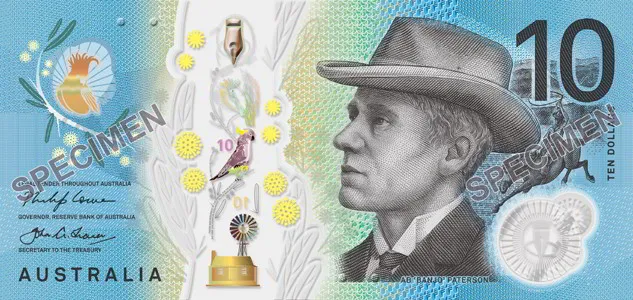
Andrew Barton "Banjo" Paterson (1864–1941) was one of Australia's most beloved poets — famous for "Waltzing Matilda" (Australia's unofficial national anthem) and "The Man from Snowy River." Dame Mary Gilmore (1865–1962) was a renowned poet, author, journalist, and passionate advocate for social justice, campaigning tirelessly against inequality throughout her life.
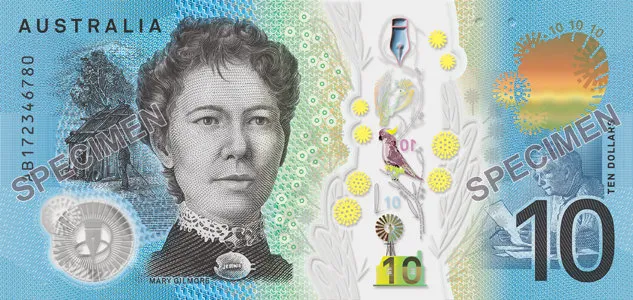
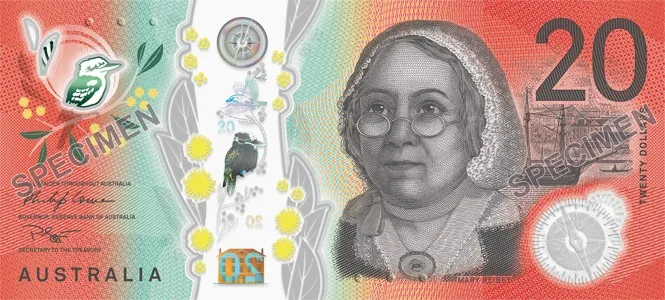
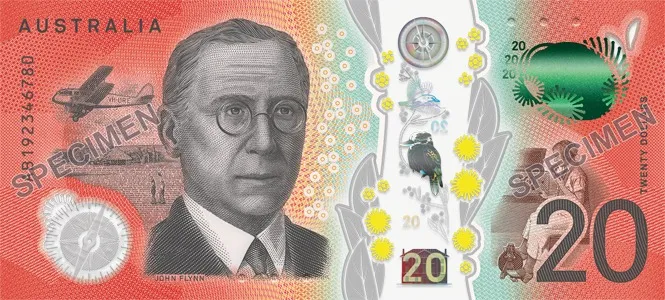
Mary Reibey (1777–1855) arrived in Australia as a convict at age 13 but became one of the colony's most successful businesswomen, building a shipping and trading empire and engaging in extensive philanthropy. Reverend John Flynn (1880–1951) founded the Royal Flying Doctor Service in 1928, revolutionising healthcare access for people in remote and rural Australia.
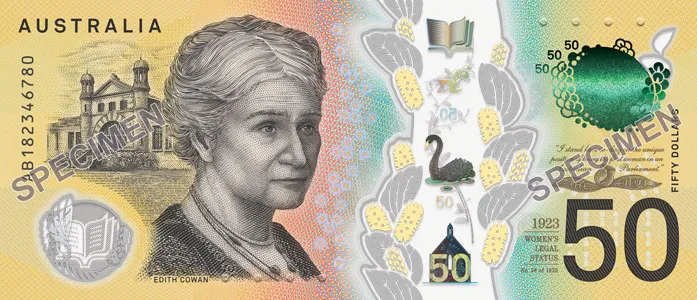
David Unaipon (1872–1967) was a pioneering Indigenous Australian inventor, writer, and public speaker whose contributions to science and engineering earned him recognition as one of Australia's most influential thinkers. Edith Cowan (1861–1932) was a social reformer and feminist who became Australia's first female member of parliament in 1921, championing children's rights, education, and women's welfare.
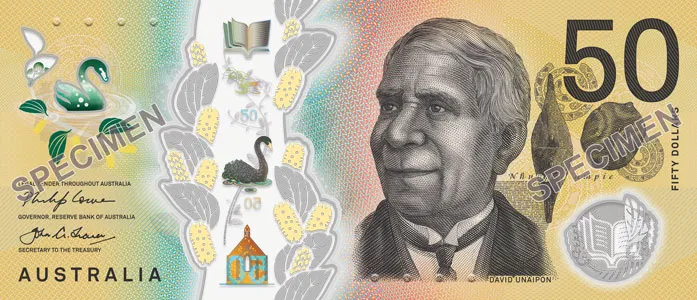
Dame Nellie Melba (1861–1931) was an internationally acclaimed soprano recognised as one of the greatest opera singers of her era — a cultural icon for Australia whose fame spread worldwide. General Sir John Monash (1865–1931) was one of Australia's most celebrated military commanders during World War I, also renowned as a distinguished civil engineer who contributed significantly to Australia's nation-building projects.
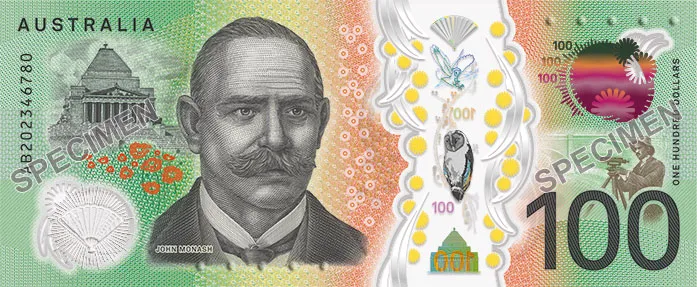
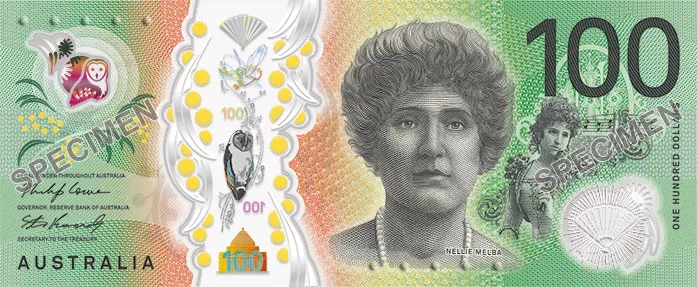
Australian banknotes are among the world's most secure currencies, incorporating multiple anti-counterfeiting technologies developed over decades of innovation:
Raised bumps on the sides help vision-impaired users identify denominations by touch. Each denomination has a different number of bumps in a distinctive location.
Transparent windows with intricate designs that are extremely difficult to replicate. Hold the note up to light to see these features clearly — fakes lack the precise optical effects.
Extremely fine text and holographic images that change appearance when tilted. Only visible under magnification — a virtually impossible feature to counterfeit at scale.
Under UV light, specific elements on the notes glow — revealing hidden security features completely invisible under normal lighting conditions.
Cooee Tours provides exceptional Australian travel experiences for visitors from around the world. Our expert local guides deliver unforgettable tours through Brisbane and beyond — from wine region day trips to nature adventures and cultural experiences. We handle all the details so you can focus on enjoying everything Australia has to offer.