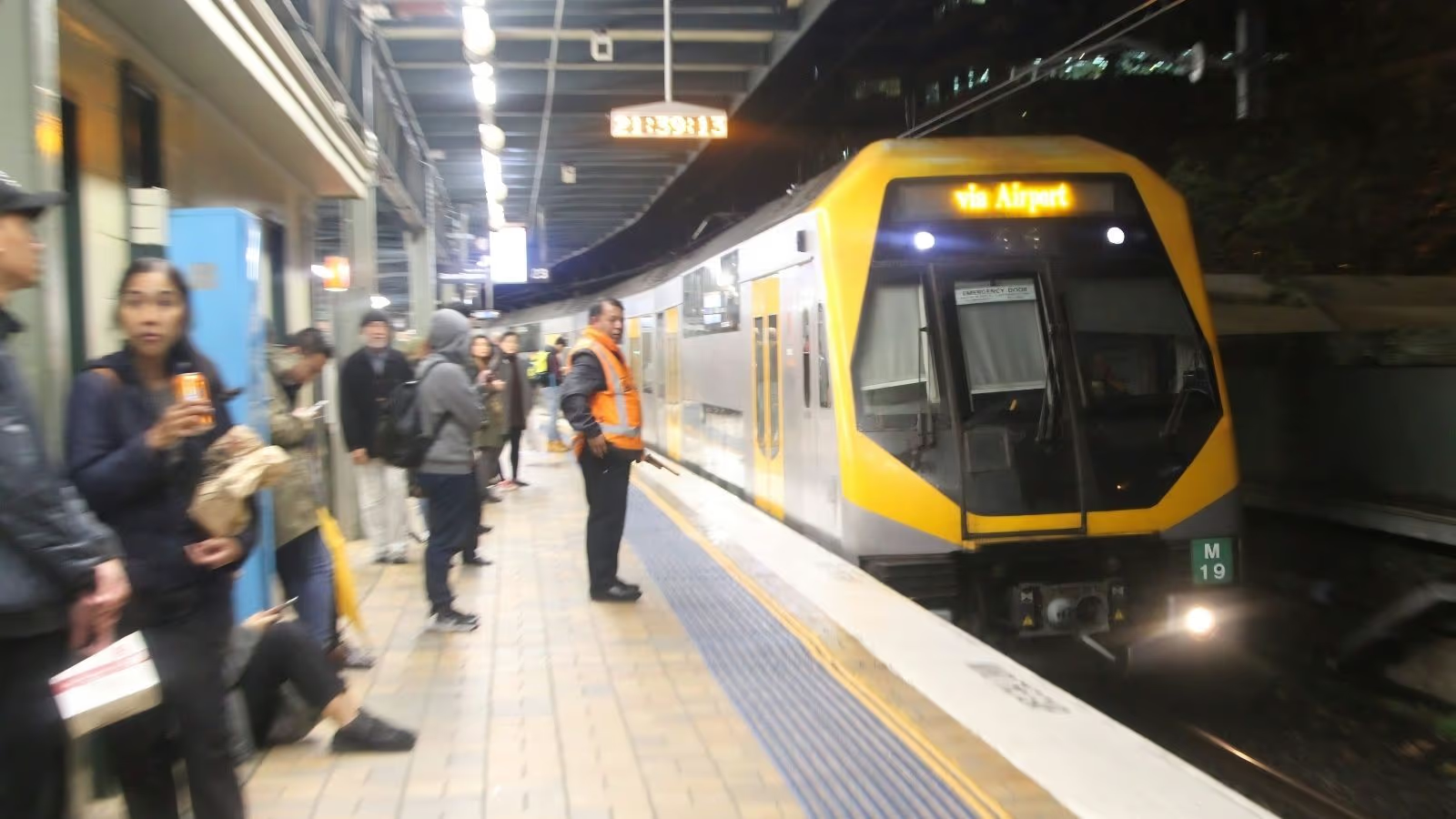
Sydney Airport sits about eight kilometres from the centre of the city, which is unusually close for a major international airport and should make this a simple question. It is not quite, because the airport rail stations are privately operated and carry a station access fee on top of the normal fare — a charge that sits outside the daily and weekly caps and catches out almost every first-time visitor. Once you know that one fact, the decision becomes straightforward, and it depends almost entirely on how many people are travelling together.
The short answer
Travelling alone or as a couple with light luggage: take the train. It is the fastest option to the central city and it is not close.
Three or more people, or two people with heavy bags: take a rideshare or taxi. Once the station access fee is multiplied by each person, the cost gap narrows to almost nothing and the door-to-door convenience wins.
On a tight budget with time to spare: the bus to Mascot station, then a normal train. This dodges the access fee entirely and is the cheapest legitimate option.
Journeys starting or ending at the domestic or international airport stations carry a station access fee on top of the standard fare, and it does not count towards your daily or weekly Opal cap. It applies per person, per journey.
The train
The airport line runs from stations directly beneath both the domestic and international terminals, on the T8 line into Central and on through the city circle to Museum, St James, Circular Quay, Wynyard and Town Hall.
Journey time to Central is around thirteen minutes, and to Circular Quay around twenty. Trains run every ten minutes or so through the day and less frequently early and late; the first services are around five in the morning and the last around midnight, so a very late arrival may miss them.
You tap on with a contactless bank card, phone or Opal card, exactly as anywhere else on the network. There is no separate airport ticket to buy and no advantage to buying one in advance.
The advantages: speed, frequency, no traffic, and it drops you in the middle of the city.
The disadvantages: the access fee, lifts and escalators with luggage, and a walk at the far end. If your accommodation is not near a city circle station you will still need a second leg.
Taxi and rideshare
Both operate from designated ranks and pickup zones at each terminal, clearly signed. Rideshare pickup is generally on a specific level of the car park rather than at the kerb, which surprises people — follow the signs rather than the app map.
Journey time to the central city is fifteen to twenty-five minutes off-peak, and can stretch to forty in heavy traffic or when the cross-city tunnels are busy. Note that some routes carry tolls, and there is an airport pickup charge levied on all taxi and rideshare journeys.
Taxis are metered and there is a minimum fare from the airport. Rideshare is usually a little cheaper off-peak and can be considerably more expensive during surge pricing, which is common on Friday and Sunday evenings and when flights bank up.
The case for: door to door, no stairs, no second leg, and for three or four people it is genuinely competitive with the train once you have paid four access fees.
The case against: traffic is unpredictable, and at peak times the train will beat a car comfortably.
The bus workaround
This is the option nobody advertises, and it is the cheapest way into the city by a clear margin.
Route 420 and other local services run from the airport terminals to Mascot station, which is one stop up the line and is an ordinary station with no access fee. Tap on for the bus, ride the few minutes to Mascot, then take a normal train into the city. Because you never tap on or off at an airport station, the fee never applies, and the whole journey counts towards your normal daily cap.
It costs a fraction of the direct train. It also takes considerably longer — allow forty to fifty minutes all up — and involves a change with your luggage.
Worth it if you are travelling light, not in a hurry, and staying long enough that the fare cap matters. Not worth it after a long-haul flight with three bags.
Our Sydney transport guide covers how the fare caps work in detail.
Shuttles and pre-booked transfers
Shared shuttle services run from the airport to city hotels and to some suburbs. They cost more than the train and less than a taxi for a single traveller, and they drop you at your door.
The trade-off is time. A shared shuttle typically waits to fill, then makes several stops, so a journey that would take twenty minutes by car can take an hour or more if you are the last drop. For a solo traveller with a lot of luggage and no schedule pressure, they are reasonable value. For a group, a private transfer or a taxi is usually both faster and cheaper.
Private pre-booked transfers make most sense for families, for arrivals in the middle of the night, and for anyone who would rather not make a decision at the kerb after a fourteen-hour flight. If you are travelling with us we can arrange this as part of the itinerary.
Comparing them properly
| Option | Time | Relative cost | Best for |
|---|---|---|---|
| Train | 13–20 min | Moderate per person, and the same in traffic | One or two people, light bags, city-centre stay |
| Taxi | 15–40 min | Fixed per vehicle | Three or four people, heavy luggage, late arrivals |
| Rideshare | 15–40 min | Usually below taxi, above it when surging | Same as taxi, if you can find the pickup zone |
| Bus to Mascot, then train | 40–50 min | Lowest — no access fee | Budget travellers with light bags and patience |
| Shared shuttle | 40–75 min | Between train and taxi | Solo travellers wanting a door-to-door drop |
| Private transfer | 15–40 min | Highest | Families, overnight arrivals, no-decision arrivals |
Fares and fees are reviewed periodically. Check transportnsw.info for current figures before you rely on any of the above.
If you are not going to the city centre
A lot of visitors are not staying in the CBD, and the calculation changes.
Eastern suburbs and Bondi. There is no direct rail. The realistic options are a rideshare or taxi straight there, or the train to Bondi Junction and a bus. For two or more people the car usually wins on both time and sanity.
The inner west. Train to Central and change, or a short rideshare. Newtown and Marrickville are close enough to the airport that a car is cheap.
The north shore and northern beaches. Train to the city then a ferry or bus, which is slow with luggage. For Manly, a rideshare to Circular Quay and the ferry is a pleasant option if you have the time and the weather.
Cruise terminals. Circular Quay is on the train line; White Bay at Balmain is not, and needs a car.
See our Sydney neighbourhoods guide if you are still deciding where to base yourself.
Practical arrival notes
- The two terminals are not walkable from each other. International and domestic sit on opposite sides of the runways. A free transfer bus runs for connecting passengers, or one stop on the train — on which the access fee applies again.
- Australian biosecurity is strict and enforced. Declare food, plant material, wooden items and anything you are unsure about. Declaring costs nothing; failing to declare carries real penalties.
- Get a SIM or eSIM before you leave the terminal if you want mobile data for rideshare apps and transport. Airport kiosks are convenient but not the cheapest.
- Use one payment method for the whole trip. Tapping with a phone on the way in and a physical card later splits your travel across two accounts and breaks the fare cap.
- Late arrivals. Trains stop around midnight. Taxis and rideshare run all night.
What about the second airport?
Western Sydney International at Badgerys Creek is the region’s second airport, roughly fifty kilometres west of the city centre. If your flight uses it, none of the advice above applies.
It is a long way from the harbour — realistically an hour or more to the CBD by road in good conditions, and considerably more at peak. A rail connection serves the site, but the journey to central Sydney involves a change and takes substantially longer than the airport line from Mascot.
The practical implications: check which airport your flight actually uses before booking accommodation, budget significantly more time and money for the transfer, and if you are connecting between the two airports on the same trip, allow a large margin. They are not close to each other.
For most international visitors this will not arise, but low-cost and regional carriers are the ones to watch.
Luggage, storage and long layovers
A specific problem worth solving in advance: you land at seven in the morning, your room is not ready until two, and you have three suitcases.
The options, in rough order of usefulness. Most Sydney hotels will hold luggage before check-in and after check-out at no charge — ask when you book rather than assuming. There are paid luggage storage counters at both airport terminals and at Central station, plus a number of app-based services that use shops and cafes around the city as drop points, which tend to be cheaper than the station lockers.
If you have a genuinely long layover rather than an early arrival, the train into the city is worth it for anything over about five hours. Circular Quay is twenty minutes away, and a ferry ride and a walk around the Botanic Gardens is a far better use of four hours than an airport lounge. Under five hours, stay put — the access fee, the security queue and the risk are not worth it.
Leaving: the same in reverse, with one warning
Going the other way, the access fee applies identically, so the same logic holds.
The warning is about timing. The train is reliable and the road is not: the routes to the airport pass through some of Sydney’s worst congestion, and a weekday afternoon run that normally takes twenty minutes can take double that. If you are travelling to a flight at peak hour, the train is the safer choice regardless of group size.
Allow the usual airport margins on top — Sydney has a strict curfew on aircraft movements overnight, which means the early morning and late evening banks of flights are busy, and the queues reflect it.
Frequently asked questions
Why is the train from Sydney Airport so expensive?
How do I avoid the Sydney Airport station access fee?
How long does it take to get from Sydney Airport to the city?
Is a taxi cheaper than the train from Sydney Airport?
Do I need to buy an Opal card for the airport train?
What time does the Sydney Airport train stop running?
Planning a Sydney trip?
We have been running guided touring in Australia since 1974. Tell us what you want out of Sydney and we will put an itinerary around it.
Talk to a specialist