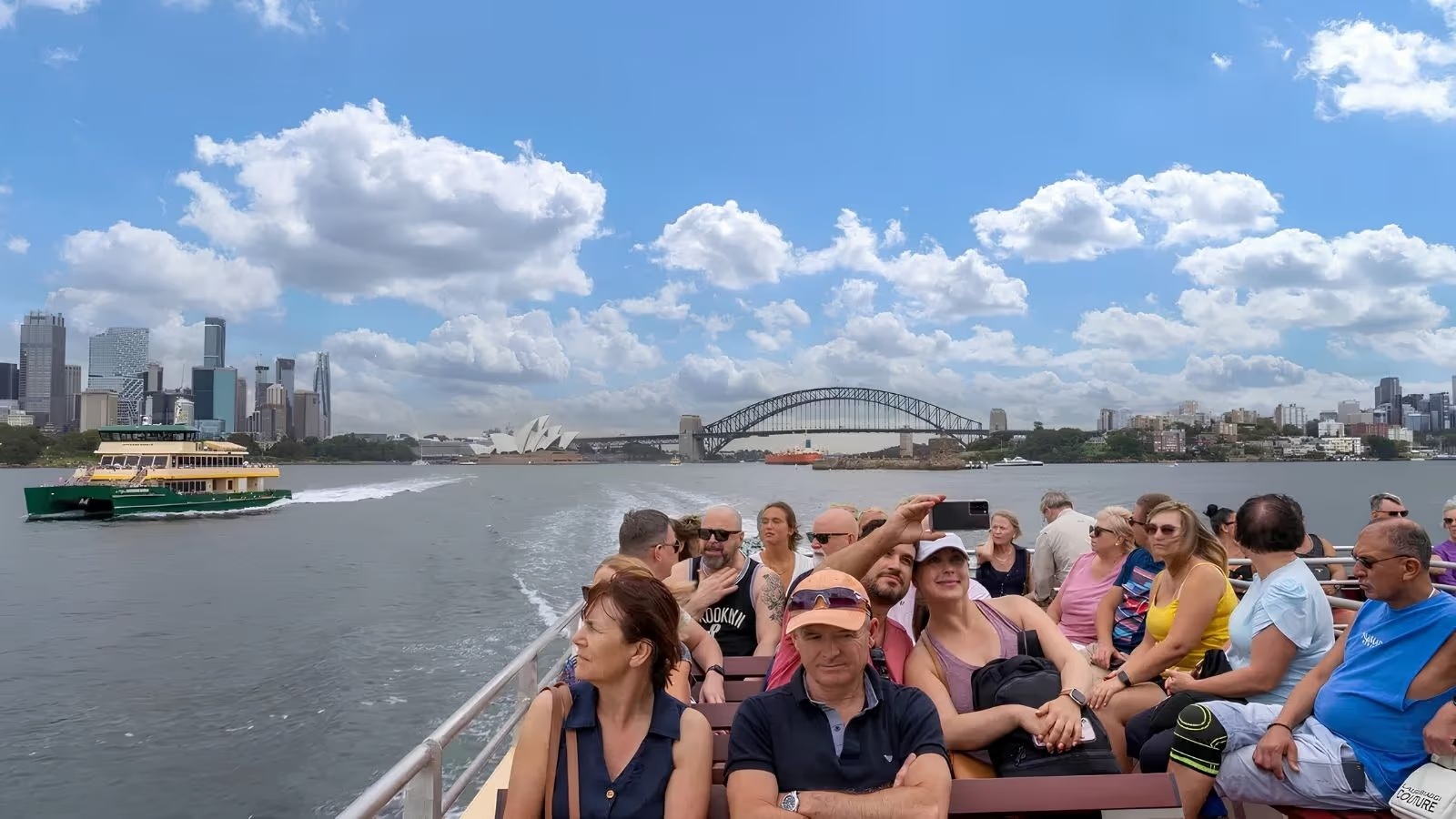
Sydney has a reputation as one of the world’s expensive cities, and the reputation is deserved — but it is deserved unevenly. The cost is concentrated in two lines, accommodation and drinking, and almost everything that makes Sydney worth visiting is free. That combination means a Sydney budget behaves differently from, say, a Tokyo or a London budget: your fixed costs are high and your daily costs can be remarkably low, and the savings available to you depend almost entirely on decisions you make before you arrive.
Where the money actually goes
For a typical week-long visit, the split looks roughly like this: accommodation is between half and two-thirds of the total, food and drink is most of the rest, and transport, attractions and everything else together are a surprisingly small slice.
That shape matters because it tells you where effort pays. Cutting a few dollars off a coffee habit will not change your Sydney budget. Choosing a different suburb to sleep in, or shifting the dates by two weeks, absolutely will.
Dates. A Sydney week in late January and the same week in late May are not comparable prices, and the difference is larger than everything else on this page combined.
Accommodation: the line that decides your budget
Sydney accommodation is priced by proximity to water and to the central city, in that order. A room with a harbour view carries a premium that has nothing to do with the room.
The levers worth pulling, in order of impact:
- Travel outside December to February. Summer is peak in Sydney, and the peak is steep. May, June and August are the cheapest months with acceptable weather.
- Stay one suburb back from the water. Randwick instead of Coogee, Kirribilli or Neutral Bay instead of the harbour proper, Newtown instead of the CBD. You lose the view and gain a bus ride; you keep a substantial share of the nightly rate.
- Check what is on. Sydney’s event calendar moves accommodation prices hard. New Year, the winter light festival, major concerts and big sporting fixtures all spike rates city-wide. Our Sydney events guide is worth a look before you book, in both directions — to avoid the spike, or to plan around the event.
- Consider the lower north shore. Ferry-connected, quiet, green, and consistently better value than the equivalent standard on the southern side of the harbour.
Where we would not economise: anywhere that requires a car, and anywhere across a harbour crossing from what you actually plan to do. Both trade money for time, and in a city where transit is the main constraint, that is usually a bad trade.
Transport is the cheap part
This surprises people. Sydney’s public transport is genuinely good value for a visitor because of the fare caps: once you hit the daily cap, everything else that day is free, and the cap on weekends and public holidays is roughly half the weekday figure.
The practical consequences:
- Do your heavy travelling on a weekend. A Saturday spent crossing the city by ferry, train and bus can cost less than a single weekday return trip to the airport.
- The ferries are the bargain. A Manly return is ordinary public transport pricing for what is effectively a harbour cruise. Paid cruises cost several times as much for a very similar view.
- Avoid the airport rail fee where you can. The station access charge at the airport sits outside the caps. For two or more people with luggage, a rideshare to the city is often no more expensive.
- Do not hire a car for the city. Parking will cost more than the transport you are replacing.
The full rules are in our Sydney transport guide. Fares are reviewed annually, so check transportnsw.info for current figures.
Eating and drinking without the damage
Food is where a Sydney budget quietly leaks. The city has excellent cheap eating and excellent expensive eating, and the trap is the middle — the unremarkable waterfront cafe that charges harbour prices for ordinary food.
What works:
- Eat where people live. Newtown, Marrickville, Ashfield, Cabramatta and Chinatown all deliver very good food at a fraction of tourist-precinct prices. Sydney’s Vietnamese, Lebanese, Thai and Chinese cooking is a genuine strength and is concentrated well away from the harbour.
- Lunch is the value meal. Many restaurants that are expensive at dinner run a considerably cheaper lunch menu.
- Buy your own picnic. A supermarket lunch eaten on a headland is not a compromise in Sydney — the setting is the meal. This is the single best value swap available in the city.
- Watch the alcohol. This is where the real money goes. A round of drinks at a harbourside bar can cost more than dinner in the inner west. Bottle shop prices are far lower than bar prices, and there are legal drinking restrictions in some public areas, so check local signage.
Our Sydney eating guide covers where the good value actually is.
The free Sydney is the good Sydney
This is the part that makes the whole budget work, and it is not a consolation prize. Several of the best things to do in Sydney cost nothing at all.
- Every beach. There is no private beach in New South Wales. Bondi, Manly, Bronte, Coogee, Palm Beach — all free, all public, all patrolled in season.
- The ocean pools. Dozens of tidal pools cut into the rock along the coast, most of them free.
- The coastal walks. Bondi to Coogee, the Spit to Manly, the Hermitage foreshore. Hours of the best scenery in the city, at no cost.
- The Royal Botanic Garden and the harbour foreshore parks.
- The Art Gallery of New South Wales permanent collection.
- The Opera House exterior and Circular Quay, which is where the building is at its best anyway.
See free things to do in Sydney for the fuller list.
What is worth paying for
Budget travel is not the same as spending nothing, and a few Sydney experiences justify their price.
The bridge climb. Expensive, and the only one of Sydney’s marquee paid experiences with no free substitute. If you spend on one thing, spend on this. See the bridge climb details.
A day trip to the Blue Mountains. Whether by train or on a tour, it is the best value day out available from Sydney, because the landscape is genuinely world-class and the train fare is capped like any other journey.
One good meal. Sydney’s top-end cooking is excellent, and one deliberate dinner is a better use of money than five mediocre ones near the water.
What we would not pay for: a paid harbour cruise, the observation tower, and any “hop-on hop-off” bus in a city with this good a ferry network.
A realistic week, three ways
Rather than quote a total that will be wrong by the time you read it, here is how the same week differs across three approaches. Prices move; the shape does not.
| Lean | Middle | Comfortable | |
|---|---|---|---|
| Sleeping | Hostel or shared room, inner west | Apartment one suburb back from the water | Hotel, central or harbourside |
| Eating | Self-catering, one meal out a day in the inner west | Cafe breakfast, picnic lunch, dinner out | Restaurants, one high-end dinner |
| Getting about | Fare cap, weekend-weighted | Fare cap daily | Fare cap plus occasional rideshare |
| Doing | Beaches, walks, ferries, gallery | The above plus Blue Mountains and one paid attraction | The above plus bridge climb and a tour day |
| Drinking | Bottle shop, picnics | Pub, not harbourside | Wherever |
The gap between lean and comfortable in Sydney is mostly accommodation and alcohol. The actual sightseeing is nearly identical across all three columns, which is the useful thing to know.
Free walks that are better than paid tours
Sydney’s best walking is self-guided, coastal and costs nothing, which makes most paid walking tours in the city a hard sell.
Bondi to Coogee is the famous one — six kilometres of clifftop path past four beaches and several ocean pools. Three to four hours with swims.
The Spit to Manly is longer, harder and considerably quieter: ten kilometres through bushland and harbour beaches, with Aboriginal rock engravings along the way. Most visitors have never heard of it, which is precisely the appeal.
The Hermitage Foreshore Walk at Vaucluse is short, easy and gives you the postcard view of the harbour with a fraction of the crowds at the standard vantage points.
Barangaroo to the Opera House along the foreshore takes under an hour and covers the entire waterfront centre on foot, which is the cheapest orientation to the city you can get.
Add the Royal National Park coast track if you have a spare day and want something wilder — it is reachable by train, which means it is covered by the same fare cap as a trip across town.
Booking decisions that save the most
Most of the Sydney budget is decided before you land, in about four choices.
The month. Already covered, and still the biggest one. Shifting from January to May changes accommodation cost materially and improves the weather for walking.
Length of stay. Weekly rates on apartments are often substantially better than nightly, and a longer stay in one place beats two short stays in two — you pay for the changeover twice, in money and in half-days lost.
Airport transfer. Decide this in advance rather than at the taxi rank. For one or two people with light luggage, the train is fine despite the access fee. For three or more, or with children and bags, a booked rideshare or shuttle usually wins.
Whether you need a car at all. If the answer is “only for one day trip”, hire it for that one day rather than the whole stay. A week of city parking will cost more than the hire.
If you are still deciding how long to stay, our how many days in Sydney guide sets out what each length buys.
False economies to avoid
A few savings that cost more than they save.
Staying too far out. A cheap room ninety minutes from the city centre costs you three hours a day. Over a week that is a lost day, and you will spend the difference on transport and convenience food anyway.
Single-trip paper tickets. They exist at machines, cost more than contactless, and do not count towards the fare caps. There is no situation in which they are the right choice.
Skipping travel insurance. Australian healthcare is excellent and expensive for visitors. Reciprocal arrangements exist for some countries but do not cover everything.
Bringing sunscreen from home. Not a saving. Australian sunscreen is cheap, sold everywhere and formulated for the UV here.
Cutting the day trip. The Blue Mountains day is one of the cheapest things in this article and one of the best. If something has to go, cut a paid attraction in the city instead.
For the national picture on costs, see our Australia on a budget guide.
Frequently asked questions
Is Sydney expensive for tourists?
What is the cheapest time of year to visit Sydney?
How much should I budget for transport?
Are Sydney beaches free?
Is a harbour cruise worth paying for?
Where should I stay in Sydney to save money?
Planning a Sydney trip?
We have been running guided touring in Australia since 1974. Tell us what you want out of Sydney and we will put an itinerary around it.
Talk to a specialist