

Bangkok is crossed off in two days by first-timers and given a week by second-timers, and the difference is knowing the hours: the temples before the heat, the river as the transport, Chinatown after six. This page is the city district by district, then the day trips, then the practical layer.
Bangkok is a city of eleven million that first-timers cross off in two days and second-timers give a week, and the difference is knowing how it works: the royal temples at 8.30 before the heat, the river and the canals as the transport and the view, Chinatown after dark, the food at every price, the malls when the afternoon wins, and the rooftops at sunset. This page is the city district by district — the old royal city, the river, Chinatown, Sukhumvit and Silom, the markets — then the day trips, then by interest, then the practical layer of getting around, sleeping and what a Bangkok day should look like in 34 degrees. Three nights is the minimum; five with the day trips is a holiday.
Bangkok at a glance
| District | What is there | Best hour | Time needed |
|---|---|---|---|
| Rattanakosin (the old royal city) | The Grand Palace and Wat Phra Kaew, Wat Pho, Wat Arun across the river, the National Museum, Sanam Luang | 8.30 opening, dressed for it | A full morning |
| The river and the khlongs | The Chao Phraya boats, the Thonburi canals by longtail, the riverside hotels and markets, Wat Arun at sunset | Morning for the canals; dusk for the river | A morning and every evening |
| Chinatown (Yaowarat) | The street-food stalls, the gold shops, Wat Traimit’s golden Buddha, the Talat Noi lanes and the flower market | From 6 pm; the flower market at 4 am | An evening, a dawn |
| Sukhumvit and Thonglor | The Skytrain spine, the malls of Siam, the food sois of Ari and Thonglor, the rooftop bars, the serviced apartments | Afternoon for the malls; evening for the sois | Where most stay |
| Silom and Sathorn | The business district, Lumphini Park, the Patpong night market, the Sky Bar and Vertigo rooftops, the Jim Thompson House | Park at 6 am; rooftops at sunset | An evening |
| The markets | Chatuchak (weekends), Or Tor Kor, the Maeklong railway market and Amphawa floating market (out of town), Pak Khlong Talat flower market | Chatuchak from 9; the floating markets by 8 | A day or a morning each |
The royal city: the Grand Palace, Wat Pho and Wat Arun
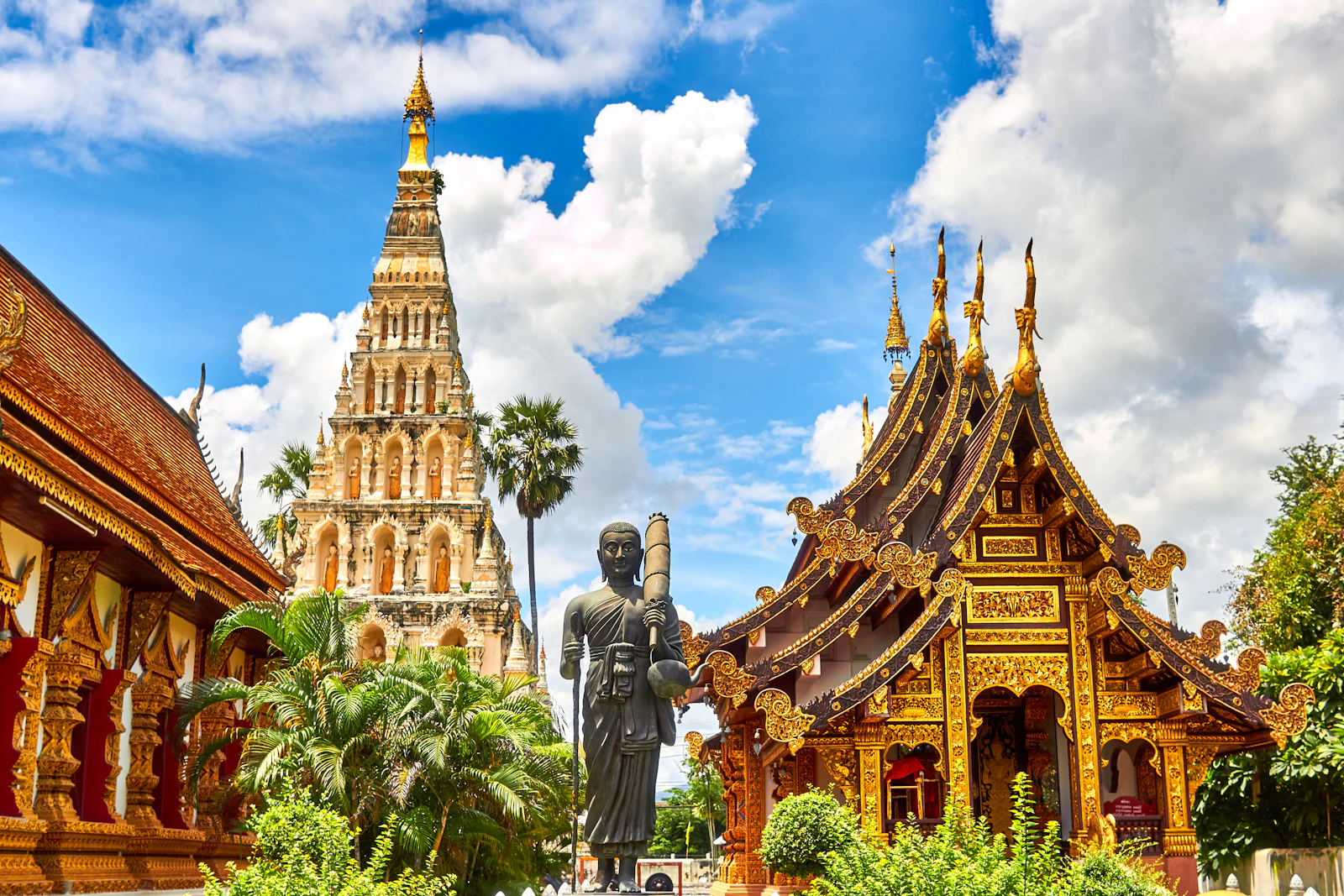
The Grand Palace opens at 8.30 and the rule is to be at the gate then, dressed for it — shoulders and knees covered, no exceptions, and the gate will rent you a cover-up if you are not. Inside, Wat Phra Kaew holds the Emerald Buddha, a small jade figure in a hall of gold and mirror, and the murals of the Ramakien run the cloister walls; the palace buildings are a century of Thai and European styles side by side; and by eleven the coaches have arrived and the heat with them. Wat Pho next door is the reclining Buddha, 46 metres of gilt with mother-of-pearl feet, and the temple’s own massage school for a thirty-minute Thai massage in a pavilion; then the ferry across to Wat Arun, the porcelain-spired Temple of Dawn that is best climbed in the morning and photographed from the other bank at sunset. A guide for this morning is the one hour of expertise that changes a Bangkok visit, and the National Museum and Sanam Luang are the afternoon for those who have not melted.
The river and the canals
The Chao Phraya is Bangkok’s spine and its best transport: the orange-flag express boats run the length of it for a dollar, stopping at the piers for the palace, Chinatown, the riverside hotels and the ICONSIAM mall; the tourist boat is the same route with commentary. The Thonburi khlongs on the west bank are the old city of stilt houses, temples with catfish, floating vendors and the Artist’s House at Khlong Bang Luang, seen from a private longtail for an hour or two in the morning — the outing that every child on the trip names first. The river at dusk from a hotel terrace, a riverside bar or the deck of a dinner cruise is the evening the city is built for, with Wat Arun lit across the water.
Chinatown and Talat Noi
Yaowarat Road is the greatest street-food street in the region and it opens at six in the evening: the crab omelette at the corner, the grilled squid, the bird’s-nest and shark’s-fin shops, the noodle stalls, the mango sticky rice cart, the durian in season, the gold shops with their neon, and two hundred stalls that are not equal, which is why a guide’s list of three is worth having. Wat Traimit holds the five-tonne solid gold Buddha; the Talat Noi lanes behind are the old Chinese shophouses, the car-part yards and the street art; and Pak Khlong Talat, the flower market at the river end, is at its best at four in the morning when the jasmine garlands are being threaded for the day’s temples. An evening, and a dawn for the committed.
Sukhumvit, Siam and the sois
Sukhumvit Road runs east under the Skytrain and is where most visitors sleep: the hotels and serviced apartments, the malls of Siam (Siam Paragon, CentralWorld, MBK for the phones, ICONSIAM on the river), the Erawan Shrine with its dancers, and the food sois — the side streets of Thonglor and Ekkamai for the restaurants, Ari for the cafes and the stalls, Phrom Phong for the Japanese quarter. The rooftop bars — Octave, Above Eleven, the Speakeasy — are the sunset; the Thonglor sois are the dinner; and the malls are where the afternoon goes when the heat has won, which in April it will. Jim Thompson’s House, the silk magnate’s teak compound and garden at the Siam end, is the one museum every first trip should include.

Silom, Sathorn and Lumphini
The business district by day and the other nightlife by night: Lumphini Park at six in the morning for the tai chi, the joggers and the monitor lizards; the Patpong night market and its infamous strip; the Sky Bar at Lebua and Vertigo at the Banyan Tree for the rooftops with the views the films used; the Chong Nonsi Skytrain for the river; and the Sathorn restaurants for the top end. Silom is where the expats eat and where the Skytrain and the subway cross.
The markets
Chatuchak is 15,000 stalls across 35 acres every Saturday and Sunday from nine, and everything — clothes, ceramics, plants, pets, antiques, food — twice; go early, take cash, and leave by two. Or Tor Kor across the road is the produce market with the best lunch in the city. The Maeklong railway market, an hour south-west, has the train running through the stalls eight times a day and the awnings folding back for it; Damnoen Saduak is the floating market of the photographs and is a tourist stage by nine, and Amphawa, near it, is the better one on a weekend evening with the fireflies by boat after. Pak Khlong Talat is the flower market at dawn. A market a day is the Bangkok rhythm.
Day trips
Ayutthaya, 80 km north and an hour by train or car: the Siamese capital for four centuries, sacked in 1767 and left as a plain of brick prangs and headless Buddhas — Wat Mahathat with the Buddha head in the tree roots, Wat Chaiwatthanaram on the river — by bicycle from the station, early. Kanchanaburi, two hours west: the Bridge on the River Kwai, the war cemetery, and Hellfire Pass with its Australian-built memorial and museum, the most affecting place in Thailand for an Australian; the Erawan falls for the afternoon. Khao Yai, two hours north-east: the national park with the wild elephants and, oddly, the vineyards. Hua Hin, three hours south: the royal seaside town and the beach without a flight. Bang Pa-In, the summer palace, on the way to Ayutthaya. The things to do in Thailand page has the country beyond.

By interest
Food
The best-value eating city in Asia: boat noodles at AUD 3 from a shophouse, the pad thai at the stall with the queue, som tam from an Isaan cart, the Or Tor Kor market, Chinatown at night, mango sticky rice from April to June, the food courts of the malls for a safe first day, and the top end — Sorn, Le Du, Gaggan, the river terraces — among the best on earth and booked before departure. A cooking class with a market visit is the most-booked half-day in the city. The Asia food guide has the Thai section.
Families
The longtail through the canals, the river boats, the Skytrain, the Grand Palace kept to an hour at 8.30, the Safari World or the Sea Life aquarium in Siam Paragon, the Kidzania, the water park at the malls, the tuk-tuk once, and the food courts. Two days, mornings only, a hotel with a pool, and the coast after. The Asia family holidays guide has the Thai section.
Culture and history
The royal temples with a guide, the National Museum, the Jim Thompson House, Wat Traimit, the Bangkok Art and Culture Centre, the Erawan Museum’s three-headed elephant, a Muay Thai night at Rajadamnern or Lumpinee (the real thing, AUD 50–120), the Siam Niramit or Aksra puppet shows, and Ayutthaya as the day. The royal family is protected by law from any disrespect and the temples enforce their dress codes.
Nightlife
The rooftops at sunset (Vertigo, Sky Bar, Octave, a cheaper one in Chinatown), Yaowarat from six, the Thonglor sois, the Silom and Sukhumvit bars, a dinner cruise on the river, the night markets (Jodd Fairs, Asiatique on the river), and the Khao San Road for the backpackers once. Bangkok goes late and the Skytrain stops at midnight; Grab covers the rest.
Spa and wellness
Thai massage at Wat Pho’s school (the origin), the hotel spas (the Mandarin Oriental’s across the river, the Peninsula’s), the neighbourhood parlours at AUD 10 an hour, and the day spas of Sukhumvit; a two-hour treatment at a good spa is AUD 60–120 and the daily massage is a Bangkok habit worth acquiring.
Wat Arun, the river and the light
The Temple of Dawn is misnamed for a visitor: it faces east and catches the morning light on its porcelain spire, but the view of it is from the east bank at sunset, when the prang goes gold and then floodlit against the darkening river. The Sala Rattanakosin’s rooftop, the Eagle Nest at Sala Arun, the Tha Tien pier and the deck of any river boat give the view; the ferry across costs a few baht and the climb up the prang’s steep stairs is for the morning. It is the photograph of the trip and the one evening a Bangkok stay should not be without, and it costs nothing but the ferry.
Two neighbourhoods worth an evening
Ari, three Skytrain stops north of Siam, is the cafe-and-stall suburb where the city eats on a Tuesday: the Ari Soi 1 stalls, the bars in converted houses, the coffee, and a street-food dinner that costs what a drink costs in Thonglor. Charoen Krung, the old road along the river south of Chinatown, is the creative district: the Warehouse 30 galleries, the Jam Factory, the Bangkokian Museum, the riverside restaurants at the Jam and the Never Ending Summer, and the Talat Noi lanes at its northern end. Both are the Bangkok that the temple-and-mall itinerary misses and the ones that make a third night worth it. Both are reached by the Skytrain and the river boat respectively, and both are ten minutes from a Sukhumvit or a river hotel, which is the point of sleeping by a station.
Bangkok for older travellers
A car and a guide for the royal city, the temples kept to two and done by eleven, a hotel on the river with a pool and a pier, the longtail with a shaded canopy and a hand aboard, the Skytrain’s lifts (most stations have them now), the malls for the heat, a daily massage, and Ayutthaya by car rather than bicycle. The heat is the constraint and the morning is the answer; the family holidays guide has the unhurried notes and the Thailand tours page the shapes.
The second visit
Talat Noi’s lanes and the flower market at four; the Ari sois; the Bangkok Art and Culture Centre and the 100 Tonson gallery; the Erawan Museum; Bang Krachao, the green lung across the river by bicycle; the Maeklong and Amphawa markets on a weekend evening with the fireflies; a Muay Thai night; Nonthaburi’s riverside; and Kanchanaburi as an overnight for the Erawan falls and the railway to Nam Tok. Bangkok is the city that most Australians hurry through on the way to a beach and the one they slow down in on the third trip.
Manners and the rules
Temple dress is shoulders and knees covered and shoes off, enforced at the palace and trusted elsewhere; feet are never pointed at a Buddha image and heads are not touched; women do not touch or hand things directly to monks; the royal family is protected by law and the anthem is stood for in cinemas and at eight and six in the parks. Bargaining is expected at the markets and not in the malls; tipping is ten per cent at restaurants without a service charge and small notes for drivers and porters; losing your temper loses the argument. The tuk-tuk driver who says the palace is closed is taking you to a gem shop; the palace is not closed. Sawasdee (with the wai) and khob khun are the two words.
Costs and timings
The Grand Palace is AUD 22, Wat Pho AUD 9, Wat Arun AUD 4, the Jim Thompson House AUD 9, the National Museum AUD 9, a longtail for the canals AUD 40–60 for the boat, a guided royal-city morning AUD 150–250 for the party, a cooking class AUD 40–70, a Muay Thai seat AUD 50–120, a rooftop cocktail AUD 15–25, a street meal AUD 3–6, a food-court meal AUD 5–8, a mid-range dinner AUD 20–40, and the top end AUD 150–400. The Skytrain is AUD 1–2, the river boat a dollar, Grab AUD 4–10 across town. A Bangkok day costs AUD 50–90 on the ground before the hotel. The palace opens at 8.30 and closes at 3.30; Wat Pho at 8 and 6.30; the canals are a morning; Chatuchak is weekends 9–6; Yaowarat is 6 pm to midnight; the flower market is all night and best at four. The South-East Asia guide has the daily budget.
Bangkok in the heat, the rain and the cool season
November to February is the season: 30°C, dry, and the city at its most walkable, with Loy Krathong on the river in November and Chinese New Year in Chinatown. March to May is 35°C-plus and Songkran’s three-day water fight on 13–15 April is the release; the day is mornings and malls. June to October is the wet, which in Bangkok means a violent hour of rain in the afternoon and a clear evening, with the streets steaming and the hotels half price; the mornings are fine and the rain is the pool hour. The city works in every month and the shape of the day changes with the thermometer.
Getting around
The BTS Skytrain and the MRT subway cover the modern city for AUD 1–2 a ride with a Rabbit card or a contactless bank card; the river express boats cover the old city for a dollar; Grab covers the gaps and removes the unmetered-taxi problem; tuk-tuks are for the experience once, with the fare agreed first; and the traffic is the reason the outings are in the morning and the hotel is by a station or the river. Suvarnabhumi is 30 km east with the Airport Rail Link (30 min, AUD 2) and Grab (AUD 20–35); Don Mueang is the low-cost airport 25 km north and the two are 50 km apart, so a connection between them needs three hours. Walking is for the sois and not the main roads.
Where to stay
On the river for the boats and the view — the Peninsula, the Mandarin Oriental, the Shangri-La, the Chatrium, the Sala Rattanakosin above Wat Arun — or on the Sukhumvit line for the food sois, the malls and the serviced apartments families prefer (Phrom Phong, Thonglor, Asok); Silom for the business district and the rooftops; the old city around Banglamphu for the atmosphere and the value. Everything else needs a station or a pier or it is a traffic jam. The where to stay in Asia page has the tiers.
What a Bangkok day looks like
The one big thing at 8.30 before the heat — the palace, the canals, a market; lunch at a shophouse or a food court; the pool, a massage or a mall through the middle of the day, because 34°C at two in the afternoon is not a sightseeing hour; and the city from five, when the light softens: the river, a rooftop, Chinatown, the sois. Two temples a day at most, one market, one outing by water, and a hotel by a station. Three nights sees the royal city, the river and Chinatown; five adds Ayutthaya and Kanchanaburi; the coast comes after, on the Bangkok and the beaches route.
Bangkok in three days, day by day
Day one: the royal city with a guide at 8.30 — the palace, Wat Pho and the massage, the ferry to Wat Arun — lunch in the old quarter, the pool, Yaowarat from six with the guide’s list of three stalls. Day two: the longtail through the khlongs at nine, the Jim Thompson House and lunch at its restaurant, the Siam malls or a cooking class in the afternoon, a rooftop at sunset, dinner in the Ari sois. Day three: Chatuchak if a weekend or Or Tor Kor if not, Lumphini or the National Museum, Wat Traimit and Talat Noi, and a dinner cruise or the Sky Bar for the last night. With more: Ayutthaya by bicycle, Kanchanaburi and Hellfire Pass, the Maeklong and Amphawa markets, a Muay Thai night, the flower market at dawn.
Frequently asked questions
How many days do you need in Bangkok?
Three nights for the royal city, the river and Chinatown; five with Ayutthaya and Kanchanaburi as day trips. Two nights, the common allocation, is a queue at the palace and a jet-lagged evening.
What time does the Grand Palace open and what do I wear?
8.30 am, and be at the gate then. Shoulders and knees covered for men and women, no exceptions; the gate rents cover-ups. By eleven the heat and the coaches have arrived.
Is Bangkok safe?
Yes for visitors, with the ordinary cautions: Grab rather than unmetered taxis, bottled water, busy stalls, no motorbikes, and a polite refusal of the tuk-tuk driver who says the temple is closed. The scams are petty and predictable and a guide removes them.
Where should I stay in Bangkok?
On the river for the boats and the view, or on the Sukhumvit Skytrain line for the food and the serviced apartments. Anywhere without a station or a pier is a traffic jam.
What are the best day trips from Bangkok?
Ayutthaya (an hour north, the old capital by bicycle), Kanchanaburi (two hours west, the River Kwai and Hellfire Pass), the Maeklong railway and Amphawa floating markets, Khao Yai National Park, and Hua Hin for the beach without a flight.
When is the best time to visit Bangkok?
November to February, the cool dry season; fine in every month if the outings are in the mornings. March to May is the hottest; June to October has afternoon storms rather than all-day rain.
Is street food in Bangkok safe?
Generally, and often safer than a quiet restaurant: choose the busy stall with the queue, eat hot food cooked in front of you, drink bottled water and use hotel ice. Chinatown and Or Tor Kor are the places to start.
How do I get from the airport into Bangkok?
From Suvarnabhumi, the Airport Rail Link (30 minutes, AUD 2) or Grab (AUD 20–35); from Don Mueang, Grab or the bus. A pre-booked car with a name board for late arrivals and families.
Where this leads
Things to do informs; tours convert.