

A first trip to Asia is easier than it sounds and decided almost entirely by the choice of country. This guide ranks the destinations for beginners, then walks through booking, entry, money, health, phones, packing, manners and the ten mistakes we watch first-timers make every year.
Asia is the closest continent to Australia and the one most Australians visit first, and a first trip there is easier than the guidebooks make it sound. The trains work, the people are kind to visitors, the food is the best on earth, and the things that go wrong — a stomach upset, a taxi that took the long way, a temple you were not dressed for — are small and survivable. What decides a first trip is the choice of country. Some are built for beginners: Japan, Bali, Singapore, Thailand, Taiwan. Some reward experience: India, China, Cambodia’s deeper temples, the Himalaya. This guide ranks the first-trip destinations, then walks through everything that happens between deciding and landing: planning, booking, packing, money, health, phones, manners and the ten mistakes we watch first-timers make every year.
Which country first
| Destination | Why it suits a first trip | Flight | Visa | Difficulty (1 easy – 5 hard) |
|---|---|---|---|---|
| Japan | Safest country on earth, flawless transport, English signage, no tipping, the most memorable first trip | 9–10 h direct | None | 1 |
| Singapore | English-speaking, orderly, air-conditioned; the softest landing in Asia | 8 h direct | None | 1 |
| Bali | Six hours, familiar, Australians everywhere, villas and resorts, a driver for everything | 6 h direct | e-VOA | 1 |
| Taiwan | Safe, cheap, gentle, superbly organised, under-visited | 9 h direct | None | 1–2 |
| Thailand | The classic; resorts, food, elephants, easy on the right coast in the right month | 9 h direct | None (60 days) | 2 |
| South Korea | Safe, modern, direct flights, cheaper than Japan; less English outside Seoul | 10–11 h direct | None | 2 |
| Malaysia | English widely spoken, cheap, food, Borneo wildlife | 8 h direct | None | 2 |
| Vietnam | The best value and food in the region; traffic and pace take a day to learn | 8–9 h | e-visa | 2–3 |
| Sri Lanka | Gentle South Asia with a driver; long flight | 12–14 h | ETA | 3 |
| Cambodia and Laos | Easy as add-ons to Thailand or Vietnam; harder alone | via a hub | e-visa / on arrival | 3 |
| China | The scale is extraordinary; visa, payments, apps and language are real friction | 9–12 h | Visa required | 4 |
| India | The most rewarding and the most demanding; go with a driver and guides, and not first | 12–13 h direct | e-Visa | 5 |
Our honest picks
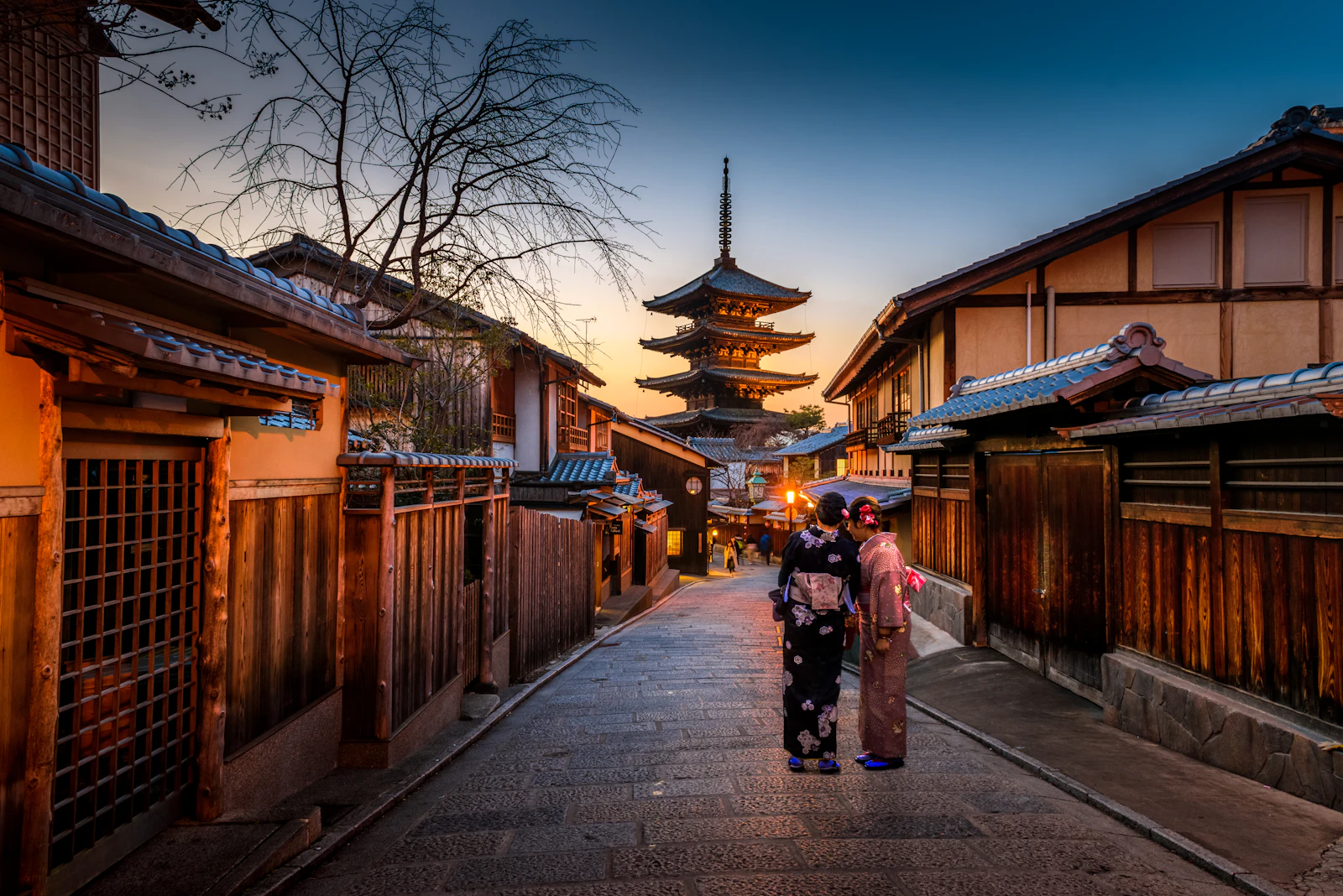
For a first trip to Asia of any kind: Japan. It is the country where a beginner is least likely to have a bad day and most likely to plan a second trip. For a beach-and-relax first trip: Bali, or Thailand’s Andaman coast between November and April. For families with young children: Bali or Singapore. For a first trip on a budget: Vietnam or Taiwan. For a nervous traveller: Singapore for three nights, then Bali or Japan. For a first trip that must include a great monument: Angkor added to Thailand, or Kyoto. The East Asia and South-East Asia guides compare the countries in depth.
How long, and how many places
Ten days is the practical minimum for one country done properly: three or four bases, no more than five hotels, and one day in every three left loose. Two weeks allows two countries if they are close (Japan and Korea, Thailand and Cambodia, Bali and Java) and one country done well if they are not. Three weeks allows a loop. The single most common first-trip error in Asia is the itinerary that lists nine places in twelve days; every move costs half a day and the pleasures of the continent are the pleasures of staying long enough to be recognised at the noodle shop. Fewer places, longer stays, and a route the trains or the short flights already run.
When to go
The month rules the destination. Japan, Korea and Taiwan in April–May and October–November; Thailand’s Andaman, Cambodia, Laos and northern Vietnam from November to February; Bali, the Thai Gulf islands and Malaysia’s east from June to September; Singapore any time. The Australian school holidays each have a natural destination and the best time to visit Asia page matches them. Avoid moving between cities during Lunar New Year, Japan’s Golden Week, China’s National Day week and Christmas–New Year in the tropics, when the whole region travels.
Booking: what, when and in what order
The order
- Choose the month, then the country, then the route — in that order.
- Flights: four to six months out for peak seasons, two to three for shoulder. Direct beats one-stop on a first trip.
- Accommodation: peak-season Kyoto, Bali in July, Christmas in Thailand need six to twelve months; shoulder seasons need six to eight weeks.
- Visas and entry: Vietnam’s e-visa, India’s e-Visa, Indonesia’s e-VOA and any medication permits, four weeks out.
- The things that sell out: Ghibli, teamLab, elephant sanctuaries, Halong boats, Angkor guides, famous restaurants, sumo, festivals.
- Travel insurance, at the moment you pay the first deposit, so cancellation cover is live.
- A travel doctor, six weeks out, for vaccinations and a kit.
- Trains and internal flights, one to two months out.
Booking yourself or through an operator
Japan, Singapore, Taiwan and Bali are easy to book independently, and many first-timers do. Thailand and Vietnam are easy to book and harder to book well, because the coast and the month have to match and the transfers add up. India, China, Cambodia and Laos are where an operator changes the trip: the driver, the guides, the hotels chosen by someone who has slept in them, and the consumer protection of an Australian booking. Our own case is the one-booking model — flights, every transfer, every hotel, every guide, quoted in Australian dollars, with a person in Brisbane to call — and the Asia tours page shows the shapes we start from.
Entry, passports and visas
Australians enter Japan, South Korea, Taiwan, Thailand, Malaysia, Singapore and the Philippines visa-free; Indonesia on an e-Visa on Arrival; Vietnam, Cambodia, Laos and India on e-visas applied for online; China on a visa from the consulate. Passports need six months’ validity beyond the trip for almost every country and the airline will enforce it even where the country would not. Some countries (Japan, Korea) are strict about medications Australians consider ordinary; check the lists. Smartraveller is the source for all of it, and registering the trip there costs nothing. The getting to Asia page has the country-by-country entry table.

Money
Cards work at hotels, chains and good restaurants across the continent and at almost everything in Japan’s cities, Korea, Taiwan and Singapore; cash rules at markets, stalls, temples, drivers and small restaurants everywhere, and rules almost everything in Vietnam, Cambodia, Laos and rural India. Withdraw local currency at an airport or bank ATM on arrival rather than exchanging Australian dollars at home; use a card with no foreign-transaction fee; tell the bank you are travelling. Carry a day’s cash, not a week’s. Prices in Japan, Korea, Taiwan and Singapore are fixed; markets in South and South-East Asia expect bargaining, shops with price tags do not. Tipping is not done in Japan, Korea, China or Taiwan, is modest (10 per cent at restaurants, small notes for drivers and porters) in Thailand, Indonesia, Vietnam, India and Sri Lanka, and is covered by a service charge in Singapore and Malaysia. The country guides have the detail; the Japan costs guide is the model.
Health
Japan, Korea, Taiwan and Singapore need nothing beyond routine vaccinations and have drinkable tap water. Everywhere else: hepatitis A and typhoid, tetanus current, a travel doctor’s advice on the rest, bottled or filtered water, hot food from busy places, peeled fruit, hand sanitiser, and mosquito repellent for dengue, which is the disease that actually affects Australian travellers. Bring your regular medicines in original packaging with the prescription. A small kit: rehydration salts, paracetamol, antihistamine, plasters, and for South and South-East Asia a course of antibiotics prescribed at home. Travel insurance with medical evacuation is the one non-negotiable; Asian private hospitals in Bangkok, Singapore, KL, Tokyo and Seoul are excellent and expensive, and elsewhere evacuation to them is the plan. Heat is the daily reality in the tropics and the trip is built around it: mornings and evenings out, midday in the shade or the pool.
Phones, apps and connectivity
An eSIM bought before departure (10–20 GB, AUD 20–40) or a local SIM at the arrival airport. Google Maps works everywhere except Korea (Naver Map) and China (a VPN and Apple Maps); Google Translate’s camera mode reads menus in every script; Grab is the ride app across South-East Asia, Kakao T in Korea, Didi in China, and Japan runs on trains. A transport card in the phone wallet (Suica) or bought on arrival (T-money, EasyCard, Octopus). Your bank’s app with travel notification set. Smartraveller. WhatsApp for the hotel and the driver. Photographs of passport, insurance and bookings emailed to yourself. Power is 100 V two-flat-pin in Japan, 220–240 V on assorted plugs everywhere else; a universal adaptor covers the continent and modern chargers handle the voltage.
Packing
Less than you think, because laundry is cheap and everything is for sale. The essentials: slip-on shoes and intact socks (you will be shoeless daily in temples, homes and ryokan), a sarong and a scarf for temple dress, light layers for aggressive air-conditioning, a folding umbrella that doubles as a parasol, a hat, a small day bag, a coin purse, reef shoes and a rash vest for any beach, a power bank, a universal adaptor, and the medicines and kit above. Leave half the suitcase empty. Dress is more modest across Asia than at home — shoulders and knees covered is the temple rule and a reasonable street rule outside the beach resorts — and looking respectable buys better treatment everywhere.
Language
English is an official language in Singapore, the Philippines and India, widely spoken in Malaysia and in the tourist areas of Thailand, Bali, Vietnam and Sri Lanka, present on signage in Japan, Korea and Taiwan and rare in China outside hotels. None of it matters as much as first-timers fear. Menus have pictures, Google Translate reads the rest, transport is signed, hotels speak English, and a guide or driver bridges the gap where there is one. Learn hello, thank you and excuse me in each country — konnichiwa, arigatou, sumimasen; sawasdee, khob khun; xin chao, cam on; terima kasih; annyeonghaseyo, gamsahamnida; namaste — and use them. A smile and a slight bow of the head are understood on the whole continent.
Manners: the rules that travel
- Shoes off wherever there is a step up and a row of slippers.
- Cover shoulders and knees at temples, mosques and palaces; hats off; feet never pointed at a Buddha.
- Heads are sacred, feet are lowly across the Buddhist world: do not touch a child’s head or gesture with a foot.
- Two hands for passing cards, money and gifts in East Asia.
- Quiet on trains in Japan and Taiwan; queue everywhere.
- Chopsticks never upright in rice, never used to pass food.
- Right hand only for eating and giving in India, Malaysia and Indonesia.
- Do not lose your temper. Anywhere. It ends the conversation.
- The royal family in Thailand is protected by law; say nothing.
- Learn hello and thank you in each country. It is repaid many times over.
Safety, honestly
Asia is safer than most of the world for a visitor. Violent crime against tourists is rare across the continent; Japan, Korea, Taiwan and Singapore are among the safest places on earth at any hour; Bali, Thailand, Vietnam and Malaysia are safe with ordinary city sense. The real risks are traffic (motorbikes above all — do not hire one without a licence, a helmet and insurance that covers it), water and food in the tropics, rips on unpatrolled beaches, and petty scams around the famous sites (the closed temple, the gem shop, the unmetered taxi) which Grab and a guide remove. Women travelling alone report Japan, Taiwan, Korea and Singapore as the easiest countries they have visited, South-East Asia as fine with ordinary care, and India as demanding. Earthquakes in Japan and Taiwan, typhoons from July to October, and the occasional political demonstration in Bangkok are the events to be aware of and insured for. Smartraveller rates most of the region at its lowest two advisory levels and advises against Myanmar.
The first day
Land in the morning if you can — the Australian overnight flights north do this naturally — and plan nothing for it but arrival. Clear immigration with the QR code or arrival card already done; withdraw local cash at the airport ATM; activate the eSIM; take the pre-booked transfer or the airport rail rather than working out the taxi rank on no sleep. Check in, shower, and walk: the neighbourhood around the hotel, a market, an early dinner at a place with a queue, and bed by nine. The first day is for the body clock and for the small competences — the transport card, the crossing, the greeting — that make the second day easy. The famous sight is for tomorrow at eight.
Jet lag
One of the continent’s underrated virtues: Bali, Japan, Korea, Taiwan, the Philippines and eastern Australia share a time zone within an hour or two, so there is no jet lag to speak of on the east coast’s most-flown routes. Thailand, Vietnam, Malaysia and Singapore are three hours behind Brisbane; India is four and a half to five and a half. The overnight flights north land in the morning; stay awake until local bedtime on day one and the body clock is set. Coming home is the same in reverse and Australians rarely notice it.
What will surprise you
The kindness of strangers, which is the consistent report from first-timers in every Asian country. The noise of a South-East Asian street and the silence of a Japanese train. Toilets: Japanese ones are the best in the world, and squat toilets still exist in the region’s countryside, so carry tissues. The heat, which is not the dry heat of an Australian summer but a wet weight. The number of scooters. The plastic stools. The cost of a meal, which will be a third of what you feared. The shrine in the middle of a shopping mall. The absence of rubbish bins in Japan and the absence of rubbish. The politeness of a chain convenience store. That nobody expects you to speak the language and everyone appreciates the attempt. And that after ten days the manners, the money and the crossing of the road are not foreign but obvious, which is when the second trip starts being planned.
Travelling as a couple, solo, in a group
Couples have the easiest time of it and the widest choice. Solo travellers find Japan, Taiwan, Korea and Singapore the best solo countries on earth — counter seating, single rooms priced fairly, safety at any hour — and South-East Asia sociable and cheap; single supplements are mild across the region. Groups of four to six do well in villas (Bali, Thailand), machiya and hanok rentals (Kyoto, Seoul) and with a private driver, whose cost splits four ways into almost nothing. Multi-generational groups suit Bali, Japan, Singapore and Thailand’s resorts, with fewer moves and a pool. Older travellers find Japan, Taiwan and Singapore step-free and gentle, Vietnam and Sri Lanka easy with a driver, and India rewarding with a slow private itinerary.
What a first trip costs
Ten days, mid-range, per person, including a shoulder-season airfare from the east coast: Bali AUD 2,500–3,800; Thailand AUD 2,800–4,200; Vietnam AUD 2,600–4,000; Taiwan AUD 3,000–4,200; Malaysia AUD 2,800–4,000; Singapore (five nights) AUD 2,800–4,000; Korea AUD 3,800–5,200; Japan AUD 4,000–6,500; Sri Lanka AUD 3,800–5,500. Peak season adds 25–40 per cent, mostly on flights and beds. On the ground, the daily numbers are AUD 100–200 in South-East Asia and AUD 180–350 in Japan and Korea, and food is cheap everywhere. The country guides — the Japan costs guide is the detailed one — break it down line by line.
Adding a second country
If the first trip has two weeks, the natural pairs are Japan with Korea or Taiwan, Thailand with Cambodia, Vietnam with Cambodia, Bali with Java or Lombok, and Singapore with anything. Each border costs a day, a currency and a new transport card; two countries in fourteen days works, three does not. The Asia itineraries page has the two-country routes and the getting to Asia page has the regional flights.
The ten first-trip mistakes
- Nine places in twelve days.
- Choosing the destination before the month, and arriving in monsoon.
- Booking Kyoto in April, Bali in July or Thailand at Christmas six weeks out.
- Hiring a motorbike in Bali or Thailand with a car licence and no helmet.
- Drinking the tap water, or the ice from a bucket, in the tropics.
- Arriving at the famous temple at eleven o’clock.
- Packing cold-and-flu tablets with pseudoephedrine for Japan.
- Not carrying cash in Vietnam, Cambodia, Laos or rural anywhere.
- Skipping the ryokan, the villa or the homestay because the hotel seemed safer.
- Buying travel insurance the week before, and finding the cancellation cover is not live when the typhoon comes.
Three first trips that work
Japan, eleven days, May or October
Tokyo 4, Hakone 1, Kyoto 4 with a Nara day, Osaka 2, in via Tokyo and out via Kansai. The first-time Japan guide has it day by day.
Thailand, ten days, December to February
Bangkok 3, Chiang Mai 3, Krabi or Khao Lak 4. The Thailand things to do page has the regions.
Bali, ten days, June to September
Ubud 4, Sanur or Nusa Dua 3, Seminyak or Uluwatu 3, with a Nusa Penida day. The Bali travel guide covers it.
What happens after the first trip
Almost everyone plans a second. The pattern is consistent: Japan leads to Korea and Taiwan; Bali leads to Thailand and then Vietnam; Thailand leads to Cambodia and Laos; and three or four trips in, people are ready for India, China and the Himalaya, which is where they should have been all along in the order they came. The Asia itineraries page has the routes for every stage, and the things to do in Asia page has the continent by interest.
Frequently asked questions
Which Asian country is best for a first trip?
Japan, for the safest, easiest and most memorable first trip; Bali or Singapore for families and nervous travellers; Thailand’s Andaman coast for a beach; Vietnam or Taiwan on a budget. India and China are better as a third or fourth trip.
Is Asia safe for first-time travellers?
Safer than most of the world. Japan, Korea, Taiwan and Singapore are among the safest countries on earth; South-East Asia is safe with ordinary care. The real risks are traffic, water and food in the tropics, unpatrolled beaches and petty scams, all of which preparation removes.
How long should a first trip to Asia be?
Ten days for one country done properly, with three or four bases. Two weeks for two nearby countries. The most common mistake is too many places; every move costs half a day.
Do I need vaccinations for Asia?
Not for Japan, Korea, Taiwan or Singapore beyond routine ones. For South-East and South Asia, hepatitis A and typhoid are recommended and a travel doctor should advise six weeks before departure. Dengue has no vaccine for travellers; repellent is the defence.
Should I book through a travel agent for Asia?
Japan, Singapore, Taiwan and Bali are easy to book independently. Thailand and Vietnam are easy to book and harder to book well. India, China, Cambodia and Laos are where an operator’s driver, guides and hotel knowledge change the trip. Australian consumer protection applies to an Australian booking.
What should I pack for a first trip to Asia?
Slip-on shoes, a sarong and scarf for temples, light layers for air-conditioning, a folding umbrella, a hat, a day bag, reef shoes for beaches, a power bank, a universal adaptor, your medicines in original packaging, and half an empty suitcase.
Can I use my phone in Asia?
Yes. Buy an eSIM before departure or a local SIM at the airport. Google Maps works everywhere except Korea (Naver Map) and China (VPN needed); Google Translate’s camera mode reads menus; Grab is the ride app across South-East Asia.
When is the best time for a first trip to Asia?
April–May or October–November for Japan, Korea and Taiwan; November to February for Thailand’s Andaman coast, Cambodia and Vietnam’s north; June to September for Bali. Match the country to the month you have.
Where this leads
Travel guide informs; things to do helps you choose; tours convert.