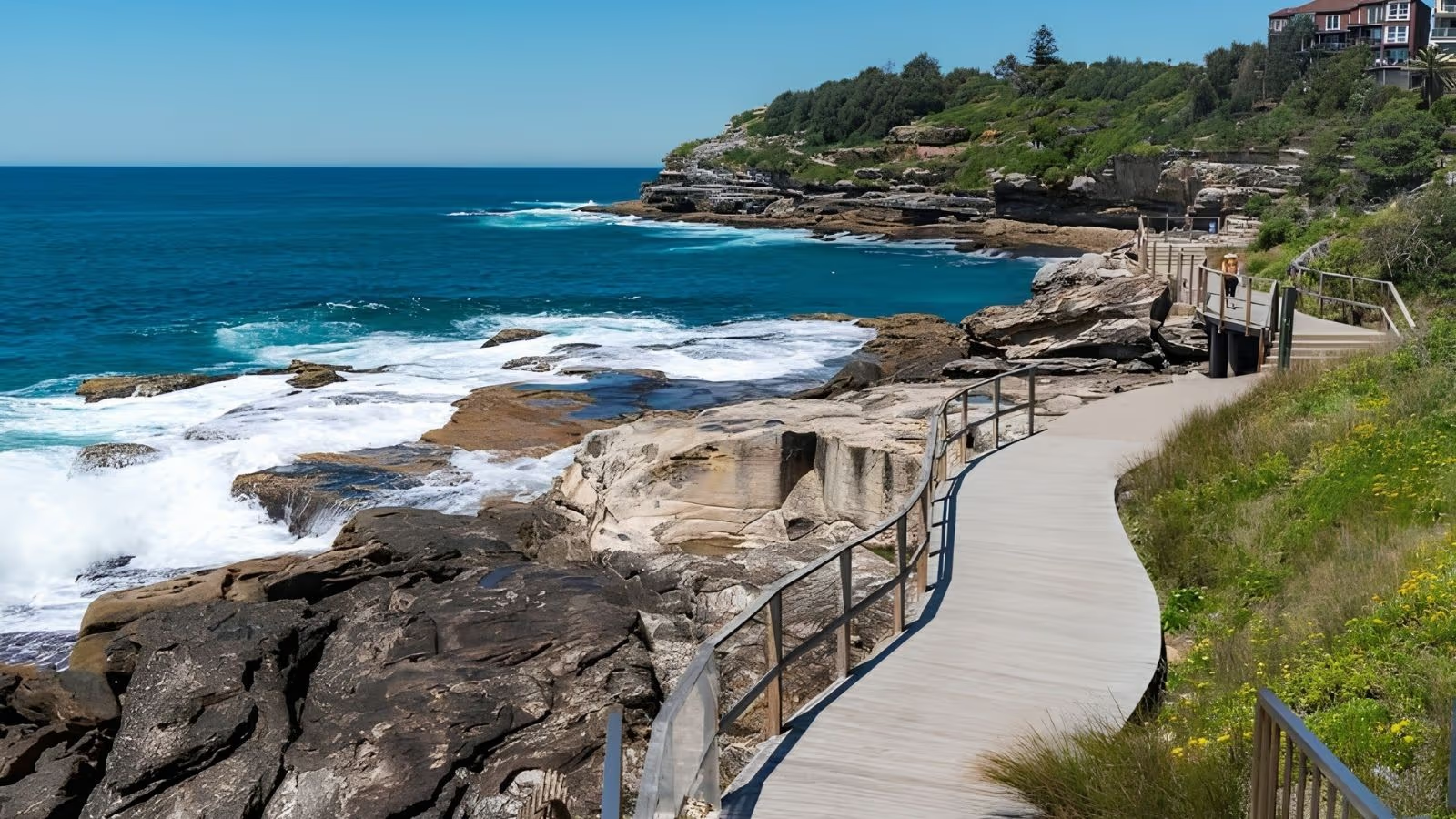
If you do one thing in Sydney, do this. The Bondi to Coogee coastal walk is a clifftop path along the eastern beaches that strings together four swimmable beaches, a run of ocean pools, a headland cemetery and a series of views that would be ticketed attractions anywhere else. It costs nothing, needs no booking, and is the clearest possible demonstration of what makes Sydney different from other big cities: the good stuff is outdoors and it belongs to everyone.
The basics
Distance: about six kilometres one way.
Time: most guides say two hours. That is true only if you walk it without stopping, which entirely misses the point. Allow three to four hours with swims, a coffee and time on the rocks. A half day is the honest budget.
Difficulty: easy to moderate. It is sealed path and boardwalk for most of the way, with a number of staircases. Not step-free, so not suitable for prams or wheelchairs over the full route, though several individual sections are.
Cost: nothing.
Shade: almost none. This matters more than the elevation.
Walk it from Coogee, not Bondi
Everyone walks it northbound to southbound because the name says so. Consider doing the reverse.
Walking south to north means the sun is behind you for most of a morning walk rather than in your eyes, the crowds thin because you are moving against the flow, and you finish at Bondi — which has by far the best food, the most frequent transport back, and somewhere to sit down. Finishing at Coogee means finishing at the quieter end and then waiting for a bus.
The one argument for the standard direction is that the coastline gets progressively more dramatic heading south, so you build to Clovelly and Gordons Bay. Either is defensible. Nobody tells you it is a choice.
In summer, be on the path by seven or eight in the morning. It is cooler, the light is better, the ocean pools are empty, and you will finish before the heat and the crowds arrive.
Section by section
Bondi to Tamarama
The busiest stretch, and where the path is at its widest. You pass Bondi Icebergs almost immediately — the famous ocean pool at the southern end of the beach, worth stopping for even if you do not swim. The path climbs onto the headland at Mackenzies Point, which gives the classic view back across the whole of Bondi. In spring this section carries the outdoor sculpture exhibition that runs along the coast.
Tamarama to Bronte
Tamarama is small, steeply shelving and has a serious reputation for rips. Locals call it Glamarama and it is a poor choice for a casual swim. Five minutes further on, Bronte is the opposite — a wide beach with a large grassy park behind it, a good ocean pool, and the best picnic ground on the walk.
Bronte to Clovelly, through Waverley Cemetery
This is the section people remember. The path runs along the edge of Waverley Cemetery, a Victorian burial ground on an exposed clifftop above the Pacific, with rows of white marble against blue water. It is genuinely extraordinary, and it is a working cemetery, so walk it quietly.
Clovelly and Gordons Bay
Clovelly is a narrow inlet with concrete decks on both sides rather than a sand beach, and the calm water makes it one of the best snorkelling spots in eastern Sydney. Just around the headland, Gordons Bay is a small boat-strewn cove that is also an underwater nature trail. Both are far calmer than the open beaches.
Gordons Bay to Coogee
The final stretch drops down to Coogee, a wide family beach with several ocean pools including Wylie’s Baths and the women-and-children-only McIver’s Ladies Baths at the southern end.
Where to swim along the way
The walk is really a series of swimming opportunities with a path connecting them. If you only get in the water once or twice, choose deliberately.
- Bondi — surf beach, patrolled, busy. Swim between the flags.
- Bondi Icebergs — the famous pool. Entry fee, closed one day a week.
- Bronte Baths — free ocean pool, dramatic setting, our pick of the lot.
- Bronte beach — patrolled, with a sheltered south corner suitable for children.
- Clovelly — flat, clear, excellent for snorkelling and weak swimmers.
- Gordons Bay — calm, no facilities, an underwater trail for snorkellers.
- Coogee — patrolled family beach plus several pools.
Avoid swimming at Tamarama unless you are confident and it is patrolled. More detail in our ocean pools guide and the Sydney beaches guide.
What to bring
- Sunscreen, and more of it than you think. There is essentially no shade on this walk and the reflected light off the water and sandstone is strong. This is the most common way people ruin the rest of their Sydney trip.
- A hat and sunglasses.
- Water. There are bubblers at the beaches but long gaps between them.
- Swimmers and a towel, obviously, plus something to put a wet towel in.
- Shoes with grip. Not thongs. There are stairs and the sandstone is slick when wet.
- Cash is unnecessary — everything along the route takes cards.
What you do not need: a guide, a booking, or a tour. This is a self-guided walk on a well-signed public path.
Doing it with a stroller, limited mobility or a dog
The full route has staircases at several points, so it is not continuously accessible. That does not rule out the coast entirely.
Step-free sections. The Bondi beachfront promenade, the Bronte park and beachfront, and the Coogee foreshore are each flat, sealed and pleasant on their own. Any of the three makes a good short outing without attempting the connecting clifftop stairs.
Wheelchair and pram access to the water. Several eastern beaches have beach matting and, in season, beach wheelchairs available through the surf clubs. Availability varies, so contact the club rather than turning up expecting it.
Dogs. This one catches people out. Dogs are not permitted on Bondi, Bronte, Tamarama or Coogee beaches at any time, and restrictions apply along parts of the coastal path. Council rangers do patrol and do fine. There are designated off-leash areas nearby, but the beaches themselves are not among them.
If mobility is a real constraint, the Manly to Shelly Beach path on the north side is flatter and largely step-free, and the ferry to get there is fully accessible.
Getting there and back
To Bondi: train to Bondi Junction, then a bus down to the beach. There is no train to Bondi itself, which surprises people every single day.
To Coogee: buses from the city centre, or from Bondi Junction.
Both ends are on the ordinary Opal network so the whole day sits inside your daily fare cap. If you are doing this on a weekend, the cap is roughly half the weekday figure, which makes an already free walk even cheaper to reach.
There is no need to return to your starting point — buses from either end run to the city and to Bondi Junction, so plan a one-way walk and take transport back. Parking at both ends is difficult and metered, and on a summer weekend it is close to impossible. See the transport guide for the fare detail.
When to walk it
Best months: March to May and September to November. Warm enough to swim, mild enough to walk, and without the summer crowds.
Summer: excellent but only early or late in the day. The middle of a January afternoon on an unshaded clifftop is genuinely unpleasant and the path is crowded.
Winter: underrated. The path is quiet, the light is superb, and between roughly May and November you have a real chance of seeing humpback whales offshore — the headlands on this walk are among the best land-based whale watching in Sydney. Bring a jacket; the wind off the ocean is cold.
Time of day: early morning is the answer in every season. Sunrise over the Pacific from the Bondi headland is one of the better free experiences in Australia.
Variations worth knowing
The short version. Bondi to Bronte is about two kilometres and covers the two best-known beaches plus the headland view. Forty-five minutes at a stroll, and a good option if you are short on time or travelling with children.
The long version. The coast path continues south from Coogee to Maroubra, adding another few kilometres and the excellent, near-empty Mahon Pool. Very few visitors do this and it is the better half in terms of solitude.
The other walk. If you have already done Bondi to Coogee, the Spit to Manly walk on the north side of the harbour is longer, harder, greener and quieter, running ten kilometres through bushland and harbour beaches with Aboriginal rock engravings along the route.
Both are covered in our things to do in Sydney guide.
What you will see along the way
Beyond the beaches, a few things worth slowing down for.
The sandstone itself. The entire eastern coastline is Hawkesbury sandstone, and the path cuts through platforms where you can see the cross-bedding laid down in ancient river channels. The honeycomb weathering on the cliff faces — the pitted, cellular texture — is salt crystallisation working on the rock over thousands of years.
Rock platforms and pools. At low tide the shelves at Clovelly, Gordons Bay and below Waverley hold anemones, crabs, chitons and sea urchins. Much of this coast is within protected aquatic reserves, so look and leave.
Whales, in season. Between May and November humpbacks pass close to these headlands on migration. Mackenzies Point above Bondi and the cliffs at Waverley are among the better free vantage points in Sydney. Look for the blow rather than the animal.
Seabirds. Silver gulls everywhere, and offshore in summer, shearwaters and terns working bait schools.
The sculpture exhibition. For roughly three weeks each spring the Bondi to Tamarama section hosts a large free outdoor sculpture exhibition, with works placed along the clifftop and on the beaches. If your visit coincides, allow extra time and expect crowds.
Eating along the route
You can do the whole walk without planning food, but a couple of stops are worth knowing.
Bondi has the widest choice by a distance — cafes along Campbell Parade and in the back streets behind the beach, with the better ones generally away from the beachfront. Finishing here rather than starting is one of the arguments for walking south to north.
Bronte is the best mid-walk stop: a cluster of cafes facing the park, a large grassed picnic area, and public barbecues. If you are carrying lunch, eat it here.
Clovelly has a kiosk and the bowling club above the beach, which is open to visitors and has a view most restaurants would want.
Coogee has a run of pubs and cafes along the beachfront, plus a surf club bistro.
All four beaches have public toilets, showers and drinking water. Tamarama and Gordons Bay have minimal facilities, so do not plan around them.
Common mistakes
Underestimating the time. Two hours is the walking time, not the visit time. People plan something else for the same morning and end up rushing the best part.
Doing it in the middle of a summer day. No shade, full sun, peak crowds.
Swimming at Tamarama because it looked quiet. It is quiet because it is dangerous.
Driving. Parking is the single worst part of this walk. Take the bus.
Skipping the cemetery. It is the most memorable section and people walk past the entrance without realising the path goes through it.
Frequently asked questions
How long does the Bondi to Coogee walk take?
Is the Bondi to Coogee walk free?
Which direction should I walk it?
Is the walk suitable for children or prams?
Where is the best swim along the walk?
Can you see whales from the Bondi to Coogee walk?
Do I need to book a tour?
Planning a Sydney trip?
We have been running guided touring in Australia since 1974. Tell us what you want out of Sydney and we will put an itinerary around it.
Talk to a specialist