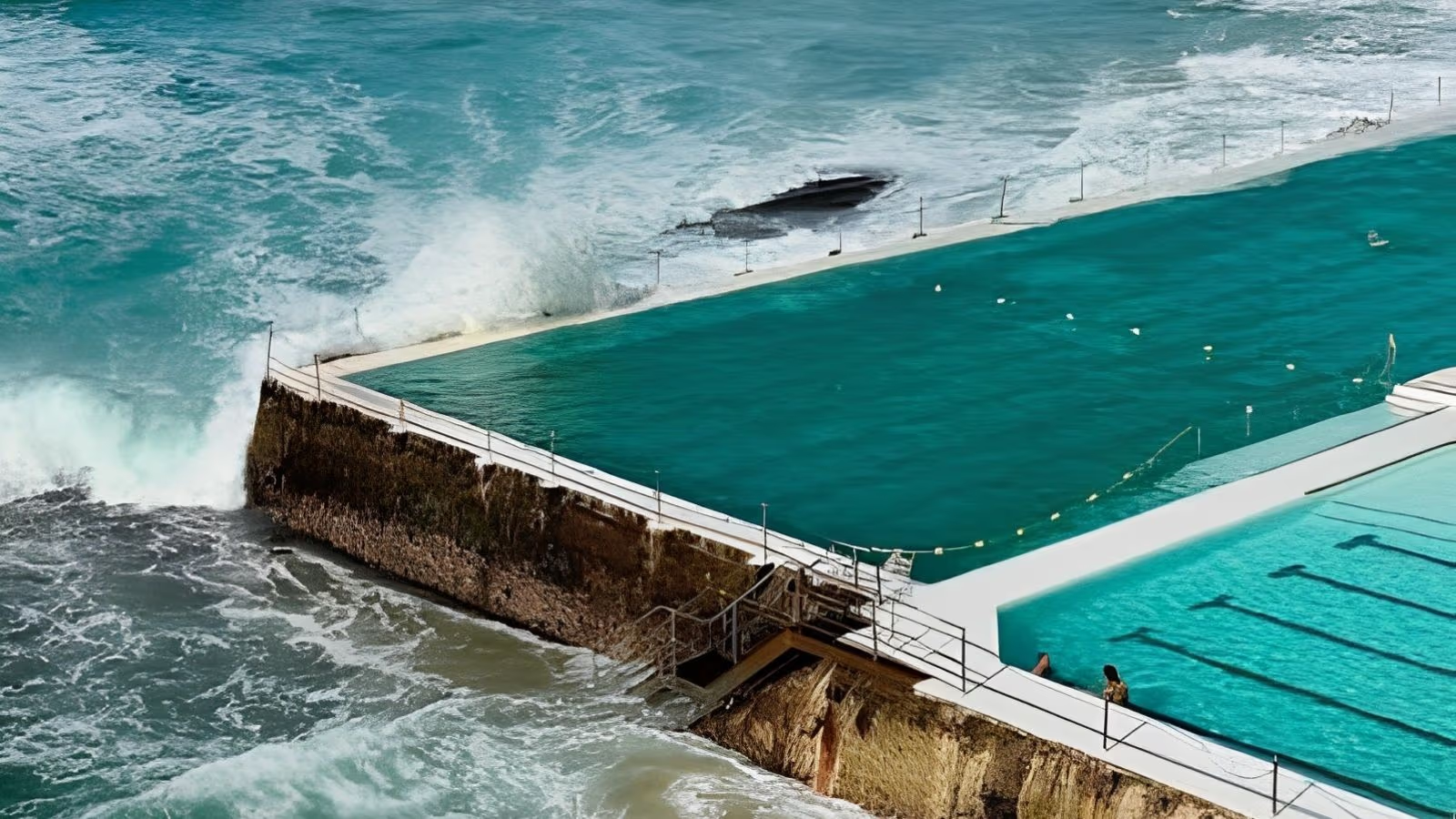
Sydney has something no other major city has: a coastline lined with swimming pools carved into the rock shelf, filled and flushed by the ocean itself. There are more than thirty of them along the metropolitan coast and about a hundred along the New South Wales shoreline — the largest concentration of ocean pools anywhere in the world. Most are free. Most are open all day, every day. And most visitors to Sydney never set foot in one, because nothing in the standard itinerary tells them these exist.
What an ocean pool actually is
An ocean pool is a swimming pool built into the rock platform at the edge of the sea, usually at the end of a beach, with one or more walls left low enough for waves to break over and refresh the water. They are not chlorinated. They are not heated. The water in them is the ocean, held still.
Most Sydney pools date from the late nineteenth and early twentieth centuries. They were built for a practical reason: the surf beaches were dangerous, ocean bathing was becoming popular, and a walled pool gave people somewhere to swim without being dragged out by a rip. That origin explains why they are where they are — almost always at the headland end of a patrolled beach, where the rock platform offered a foundation.
They are also, incidentally, the reason Australia produced so many competitive swimmers. Generations of coastal children learned in them.
Why they beat the beach on a lot of days
Sydney’s surf beaches are excellent when conditions suit. The pools are excellent when they do not, and that covers more days than people expect.
- Big swell. When the surf is too rough to swim, the pools are usually still fine — and considerably more dramatic, with waves breaking over the wall.
- Rip currents. There are none in a pool. For weak swimmers and children, this is the difference between swimming and paddling at the edge.
- Out of patrol season. Beach flags only fly during patrol hours in the warmer months. The pools are there year-round.
- Doing laps. Several are proper lane-marked fifty-metre pools, which no beach can offer.
- Crowds. Even at a busy beach, the pool at the end of it is usually quieter than the sand.
At low tide many pools are calm and clear. At high tide with swell running, waves wash across them continuously — spectacular to watch, and at some pools genuinely unsafe to be in. Check the tide before you go, not the temperature.
The eastern suburbs pools
The stretch from Bondi south to Maroubra has the highest concentration and is the easiest to reach without a car. The Bondi to Coogee coastal walk passes several of them, which makes it the best introduction to the whole idea.
Bondi Icebergs is the famous one — the fifty-metre pool at the southern end of Bondi with waves breaking over the edge, and the most photographed swimming pool in Australia. It is one of the few that charges an entry fee, and it closes one day a week for cleaning. Worth it once.
Bronte Baths, a short walk south, is free, smaller and cut into a dramatic rock shelf. Locals will tell you it is better than Icebergs, and on a quiet morning they are right.
Wylie’s Baths at Coogee is a tidal pool on a timber deck built into the cliff, and one of the most atmospheric swimming spots in the city. Small entry fee.
McIver’s Ladies Baths, also at Coogee, is a women-and-children-only pool that has operated continuously for well over a century. A nominal entry fee applies.
Mahon Pool at Maroubra is the one to go to if you want the experience without the crowds. Free, wild, and at high tide with swell running it is a genuinely spectacular place to stand.
Our Sydney beaches guide covers the beaches these sit at the end of.
The northern beaches pools
North of the harbour the pools are more spread out, generally quieter, and reward a car or a committed bus trip.
North Curl Curl and South Curl Curl are both rugged, free and beautifully sited. North Curl Curl at low tide is one of the loveliest swims in Sydney.
Freshwater, Dee Why and Collaroy form a run of large, well-maintained free pools within a few kilometres of one another — the easiest stretch to pool-hop.
Palm Beach at the far northern tip has a pool at the southern end, which is a good reason to make the trip beyond the Summer Bay filming locations most people go for.
Fairy Bower at Manly is not strictly a lap pool but a small ocean rock pool on the walk from Manly to Shelly Beach, and it is charming. Easily combined with the ferry.
Harbour and southern options
The harbour does not have ocean pools in the same sense, but it does have netted harbour baths — enclosed swimming areas in calm water. Dawn Fraser Baths at Balmain is the oldest surviving structure of its kind in Australia and worth seeing for that alone. MacCallum Pool at Cremorne Point is a small harbour pool with a view straight down the harbour to the bridge, and it is free.
South of Maroubra the coast continues into the Sutherland Shire with several more pools, of which Oak Park at Cronulla is the most accessible by train.
Practicalities
- Cost. The large majority are free. Bondi Icebergs, Wylie’s and McIver’s charge modest entry.
- Opening. Free pools are generally open at all hours. Most close periodically for cleaning — Icebergs has a fixed weekly closure. Check before making a special trip.
- Water temperature. The same as the sea. Comfortable roughly December to May, bracing June to September. Sydney locals swim year-round and are not being brave; they are just used to it.
- Footwear. Rock shelves are sharp and often covered in barnacles. Something on your feet is a good idea at the wilder pools.
- Facilities. Vary enormously. The big beach pools have changing rooms and showers; the small ones may have nothing at all.
- Safety. Pools are not patrolled the way beaches are. In big swell, water washing over a wall can knock you off your feet. If waves are breaking across the pool, watch rather than swim.
The best pool for each kind of swimmer
| You want… | Go to | Why |
|---|---|---|
| The famous one | Bondi Icebergs | Fifty metres, waves over the wall, the photograph everyone knows. Entry fee, closed one day a week |
| Proper laps | Dee Why or Collaroy | Large, lane-marked, free, well maintained |
| Somewhere quiet | Mahon Pool, Maroubra | Free, wild, spectacular at high tide, few visitors |
| Young children | Fairy Bower, Manly | Small, shallow, sheltered, ten minutes from the ferry |
| Atmosphere | Wylie’s Baths, Coogee | Timber deck built into the cliff; small entry fee |
| Women and children only | McIver’s, Coogee | Continuously operating for over a century; nominal fee |
| A harbour view | MacCallum Pool, Cremorne | Free, small, looks straight down the harbour to the bridge |
| History | Dawn Fraser Baths, Balmain | The oldest surviving structure of its kind in Australia |
If you only do one and you want the experience rather than the photograph, make it Mahon or Bronte early on a weekday.
How to build a day around them
The best single day is the Bondi to Coogee walk, done early, swimming as you go. It is about six kilometres, takes three to four hours at a proper pace with stops, and passes Icebergs, Bronte Baths, Clovelly and Wylie’s. Start at Bondi around seven in the morning in summer and you will have the first two largely to yourself.
For a quieter version, take the ferry to Manly, walk to Fairy Bower and Shelly Beach, swim, and eat lunch on the way back. That is a half-day and uses the best ferry route in the city.
For the northern beaches run you really want a car: Freshwater, Curl Curl, Dee Why and Collaroy in one morning is an excellent and almost entirely tourist-free day.
If you are working out how much time Sydney needs overall, our how many days in Sydney guide sets out what fits.
A short history worth knowing
The pools are Victorian public infrastructure, and understanding why they were built explains why Sydney has so many.
Through most of the nineteenth century, daylight sea bathing was actually prohibited on Sydney beaches on grounds of public decency. When the restrictions eased around the turn of the twentieth century, enormous numbers of people went into the water at once — and drowned, because the surf on an exposed ocean coast is genuinely dangerous and almost nobody could swim well.
The response came in two forms. The surf lifesaving movement, which began on these beaches and is now a national institution. And the pools: walled enclosures on the rock platform where the ocean could be enjoyed without the risk. Many were built by local councils, some by volunteer labour during the Depression, and a number were originally segregated by sex — which is why McIver’s at Coogee still operates as a women-and-children pool today, as it has since the 1870s.
The result is that Sydney ended up with a chain of free civic swimming infrastructure along its entire coastline, built for safety and kept because people loved it.
Etiquette and small courtesies
Ocean pools are used by locals every single day, often at dawn, and there are a few unwritten conventions worth respecting.
- Lanes are for lap swimmers. At the pools with lane ropes — Icebergs, Dee Why, Collaroy — the marked lanes are in use from early morning. Swim across them at your own risk and to nobody’s pleasure.
- Do not jump in near swimmers. Obvious, routinely ignored, and the pools are small.
- Rock platforms are habitat. The shelves around the pools hold molluscs, crabs and sea urchins. Look, do not collect; much of the coast is within protected aquatic reserves where taking anything is illegal.
- Take your rubbish. Most free pools have no staff and no bins.
- Photography. These are public swimming places used by families and by women-only groups at McIver’s. Be sensible about where the camera points.
None of it is onerous. The pools work because generations of people have treated them as shared property rather than as an attraction, and visitors who behave the same way are entirely welcome.
Why they matter
It is easy to present ocean pools as a quirky local detail. They are more than that. They are the clearest physical expression of how Sydney relates to its coast — a city that decided, more than a century ago, that everyone should be able to swim in the sea safely and for free, and then built the infrastructure to make it true.
They are also the antidote to the two complaints visitors most often have about Sydney: that it is expensive, and that the famous places are crowded. An ocean pool at eight on a weekday morning is free, empty, and better than anything on the itinerary you paid for.
Frequently asked questions
How many ocean pools does Sydney have?
Are Sydney ocean pools free?
Which Sydney ocean pool is the best?
Are ocean pools safe to swim in?
When is the best time to visit an ocean pool?
Can you swim in Sydney ocean pools in winter?
Planning a Sydney trip?
We have been running guided touring in Australia since 1974. Tell us what you want out of Sydney and we will put an itinerary around it.
Talk to a specialist