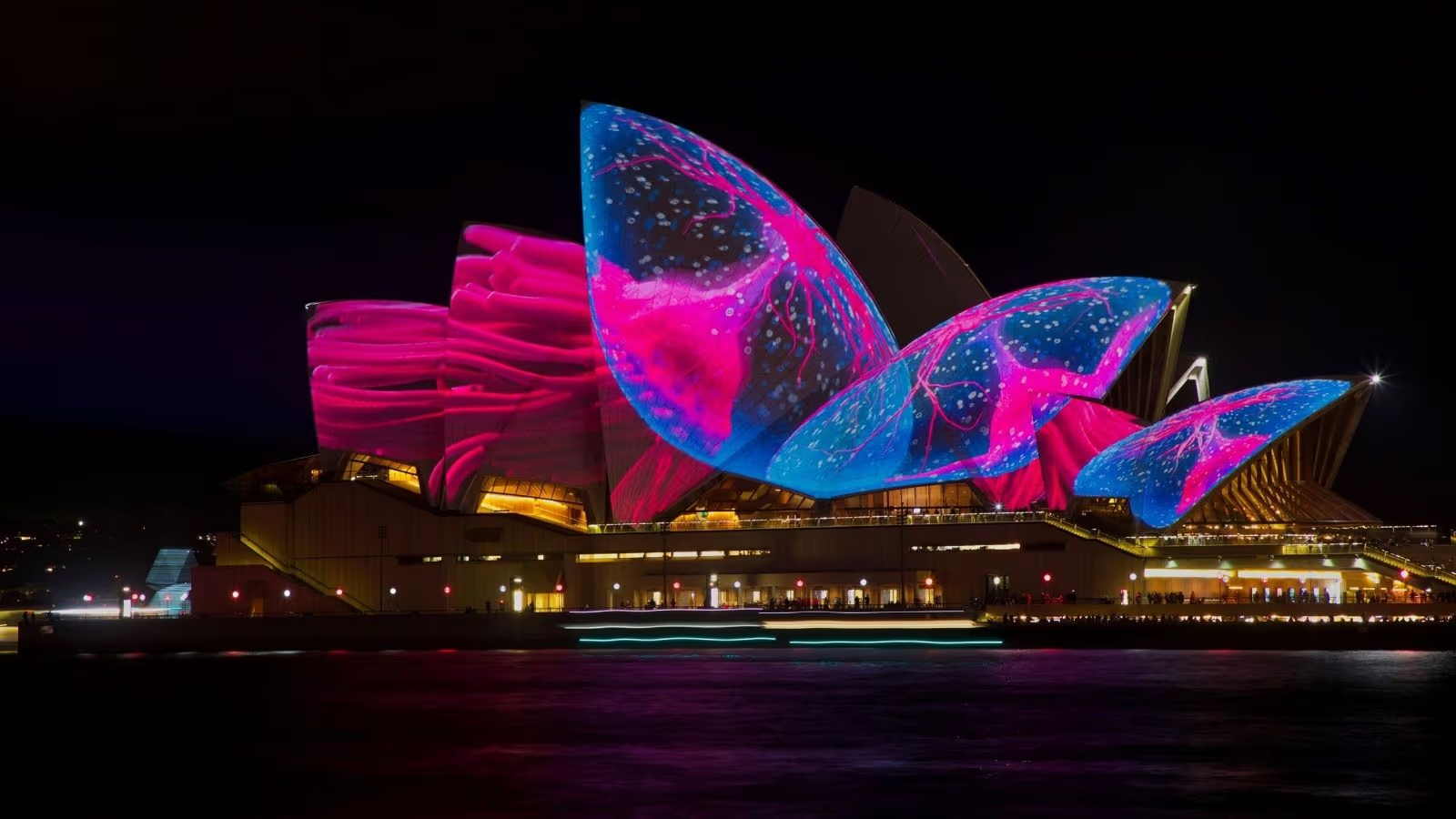
Vivid Sydney is the reason to visit Sydney in winter, and it is the single strongest argument against the idea that the city is only worth seeing between December and February. For roughly three weeks from late May into June, the harbour foreshore becomes a continuous outdoor light exhibition, the Opera House sails carry large-scale projections, and the city that normally empties out after dark fills up instead. It is free, it is genuinely good, and it is very easy to do badly.
When it runs
Vivid takes place across roughly three weeks from late May into mid-June, with installations lit from around 6pm each evening until about 11pm. The 2026 festival ran 22 May to 13 June. The official dates announced for 2027 are 28 May to 19 June.
Because the exact dates shift each year, confirm at vividsydney.com before booking flights or accommodation around it.
The timing is deliberate: late May and June is the quietest part of the Sydney tourism year, and Vivid exists in large part to fill it. That is useful to know, because it means the festival dates are the one stretch of winter when Sydney accommodation is not cheap. Rates rise sharply across the city for the duration.
Vivid produces the highest hotel occupancy of any Sydney winter period. If you want to attend, book months ahead. If you do not, check the dates before you book a May or June trip — you may be paying a festival premium for a festival you are not attending.
What Vivid actually is
Four programmes under one name, and only one of them is what most people picture.
Vivid Light is the free public part: large-scale projections, sculptural light installations along the foreshore, and interactive works. This is the festival for the overwhelming majority of attendees and it costs nothing.
Vivid Music is a ticketed programme across the Opera House, Carriageworks, City Recital Hall and smaller venues, running the length of the festival.
Vivid Minds is talks, forums and immersive experiences with writers, film-makers, musicians and thinkers. Ticketed.
Vivid Food covers chef collaborations, pop-up dining and special menus in unusual venues, from casual through to serious set dinners. Mostly ticketed.
Over eighty per cent of the overall programme is free, including the entire Light Walk. You do not need to buy anything to have a full Vivid night.
The Light Walk
The centrepiece, and the thing to plan around. The Light Walk is a continuous route along the harbour foreshore, running roughly 6.5 kilometres from Circular Quay through The Rocks and Barangaroo to Darling Harbour, with several dozen installations placed along it.
It is entirely free, entirely outdoors, and open every night of the festival from around 6pm. There is no ticket, no entry point and no queue for the walk itself — you simply join it.
Walking the whole thing takes two to three hours at a realistic pace with stops, longer on a busy night when the crowd sets the speed. Most people do not complete it, and there is no need to. Picking one or two precincts and doing them properly is a better night than route-marching the full 6.5 kilometres.
Recent editions have added daytime programming for the first time, with sculptures and installations viewable during the day around Circular Quay. If you cannot face the evening crowds, that is worth checking.
The precincts, and which are worth your night
Circular Quay and the Opera House. The heart of it and the most crowded by a wide margin. The Opera House sail projections are the signature work of the festival and genuinely worth seeing. Expect to be shoulder to shoulder between about seven and nine.
The Rocks. Installations threaded through the historic laneways, which suits the setting well. Denser and more interesting to wander than the open foreshore, and there are pubs when you need a break.
Barangaroo. Newer, more open, generally less crowded than the Quay, with room to actually stand back and look at large works.
Darling Harbour. The family end. Water and laser shows, free live music at Tumbalong Park most nights, and the widest open space. Good with children, less interesting for the art.
The Royal Botanic Garden and Taronga Zoo have hosted separate ticketed light experiences in recent years. These are distinct from the free walk and sell out, so check the programme early if either appeals.
Precincts change between editions — some years include Walsh Bay, Central Station or Martin Place, some do not. Check the current map rather than assuming.
How to avoid the worst of the crowds
This is the single biggest determinant of whether you enjoy Vivid.
- Go midweek. Friday, Saturday and Sunday are dramatically busier. A Tuesday or Wednesday night at the same installations is a different, far better experience.
- Go early in the festival run. The first week is quieter than the last, and the final weekend is the worst of the lot.
- Start at 6pm sharp, or after 9pm. The peak crush is roughly 7 to 9. Arriving as the lights come on gives you an hour of relative calm; staying late gives you the same at the other end, and the installations run to about 11.
- Walk against the flow. Most people start at Circular Quay and head west. Start at Darling Harbour and walk east and you will meet the crowd rather than move inside it.
- Skip the Opera House on a Saturday. If your only night is a weekend, see the sails from across the water instead — from a ferry, from Blues Point, or from the north side of the harbour.
Seeing it from the water
The best-value Vivid experience is not on the Light Walk at all. It is a regular Sydney ferry.
Ferries run their normal timetables through the festival at normal fares, and the harbour crossing gives you the Opera House sails, the bridge and the foreshore installations from the water — the view that the paid cruises charge substantially for. The Manly, Taronga and Cremorne Point services all give you a good look, and you can ride out and back for the cost of a capped fare.
Sit on the deck facing the city, dress for wind, and go after dark.
Paid Vivid cruises exist in large numbers and range from dinner boats to short harbour loops. They are not bad, but you are paying a considerable premium for a view a public ferry delivers. If you want to be on the water with a drink and a table, they make sense; if you just want the view, they do not. This is the same logic as the rest of the year, covered in our Sydney on a budget guide.
What to wear and bring
People underdress for this constantly. Sydney in late May and June is mild by northern-hemisphere standards but the festival is outdoors, at night, beside water, for several hours, and the wind off the harbour is genuinely cold.
- A proper jacket, plus a layer under it. Evening temperatures commonly sit around ten to fourteen degrees and feel colder on the foreshore.
- Comfortable shoes. You will walk further than you plan to.
- A charged phone and a battery pack. Cold drains batteries and you will take more photographs than you expect.
- Contactless card or phone for transport. The network is the only sensible way in and out.
- Rain jacket rather than umbrella. Vivid runs in all but the most extreme weather, and umbrellas in a dense crowd are miserable for everyone.
Getting there and away
Do not drive. Central Sydney parking is expensive at the best of times and the festival area has road closures and heavy pedestrian traffic. Public transport is the only sensible answer.
Circular Quay, Wynyard, Town Hall and Martin Place stations all put you within walking distance of a precinct, and the light rail runs down George Street through the middle of it. Services run more frequently during the festival, but they are also very full between about nine and eleven when large numbers leave at once.
The trick, as with the crowds, is to leave either before or after that window. Or walk one station further out and board somewhere less congested — from Circular Quay, walking up to Wynyard or Martin Place usually gets you a train faster than queuing at the Quay.
Our Sydney transport guide covers fares and the daily caps, which are worth knowing since a Vivid night will involve several legs.
Vivid with children
It works well, with adjustments.
Go at 6pm, not 8pm. The lights come on at dusk and the first hour is both calmer and early enough for younger children.
Choose Darling Harbour. It is the most child-oriented precinct, with open space, water shows and free live music, and it is far less crowded than the Quay.
Do one precinct, not the walk. The full 6.5 kilometres is too much for small legs, and the crowd density at the Quay is genuinely difficult with a pram.
Eat before you go. Restaurants in the festival precincts are heavily booked and the queues are long.
More on family logistics in our Sydney with kids guide.
Where to eat and drink during Vivid
The festival precincts are the worst place to eat during Vivid and the most obvious, which is a bad combination. Restaurants along Circular Quay and the Rocks are fully booked weeks ahead, run set festival menus, and charge accordingly.
Three better approaches. Eat early — a five o’clock table before the lights come on is far easier to get and means you walk on a full stomach. Eat one suburb out — Surry Hills, Potts Point and Chinatown are all within a short walk or one stop of the festival and are not running festival pricing. Or eat afterwards, after nine, when the crowds thin and kitchens have capacity again.
The Vivid Food programme itself is a separate thing: chef collaborations, pop-up dining and special menus in unusual venues, some casual and some serious. If food is a reason for your trip, that programme is announced with the rest and is worth booking when it opens rather than deciding on the night.
Tumbalong Park at Darling Harbour runs free live music most nights of the festival, and the food options around it are more casual and less pressured than the Quay. Our Sydney eating guide covers where the value sits year-round.
Is it worth planning a trip around?
Yes, with one qualification.
Vivid is the best reason to visit Sydney in winter, and winter Sydney is otherwise underrated — clear light, mild days, whales offshore, and none of the summer crowding. A trip built around the festival gets you the city at its quietest and one genuinely world-class free event.
The qualification is that accommodation is the exception to winter pricing. You will pay summer-adjacent rates for the festival period, and if Vivid is not the point of your trip you are better off travelling in the weeks either side.
If you are weighing up when to come more broadly, our best time to visit Sydney guide and the national Australia seasonal guide both cover the trade-offs.
Frequently asked questions
When is Vivid Sydney?
Is Vivid Sydney free?
How long does the Vivid Light Walk take?
What is the best night to go to Vivid?
Do I need to book a Vivid cruise?
Is Vivid Sydney good for kids?
Does Vivid run in the rain?
Planning a Sydney trip?
We have been running guided touring in Australia since 1974. Tell us what you want out of Sydney and we will put an itinerary around it.
Talk to a specialist