

The Thailand of the photographs, done from north to south in its season: Phuket for the island and Phang Nga Bay, Khao Lak for the calm coast and the Similan Islands, Krabi for Railay and the Four Islands, and Koh Lanta to finish with nothing planned. Four bases, four boat days, a car between them, and the coast that is only open from November to April.
The west coast of southern Thailand faces the Andaman Sea and holds the scenery the country is famous for: sheer limestone towers rising from green-blue water, longtail boats, and beaches reached only by sea. It also has the sharpest season in the region — dry, calm and clear from November to April, and closed by the south-west monsoon from May to October, when the national parks shut and the beaches fly red flags. This route takes the whole coast in its season, north to south, with a boat day at each base: Phang Nga Bay from Phuket, the Similans from Khao Lak, the Four Islands from Krabi, the southern islands from Lanta. It is the second Thai trip for most people and the first for those who came for the water. The Gulf coast, on the opposite calendar, has its own route on the Gulf islands page; the things to do in Thailand page explains the two.
Why this route
Because the Andaman is the best coast in Thailand and it is open for six months, and a trip that gives it one resort for a week sees a tenth of it. Phang Nga Bay, the Similans, Railay and the southern islands are four different kinds of extraordinary and they are two hours apart; the road down the coast is easy and the boats at each stop are the day. Four bases in thirteen days lets each one breathe — a boat day, a beach day, a loose day — and the order runs from the busiest (Phuket) to the quietest (Lanta) so the trip winds down. It is the route we build for people who have done Thailand and want the water, and for people who have not and want it first.
At a glance
| Duration | 13 days / 12 nights |
|---|---|
| Route | Phuket (3) → Khao Lak (3) → Krabi / Ao Nang (3) → Koh Lanta (3) |
| Fly | Into Bangkok and on to Phuket; home from Krabi via Bangkok on one ticket |
| Best months | November to April only; December–January and Easter are the peaks; November and March the value |
| Pace | Moderate: four bases, a boat day at each, a car or a two-hour boat between them |
| Style | Private itinerary; drivers on the island days; small-group or private boats; resorts chosen for the beach |
| Suits | Couples, families with children over five, snorkellers and divers, second trips to Thailand, photographers |
| Accommodation | Resorts at Kata or Phuket’s north, Khao Lak, Ao Nang or Railay, and Lanta’s west coast |
| Price | Quoted per departure in AUD |
Day by day
Day 1: Arrive Bangkok, connect to Phuket
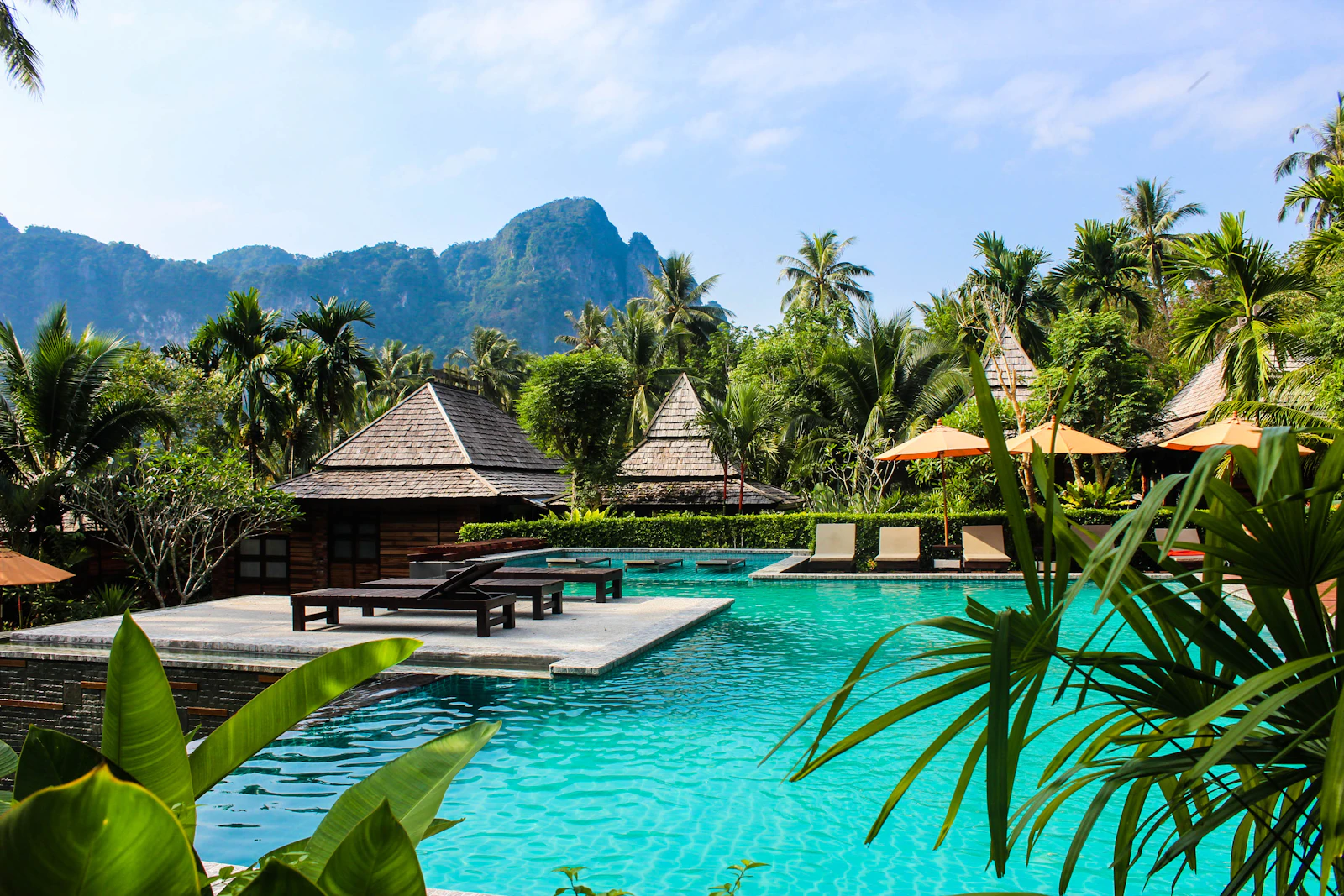
The morning arrival at Suvarnabhumi and the 90-minute connection to Phuket on the same ticket. A private transfer across the island to Kata or the northern beaches, the pool, the water, the sunset from the sand. November to April is dry, calm and clear on this coast and the itinerary does not exist outside it.
Day 2: Phuket: the island
A car and driver: the Big Buddha on its hill at eight, Wat Chalong, Phuket’s Sino-Portuguese old town for the shophouses, the street art and a coffee, lunch at a local restaurant, and the afternoon at the beach. Promthep Cape at sunset with the rest of the island, then dinner in the old town or on Rawai’s seafood front.
Day 3: Phang Nga Bay
A speedboat or, better, a slower boat into the bay of limestone towers: James Bond Island (Khao Phing Kan) before the crowds, the sea caves of Koh Panyee’s stilt village by kayak, the hongs (hidden lagoons) reached through tunnels at low tide, lunch on the boat or in the village. Back by four.

Day 4: Phuket to Khao Lak
An hour north by private car to the calm resort coast of Khao Lak, long beaches backed by casuarina and a fraction of Phuket’s traffic. The afternoon at the resort; the evening at the small town’s night market.
Day 5: The Similan Islands
The day trip that is one of the best snorkelling and diving days in Asia: a speedboat from Khao Lak to the nine granite islands of the Similans, 70 km out, with their white beaches, the Donald Duck Bay boulder, and reefs of soft coral, turtles and reef fish in water of 30-metre visibility. Two or three snorkel stops, lunch on the beach at island four, and back by four. The park is open from mid-October to mid-May and this route is timed for it; divers take the liveaboard version. The Similans are the reef every other reef on the coast is measured against — granite rather than limestone, boulders the size of houses above and below the water, and visibility that makes the fish look painted — and the only thing wrong with them is that everyone knows, which is why the boat leaves at eight.
Day 6: Khao Sok, or the beach
A choice at booking. Khao Sok National Park, ninety minutes inland: the limestone karsts of Cheow Lan lake by longtail, the floating raft houses, a jungle walk, and the possibility of hornbills and gibbons — either as a long day or as an overnight on the lake in place of a Khao Lak night. Or the beach, the pool and the spa.
Day 7: Khao Lak to Krabi
A private car around the bay, three hours, or the Phuket–Krabi road via the Sarasin bridge; the Krabi coast by lunch, and the afternoon at Ao Nang or, by longtail, at Railay, the peninsula reachable only by boat, with the cliffs, the cave beach and the climbers.
Day 8: The Four Islands
The Krabi day: Poda, Chicken, Tup and Phra Nang by longtail, the sandbar at low tide, the Phra Nang cave beach under Railay’s cliffs, snorkelling off Poda, lunch on the sand. Or the Hong Islands by speedboat, further out and quieter. The small boat, the early departure.
Day 9: Railay and the cliffs
A day on the Railay peninsula: East Railay’s mangroves, West Railay’s beach, the Phra Nang cave and its shrine, a climbing lesson for those who want it on the limestone that made the place famous, the Diamond Cave, and the sunset from the beach. Dinner at the cliffside, with the longtails pulled up on the sand below and the climbers coming down off the last routes in the dusk.

Day 10: Ferry to Koh Lanta
The morning speedboat or ferry from Ao Nang, two hours down the coast, to the long quiet island of Koh Lanta: nine beaches on the west coast, a Muslim fishing community and an old town of Chinese shophouses on the east, and a national park at the southern tip. The resort on Long Beach or Klong Nin; the afternoon in the water. Lanta is the island the coast keeps for last: no airport, no strip, a speed limit that nobody breaks, and the sunset in the right direction.
Day 11: Lanta: the island
A car around the island: the old town’s stilt houses over the sea, the lighthouse and the beach at the national park, lunch at a fishing-village restaurant, and the afternoon at the beach; or the boat to Koh Rok for the snorkelling, or the Four Islands south (Koh Ngai, Koh Mook and the Emerald Cave, Koh Kradan) for a day among the quietest islands on the coast.
Day 12: Lanta: the loose day
Nothing planned. The beach, a massage, a longtail, the sunset from the west coast, which faces it. The last dinner on the sand, at the restaurant that has been the good one all week, with the lights of the fishing boats out on the water.
Day 13: Depart
A speedboat back to Krabi or a car to Krabi airport (two hours via the car ferries), the flight to Bangkok and the connection home on one ticket. Thirteen days, four bases, the whole Andaman coast in its season, and the reef at the Similans to measure every other reef against. The Krabi flight is on the international ticket and the Bangkok transit is airside; if the party would rather end in Bangkok for a last Chinatown dinner, a night there is the usual add-on.
Variations and extensions
Ten days, three bases: Phuket three, Khao Lak three, Krabi three, home from Krabi; the version without Lanta for shorter leave. Eight days, two bases: Khao Lak four and Krabi three — the Similans and Railay, the two things this coast has that no other does. With Bangkok: three nights in the capital first on the Bangkok and the beaches shape. The dive version: a Similans liveaboard of two to four nights from Khao Lak in place of the Khao Lak beach days — Richelieu Rock, Koh Bon’s mantas, Koh Tachai — and a Koh Lanta dive day at Hin Daeng and Hin Muang, among the best sites in Asia. Koh Lipe: the far-south island near the Malaysian border, with the clearest water on the coast, as a three-night finish instead of Lanta, by speedboat from Lanta or from Pak Bara; harder to reach and worth it. Koh Yao Noi: the quiet island between Phuket and Krabi, for couples, in place of Ao Nang. Khao Sok overnight: a night in the floating raft houses on Cheow Lan lake between Khao Lak and Krabi, for the jungle and the karsts from the water. Phi Phi: a day from Phuket or Krabi when Maya Bay is open, or a night on the island for the sunset without the day boats.
What a day looks like. Boat days leave at eight and are back by four, with the reef stops before the day trippers from the bigger resorts arrive and lunch on a beach; beach days start whenever and involve a longtail to the next bay if the mood takes; the loose day in each base is the one that turns four resorts into a holiday. Sunscreen at seven, a rash vest and reef shoes in the dry bag, and the driver’s number for the day the plan changes. Dinner is on the sand almost everywhere and the coast goes quiet by ten outside Patong and Ao Nang’s front. Thirteen days sounds long for a coast; it is the number at which the four boat days stop feeling like a schedule.
Eating on this route
The Andaman coast is southern Thai cooking, the hottest in the country, and seafood. Phuket: the old town’s Hokkien-Thai dishes (the moo hong braised pork, the o-tao oyster omelette, the roti at the Muslim stalls), the Sunday walking street, seafood on Rawai’s front chosen from the tanks and grilled by the restaurant across the road, and the Blue Elephant for the royal-Thai version. Khao Lak: the night market, the beach restaurants along Bang Niang, and the resorts’ own kitchens, which on this stretch are good. Krabi: the town’s night market by the river, Ao Nang’s seafront, the cliffside at Railay, and the Muslim-Thai food of the province — the massaman, the khao mok gai biryani, the roti with condensed milk. Lanta: the old town’s fishing restaurants over the water, the beach barbecues at Long Beach, and the Muslim village’s morning market. Southern curries use turmeric, fresh chilli and fermented shrimp and are fierce; every kitchen makes them mild on request, and grilled fish, satay and fried rice are the mild default. Lunch on the boat days is on the sand and included. The Asia food guide has the Thai section.
What is included
- Return economy airfare from Sydney, Melbourne or Brisbane, open-jaw where the route allows; premium economy and business on request
- All internal flights, ferries and speedboats named in the itinerary, ticketed
- Private airport and hotel transfers throughout, and a car and driver on the touring days
- Accommodation as described with breakfast; villas with a cook where named
- Guides on the days named, licensed and English-speaking
- Pre-booked entries and experiences named in the itinerary
- Thailand Digital Arrival Card guidance and entry checks for every traveller
- A day-by-day document with maps, timings and restaurant suggestions
- Australian consumer-law protection and a Cooee contact in Brisbane throughout
- The Bangkok–Phuket and Krabi–Bangkok flights on the international ticket
- Private cars Phuket–Khao Lak, Khao Lak–Krabi and to Krabi airport
- The Ao Nang–Lanta speedboat
- Four boat days — Phang Nga Bay, the Similans, the Four Islands, and a Lanta boat — on small-group or private boats
- A car and driver for the Phuket and Lanta island days
- Similan national park fees
Not included
- Lunches and most dinners
- Travel insurance (required)
- Personal spending, optional experiences not named, and tips (modest and appreciated in Thailand: about 10 per cent at restaurants without a service charge, small notes for drivers and porters)
- Boat and dive trips beyond those named
- The Khao Sok overnight and the Railay climbing lesson, booked on request
- Similans liveaboard diving (two to four nights), quoted separately
Where you stay
Phuket: Kata or Karon for families, the northern beaches (Bang Tao, Surin, Nai Thon) for quiet and the top resorts (Trisara, the Amanpuri, the Banyan Tree), Nai Harn for the south; never Patong unless the nightlife is the point. Khao Lak: the calm-coast resorts along Bang Niang and Khuk Khak — the Sarojin, the JW Marriott, the Casa de la Flora, or a dozen good mid-range beachfront properties — with the Similan speedboats leaving from the pier down the road. Krabi: Ao Nang for choice and the boats, or Railay for the setting (the Rayavadee at the top, the Railay Village and the Sand Sea for mid-range), where the resort is reached by longtail and the cliffs are the view. Lanta: the west-coast beaches — Long Beach for the choice, Klong Nin and Kantiang Bay for quiet, the Pimalai at the top — and the simplest accommodation on the route, which we say. Every resort is chosen for the beach it sits on; on this coast the sand is the point.
What it costs
Thirteen days for two in mid-range resorts at all four bases, with the four boat days and the cars, in November or March, is the version most people book; Christmas–New Year adds half again on the resorts and the flights, and the boats and the park fees do not move. We do not publish a from-price because two factors move it by thousands: the season (Christmas–New Year and the July school holidays cost 30–50 per cent more than early November or May on flights and resorts combined) and the resort tier (a four-star with a kids’ club against a five-star with a pool villa). We quote every departure individually in Australian dollars with everything above included. The South-East Asia guide sets out the underlying daily numbers, and Thailand’s own costs article is in the journal queue. Railay and the northern Phuket resorts are the upper tier; Khao Lak and Lanta are where the value lives.
Practical notes
Entry: Australians enter Thailand visa-free for 60 days; the Thailand Digital Arrival Card is completed online before you fly and we send the link. Passports need six months’ validity. Health: hepatitis A and typhoid vaccinations are recommended; dengue is present year-round and repellent morning and dusk is the defence; bottled or filtered water; hot food from busy places; a travel doctor six weeks out. Hospitals in Bangkok, Phuket, Samui and Chiang Mai are excellent and insurance is required. Money: baht; cards at hotels and good restaurants, cash for markets, stalls, drivers and temples; ATMs everywhere. Heat: every month is hot; the itinerary puts the outing in the morning and the pool in the afternoon. Temple dress: shoulders and knees covered, shoes off; the Grand Palace enforces it at the gate. Etiquette: heads are sacred and feet are lowly; the royal family is protected by law; lose your temper and you lose the argument. Motorbikes: the leading cause of Australian injuries in Thailand; not hired on our itineraries. Apps: Grab for rides, Google Maps, Google Translate’s camera for menus. Season, absolutely: the Similan and Surin marine parks close from mid-May to mid-October; the beaches fly red flags; the boats are cancelled. We do not route the Andaman outside November to April, and the shoulder weeks of late October and early May are booked with a warning. Boats: speedboats are fast and rough; the slower boats are kinder and the ones we prefer for families and for anyone who has been seasick; life jackets in every size are checked before we book; the early departure is the whole difference at the Similans, the Four Islands and Maya Bay. Maya Bay: reopened with a visitor cap and closed for part of the year; a Phi Phi day can be added from Phuket or Krabi on the days it is open. Rips: Phuket’s west coast has them even in the dry season and the beaches are flagged; the resorts we book have lifeguards or calm bays. Sun and reef: mineral sunscreen, rash vests, reef shoes; do not stand on the coral; the boats we use anchor on buoys. Jellyfish: rare in the dry season; the boats carry vinegar. Families: Kata, Khao Lak and Lanta are the family bases; Phang Nga Bay with kayaks and the Four Islands sandbar are the children’s days; the Similans are for confident swimmers over about eight. Older travellers: Khao Lak and Lanta for the calm and the flat; the Similans by the slower boat; a car for every transfer; Railay by longtail with the boatman’s hand.
How to book
Send us your preferred dates, your departure city and the names and ages of the party through the enquiry form or on 0409 661 342. We check the season against the route, confirm availability at the hotels and inns that matter, and send an itinerary and a quote in Australian dollars within two working days. A deposit holds the booking; the balance is due before departure under our booking conditions. Travel insurance is required and we can recommend a policy.
Frequently asked questions
How many days is the Andaman Coast itinerary?
Thirteen days and twelve nights. It can be shortened or extended; the day-by-day above is the shape we start from.
When is the best time for the Andaman Coast itinerary?
November to April, and only then: the coast is dry, calm and clear, the marine parks are open and the boats run. December–January and Easter are the peaks; November and March are the value months with the same weather. From May to October the coast is in monsoon and the Gulf islands are the Thailand to book instead.
Is this a group tour or a private itinerary?
A private itinerary built for your party and your dates, not a fixed-departure group. Guides and drivers join on the days named; the rest is independent with everything pre-booked.
Are flights included?
Yes: return economy from Sydney, Melbourne or Brisbane, open-jaw where the route allows, plus every internal flight and ferry named. Premium economy and business on request.
Do Australians need a visa for Thailand?
No — 60 days visa-free. The Thailand Digital Arrival Card is completed online before departure and we send the link with the pre-departure pack.
Who is this itinerary for?
Couples and honeymooners; families with children over about five who are confident in the water; snorkellers and divers, for whom the Similans are the reason; photographers, for whom Railay and Phang Nga Bay are; and anyone on a second Thai trip who did Bangkok and a beach and wants the coast done properly.
Is Thailand safe?
Yes, with the ordinary cautions: traffic (we do not hire motorbikes), water and food (bottled water, busy stalls), sun and rips on the beaches, and petty scams around the famous sites, which a driver and a guide remove. Smartraveller rates Thailand at “exercise a high degree of caution” with regional notes we follow.
How much does it cost?
Quoted per departure in Australian dollars with flights, internal flights, transfers, accommodation, drivers, guides and named experiences included. Season and resort tier move the total; the South-East Asia guide shows the underlying numbers.
Related
Tours convert; things to do informs. If you are still choosing, the things-to-do page is the step before this one.