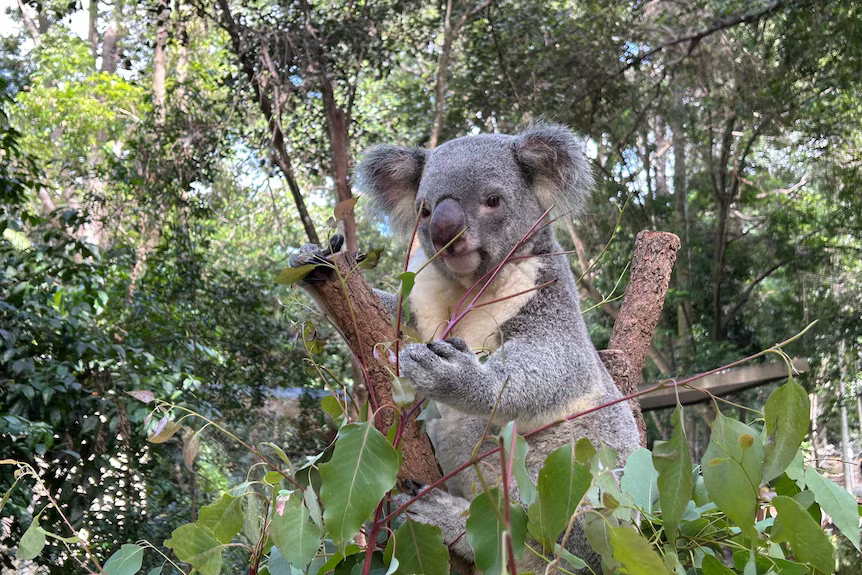
The world's first and largest koala sanctuary, opened at Fig Tree Pocket in 1927 and still the reason most visitors to Brisbane end up holding a koala. Twenty minutes from the CBD by road, seventy-five by river.
✍️ By Frank Adam Burns📅 Updated 2026📍 Brisbane, QLD
📅
1927
World's first sanctuary
🚗
~25 min
From the CBD
🚤
75 min
By river cruise
⏱
3 hrs
Allow at least
Lone Pine opened in 1927 and is the oldest and largest koala sanctuary in the world. It sits on a bend of the Brisbane River at Fig Tree Pocket, about twelve kilometres upstream from the CBD, and it is the single most common answer to "where do I see a koala in Brisbane".
Holding a Koala
Queensland is one of the few places in Australia where holding a koala is legal, and this is where most Brisbane visitors do it. The rules exist for the animal's welfare and are worth understanding before you queue.
Each koala works a strictly limited roster with mandated rest days, which is why holding sessions run at set times rather than continuously. A keeper places the animal on you rather than handing it over, and staff take the photograph. The whole thing takes about a minute.
It is a separate paid experience from general admission and it books out on busy days, particularly in school holidays. If it is the reason someone in your group wants to come, secure it rather than assume.
The Kangaroo Paddock
The part most people remember is not the koalas. The kangaroo paddock is a large open enclosure you walk into, with free-roaming kangaroos and wallabies that you can hand-feed with food bought at the gate.
There is no barrier and no queue — you simply walk among them. For many visitors, particularly children, this is the strongest half-hour of the day.
Everything Else
The sanctuary is larger than its name suggests. Alongside the koalas there are dingoes, wombats, Tasmanian devils, echidnas and a platypus house — one of the few places to reliably see a platypus, since they are nocturnal and almost never seen in the wild.
The sheepdog show and the bird of prey presentation run to a daily schedule and are worth timing your visit around. There are also reptiles, a barn area and extensive open lawn.
How Long to Allow
Three hours is the minimum for a proper visit; a half day is more comfortable, particularly with children or if you want to catch both scheduled shows.
People who budget an hour consistently regret it. The site is spread out and the shows are timed, so a rushed visit means missing most of what makes it worth the trip.
Getting There by River
The road trip is about twenty-five minutes from the CBD, or a straightforward bus at Queensland's 50-cent flat fare.
The better option is the river. A cruise upstream to the sanctuary takes about seventy-five minutes each way and passes the Kangaroo Point cliffs, the university reach and the riverside suburbs. It turns the transfer into part of the day rather than a means to an end, and it is the version we recommend when time allows.
Lone Pine or Australia Zoo?
The comparison every Brisbane visitor makes, and the answer depends on the day you have.
Lone Pine is twenty-five minutes away, cheaper, koala-focused and comfortably done in a morning. Australia Zoo is an hour north at Beerwah, considerably larger and more expensive, and a full day covering animals from every continent.
If holding a koala and being back in the city for lunch is the goal, Lone Pine wins easily. If you want crocodile shows, tigers and elephants across a whole day, that is Australia Zoo and Lone Pine is not a substitute.
Why 1927 Matters
Lone Pine opened at a point when koalas were being shot in enormous numbers for their fur. Queensland's open seasons in the 1910s and 1920s killed millions of animals, and the 1927 season in particular caused a public outcry that contributed to the trade being shut down.
The sanctuary was founded in that context by Claude Reid, as a refuge for animals that had nowhere else to go. It began with two koalas, Jack and Jill, on a site at Fig Tree Pocket chosen for its eucalypt stands.
That origin explains the sanctuary's character. It is not a zoo that added koalas — it is a koala refuge that grew, which is why the collection is almost entirely Australian and why the koala husbandry is the part it does best.
It remains the oldest and largest sanctuary of its kind anywhere, and it has supplied animals and expertise to institutions internationally.
What the Koalas Actually Eat
The feeding operation is the part visitors do not see and the reason the place works.
Koalas eat eucalyptus leaves almost exclusively, they are fussy about species, and they will reject leaf that is not fresh. The sanctuary runs its own eucalypt plantations and cuts fresh browse daily, rotating between species because individual animals have preferences that change.
Eucalyptus is low in nutrition and mildly toxic, which is why koalas sleep up to twenty hours a day — the energy budget simply does not allow for more activity. It is also why a koala that looks inert is behaving completely normally rather than being unwell.
Understanding that before you arrive changes the visit. People who expect an animated animal are disappointed; people who understand the biology find the stillness interesting.
The Welfare Rules Around Holding
Queensland permits koala holding under conditions that are stricter than most visitors realise, and it is worth knowing what they are.
Each animal works a limited roster with mandated rest days and a capped number of handling sessions. A keeper places the koala on you rather than handing it over, and you are positioned rather than instructed — the animal's comfort determines the posture, not the photograph.
Sessions run at set times because of the roster, not for crowd control. If a particular animal is unsettled it is withdrawn, and that decision sits with the keeper.
New South Wales and Victoria do not permit holding at all, which is why this is a Queensland experience specifically and why it draws people who have travelled a long way for it.
The Kangaroo Paddock in Practice
The paddock is a large open enclosure with free-roaming eastern grey kangaroos and wallabies, and you walk in among them with feed bought at the gate.
A few things make the difference between a good half hour and a frustrating one. Go early or late — kangaroos rest through the middle of the day and will not approach. Crouch rather than stand over them. Hold feed flat on an open palm. And let the animals come to you; chasing one guarantees it moves away.
They are wild animals in a managed setting rather than pets, and larger males in particular should be given space. Staff supervise and will tell you if an animal is best left alone.
The Platypus, and Why It Is Rare
The platypus house is one of the few places anywhere you can reliably see the animal, and that rarity is worth understanding.
Platypuses are nocturnal, semi-aquatic, extremely shy and live in burrows along freshwater creek banks. They are present in South-East Queensland waterways in reasonable numbers and almost never seen — people who live beside platypus creeks for years may never spot one.
They are also notoriously difficult to keep, and only a small number of institutions worldwide hold them. The enclosure is kept dim to match their activity cycle, so allow your eyes to adjust and be patient rather than passing straight through.
The Shows, and When to Time Them
The sheepdog show demonstrates working kelpies and border collies moving sheep, and it is genuinely skilled rather than a novelty — these are the dogs that make Australian pastoral agriculture possible on the scale it operates.
The birds of prey presentation flies wedge-tailed eagles, barn owls and kites, and the wedge-tail is the one people remember: it is Australia's largest raptor with a wingspan over two metres.
Both run to a daily schedule that is posted at the entrance. Building your visit around them rather than hoping to catch them is the difference between three good hours and three scattered ones.
Questions About Lone Pine
Yes — Queensland is one of the few places in Australia where it is legal. It is a separate paid experience, runs at set times because each koala works a limited roster, and books out in school holidays.
It opened in 1927 and is the world's first and largest koala sanctuary.
Three hours minimum, half a day comfortably. People who budget an hour consistently regret it.
Yes — the kangaroo paddock is a walk-in enclosure with free-roaming kangaroos and wallabies, and food is available at the gate.
About 25 minutes by road, or a bus for 50 cents. The river cruise takes around 75 minutes each way and is the more enjoyable option.
Yes — there is a dedicated platypus house, which is one of very few reliable places to see one, since they are nocturnal and rarely seen in the wild.
Different propositions. Lone Pine is closer, cheaper and koala-focused — a morning. Australia Zoo is an hour north, much larger and a full day.
Cooee Tours acknowledges the Turrbal and Yuggera (Jagera) peoples as the Traditional Custodians of the land on which Brisbane stands. We pay respect to Elders past, present and emerging.
See It With a Local
Lone Pine and a river cruise make one of the better half-and-half Brisbane days. Family owned and operating in South-East Queensland since 1974.