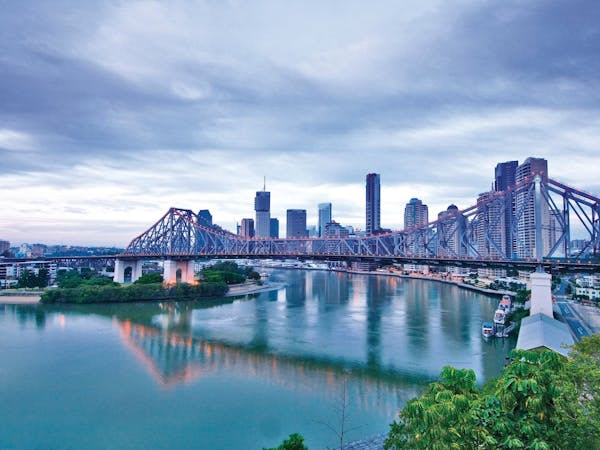
777 metres of steel cantilever, opened in 1940, and the largest bridge of its kind designed, built and fabricated in Australia by Australians. You can drive it, walk it, ride it or climb over the top of it.
✍️ By Frank Adam Burns📅 Updated 2026📍 Brisbane, QLD
📏
777 m
Total length
⬆
74 m
Height at the top
📅
1940
Opened 6 July
🚶
Free
To walk across
The Story Bridge is the structure Brisbane puts on its postcards, and unlike most landmarks it is genuinely useful — a working road bridge carrying traffic, cyclists and pedestrians between Kangaroo Point and Fortitude Valley. It is also free to walk across, which makes it one of the better no-cost things to do in the city.
The Numbers and the History
Construction began in May 1935 and the bridge opened on 6 July 1940 to a crowd of 37,000 people. It runs 777 metres end to end, stands 74 metres at its highest point, and its longest span reaches 282 metres with about 30 metres of clearance above the river at mid-span.
It was designed by John Bradfield — the engineer behind the Sydney Harbour Bridge — and built by Evans Deakin and Hornibrook Constructions. What makes it locally significant is that it is the largest steel bridge designed, fabricated and constructed in Australia by Australians, at a time when that was not the norm.
During construction it was called the Jubilee Bridge for King George V. By 1940 it had been renamed for John Douglas Story, the public servant who had pushed hardest for a crossing at Kangaroo Point. The bridge is heritage-listed and repainted roughly every seven years, which takes around 17,500 litres of paint across some 105,000 square metres of steel.
Walking Across It
There are footpaths on both sides and the walk takes about fifteen minutes end to end. The eastern side gives you the better view downstream towards the river mouth; the western side looks back at the CBD.
It is genuinely worth doing at least one way. The bridge is high enough that the city arranges itself below you, and the mid-span is the single best free vantage point over the Brisbane River. Traffic noise is constant, so it is a viewing walk rather than a peaceful one.
Both ends connect to something. The Kangaroo Point side drops to the cliffs and the riverside parks; the Fortitude Valley side descends to Howard Smith Wharves directly underneath.
The Story Bridge Adventure Climb
The climb takes you up the structural steel to the apex, 74 metres above the water, and it is one of only three bridge climbs in the world. Groups are harnessed to a static line, and the guides talk through the construction history on the way up.
The view from the top takes in the CBD, Kangaroo Point, the river in both directions and, on a clear day, the ranges beyond the city. Dawn and twilight climbs are the ones that book out.
It is a ticketed third-party experience rather than something Cooee operates, and it has minimum age and fitness requirements — check those before booking rather than at the briefing.
Howard Smith Wharves, Underneath
The precinct directly below the bridge on the CBD side is a former shipyard and wharf area, derelict for decades and redeveloped into one of Brisbane's better riverside destinations.
It now holds a brewery, several restaurants, bars and open parkland along the water, with the bridge structure directly overhead — which is the point. Arriving on foot from the CBD along the Riverwalk, or by CityCat to Holman Street and across, is more pleasant than driving.
Photographing the Bridge
The best angles are not from the bridge itself. Kangaroo Point at river level gives you the full span with the CBD behind it, and the cliffs above give elevation. Wilson Outlook Reserve at New Farm is the classic long view.
The bridge carries an LED lighting scheme that changes colour for events and causes, so it photographs differently through the year. Twenty minutes after sunset is the window — the sky still holds colour and the lights are on.
Getting There
The Kangaroo Point end is walkable from the CBD across the Goodwill Bridge, or by CityCat to Holman Street. The Fortitude Valley end sits above Howard Smith Wharves, reachable from the city along the Riverwalk in about fifteen minutes.
Every public transport journey in Brisbane costs 50 cents under Queensland's flat fare, so reaching either end is close to free. Parking at both ends is limited and metered.
Building It: Five Years Through the Depression
Construction began in May 1935 and the bridge was not a straightforward job. The Brisbane River at Kangaroo Point is deep and the bedrock sits well below the riverbed, which meant the foundations had to go down further than anything attempted in Queensland at that point.
The southern anchor pier is founded on rock roughly forty metres below water level. Workers excavated in compressed-air caissons — sealed chambers pressurised to keep water out, which men entered through airlocks and worked inside for limited shifts. Decompression illness was a genuine and understood hazard of the method.
The steel was fabricated in Australia at a time when major structural steel was routinely imported. Evans Deakin produced it at Rocklea, and the cantilever arms were built out from each side simultaneously, meeting in the middle — which is why the two halves had to be within millimetres of each other after months of independent construction.
The bridge opened on 6 July 1940, five years after work began, into a country already at war. It cost the equivalent of a substantial share of the state's annual budget and was funded partly as Depression-era employment relief, which is the reason a project of that scale proceeded at all in the mid-1930s.
Bradfield, and the Sydney Comparison
John Bradfield's name attaches to both the Sydney Harbour Bridge and the Story Bridge, and the comparison is inevitable — but the two are different structures solving different problems.
Sydney's is a through arch: the roadway hangs from a single steel arch and traffic passes beneath it. Brisbane's is a cantilever: two arms extend from anchor piers and meet at a suspended central span, with the roadway on top throughout.
The cantilever design suited Brisbane because the site could not accommodate the enormous horizontal thrust an arch generates at its abutments. It also allowed construction without falsework in the river, which mattered on a working waterway.
Bradfield's involvement was as consulting engineer rather than day-to-day designer — the detailed design work was done by his team and by the contractors. The bridge is genuinely his in conception and not entirely his in execution.
The Paint, and Why It Matters
The bridge is repainted on a rolling cycle of roughly seven years, and the numbers are the part people remember: around 105,000 square metres of steel surface and approximately 17,500 litres of paint per full cycle.
This is not cosmetic. Steel in a subtropical marine environment corrodes, and the paint system is the primary protection for the structure. Crews work year-round on sections rather than closing the bridge, which is why you will usually see scaffolding somewhere along it.
The colour is a specified grey rather than a decorative choice, and repainting in a different colour has been raised and rejected repeatedly on heritage grounds.
The Lights
The bridge carries an LED lighting system capable of displaying colour across the structure, and it is used deliberately rather than decoratively. Colours mark national days, health awareness campaigns, sporting results and civic events.
For photographers this matters practically: the bridge looks different from one night to the next, and there is no single definitive night shot. The lighting comes on at dusk and the twenty minutes afterwards — when the sky still holds blue and the LEDs are lit — is the window everyone works in.
Riverfire, the fireworks event that closes the Brisbane Festival each September, uses the bridge as its centrepiece. It is the busiest night of the year on both riverbanks, and CityCat services are suspended or rerouted for it.
Crossing It by Bike or on Foot
Both footpaths are shared between pedestrians and cyclists, and both connect into Brisbane's wider active-transport network.
From the Kangaroo Point side the path drops to the cliffs and the riverside bikeway, which runs south towards the Goodwill Bridge and South Bank. From the Fortitude Valley side it descends to Howard Smith Wharves and connects to the Riverwalk, which floats on the river all the way to New Farm.
That makes a genuinely good circuit: over the bridge, along the Riverwalk to New Farm, CityCat back into the city. About an hour and a half with stops, and the ferry leg costs 50 cents.
The gradient onto the bridge from either side is noticeable but not steep. The surface is sound and the barriers are high.
What the Bridge Replaced
Before 1940 the only way across the river at this point was by ferry, and Kangaroo Point was effectively cut off from the city despite being a few hundred metres away across the water.
The peninsula was industrial and working-class, and the bridge changed its trajectory permanently — first by connecting it to the CBD, and much later by making the cliffs and the riverfront desirable rather than merely convenient.
Ferries still run, and the Holman Street terminal sits almost directly beneath the bridge's southern approach. The CityCat and the free CityHopper both call there, which means you can still make the crossing the way it was made before 1940, for fifty cents or nothing.
Seeing It From the Water
The bridge reads differently from beneath, and the cheapest way to get there is the CityCat. The route passes directly under the span between the Holman Street and Sydney Street terminals, and the upper deck puts you in the open air for it.
At 50 cents that is the best-value view of the structure available. The free CityHopper covers the inner-city terminals and passes under it too, which makes the whole thing cost nothing if you time it right.
Commercial river cruises cover the same water with commentary and a bar, and kayak tours go under it at water level, including after dark when the LEDs are lit. Each gives you a different sense of the scale, and the kayak version is the one that makes 74 metres feel like a real number.
Where the Photographs Are Actually Taken
Almost none of the well-known shots of the Story Bridge are taken from it.
Wilson Outlook Reserve at New Farm gives the classic long view down the reach with the bridge framed against the CBD. Captain Burke Park sits directly beneath the northern approach and gives the dramatic upward angle through the steelwork. Kangaroo Point at river level puts the full span across the water with the city behind it, and the clifftop lookouts on River Terrace add elevation to the same composition.
From the CBD side, the Howard Smith Wharves lawn and the Riverwalk both give you the underside and the approach spans.
The light matters more than the position. Twenty minutes after sunset is the window everyone works in, and the LEDs mean the colour changes night to night.
Questions About the Story Bridge
Yes — there are footpaths on both sides and it is free. The walk takes about fifteen minutes end to end, and mid-span is the best free river view in Brisbane.
It opened on 6 July 1940, five years after construction began, to a crowd of 37,000 people.
777 metres in total, with a longest span of 282 metres. It stands 74 metres at its highest point.
John Bradfield, the engineer behind the Sydney Harbour Bridge. It was built by Evans Deakin and Hornibrook Constructions.
It is a ticketed third-party experience with pricing set by the operator, and there are minimum age and fitness requirements. Dawn and twilight climbs book out first.
Howard Smith Wharves on the CBD side — a former shipyard redeveloped into a precinct with a brewery, restaurants, bars and riverside parkland.
After John Douglas Story, a senior public servant who campaigned for a river crossing at Kangaroo Point. During construction it was called the Jubilee Bridge.
Cooee Tours acknowledges the Turrbal and Yuggera (Jagera) peoples as the Traditional Custodians of the land on which Brisbane stands. We pay respect to Elders past, present and emerging.
See It With a Local
The Story Bridge is on every one of our Brisbane city days, from underneath, alongside and from the water. Family owned and operating in South-East Queensland since 1974.