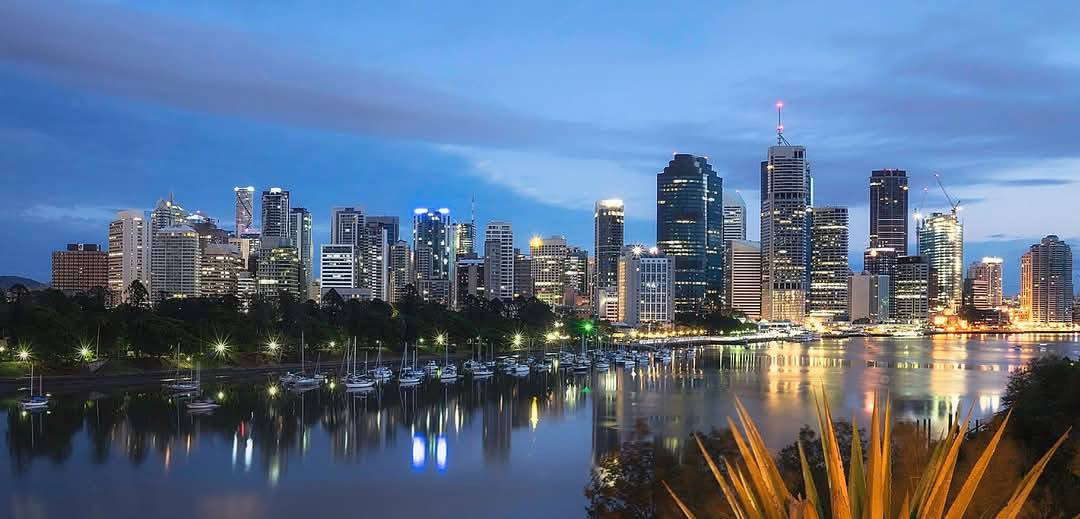
Brisbane's oldest park, laid out on the river bend in 1828 and formally declared a botanic garden in 1855. Free, heritage-listed, and regularly confused with the much larger gardens at Mt Coot-tha.
✍️ By Frank Adam Burns📅 Updated 2026📍 Brisbane, QLD
📅
1855
Declared a botanic garden
📏
~18 ha
Site area
🎟
Free
Always open
🚶
5 min
From the CBD
The City Botanic Gardens occupy the tip of Gardens Point, wrapped on three sides by the Brisbane River and bordered by Alice Street and the CBD on the fourth. They are free, open, heritage-listed on the Queensland Heritage Register, and the single most common source of confusion for visitors planning a Brisbane garden day.
Not the Same as the Mt Coot-tha Gardens
This is worth settling first. Brisbane has two botanic gardens and they are eight kilometres apart.
The City Botanic Gardens are here at Gardens Point in the CBD — about 18 hectares, the older of the two, and walkable from anywhere in the city centre.
The Brisbane Botanic Gardens are at the foot of Mount Coot-tha — 52 hectares, considerably larger, with the Japanese Garden, the Tropical Display Dome and the planetarium.
A surprising number of itineraries send people to the wrong one. If you want the domes and the planetarium, you want Mt Coot-tha. If you want a shaded riverside walk five minutes from the Queen Street Mall, you want this one.
The History
The site was set aside as a public garden in 1828, when the fertile river-bend soil was used to grow crops for the penal settlement. In 1855 the colonial botanist Walter Hill declared the area a botanic garden, and he served as its first curator.
The gardens as they stand were formed in 1916 by amalgamating the original botanic gardens with the Domain on the southern side of Gardens Point and Queen's Park, a ten-acre strip along Alice Street that had been a sporting field where cricket and football were played.
The former curator's cottage, built for John Frederick Bailey during his tenure from 1905, is now a cafe. That continuity — a working garden on the same ground for nearly two centuries — is what earned the heritage listing.
What to See
The gardens are laid out as a series of connected lawns and plantings rather than formal themed zones, which makes them better for wandering than for ticking off.
The bunya pines and weeping figs along the main avenues are the oldest plantings and the most photographed. The mangrove boardwalk at the river edge is the surprise — a raised walkway through tidal mangroves within sight of the CBD towers, and one of the few places in a capital city where you can stand in mangrove habitat. The bamboo grove, the ornamental ponds and the riverstage amphitheatre fill out the rest.
Wildlife is easy here: eastern water dragons are everywhere and largely unbothered by people, ibis and rainbow lorikeets are constant, and possums appear at dusk.
Using the Gardens
The paths are sealed and level throughout, which makes this the most accessible green space in the CBD — better for wheelchairs, prams and anyone who tires easily than the Mt Coot-tha gardens with their gradients.
There is a cafe in the old curator's cottage, public toilets, and plenty of shaded lawn. The gardens are open at all times, though the riverstage is fenced for ticketed events.
It is a genuinely good lunch spot for anyone working or staying in the CBD, and one of the quietest places in the centre of the city.
What Is Next Door
The gardens connect directly to several things worth combining them with. The Goodwill Bridge crosses from the southern tip to South Bank in about five minutes on foot, which makes a natural loop: gardens, bridge, South Bank, back over Victoria Bridge.
The Queensland University of Technology Gardens Point campus sits alongside, including Old Government House — a restored 1860s residence, free to enter. Parliament House is on the Alice Street corner.
The Riverwalk and the Eagle Street precinct run north along the water towards Howard Smith Wharves and the Story Bridge.
Getting There
Walk. The gardens are five minutes from the Queen Street Mall down Albert or Edward Street, and that is the easiest approach.
By public transport, the Botanic Gardens CityCat terminal is at the river edge, and the QUT Gardens Point bus stops are on Gardens Point Road — both at Queensland's 50-cent flat fare. Parking is limited and metered; there is no visitor car park.
Walter Hill and the Working Garden
The gardens were not created as ornament. When Walter Hill was appointed the first curator in 1855, the site's purpose was economic botany — testing which crops would grow in the Queensland climate and distributing the successful ones to settlers.
Hill trialled sugar cane here, and the gardens played a direct part in establishing what became one of Queensland's major industries. Mangoes, pineapples, macadamias, coffee, tea and a long list of tropical and subtropical species were tested on this ground.
He is also credited with the first recorded processing of the macadamia nut for eating — the species is native to South-East Queensland and northern New South Wales, and its commercial history begins in gardens like this one.
That working history is why the plantings are laid out the way they are: as collections and trials rather than as designed vistas. The gardens became decorative later, largely by growing up.
The Trees Worth Finding
The oldest plantings are the reason to walk slowly here.
The bunya pines are the signature. Native to the Bunya Mountains north-west of Brisbane, they carry enormous cones — heavy enough that the trees are fenced off when in fruit, and genuinely dangerous underneath. The bunya nut was a staple food and the trigger for large ceremonial gatherings of Aboriginal groups from across a wide region.
The weeping figs along the main avenues form the deep shade the gardens are known for. Several date to the nineteenth century and have the buttressed roots and aerial growth that only come with age.
There are also mature Moreton Bay figs, jacarandas that flower purple in late October and November, and a substantial bamboo grove that is considerably older than it looks.
The Mangrove Boardwalk
The boardwalk at the river edge is the most unusual thing in the gardens and the most frequently missed.
It carries you out over grey mangroves growing on the tidal mud of the Brisbane River, within sight of the CBD towers. At low tide the pneumatophores — the vertical breathing roots that let the trees survive in oxygen-poor mud — carpet the ground beneath you, and crabs are everywhere.
Mangroves are the nursery habitat for a large share of the fish and crustaceans in Moreton Bay, and this stand is a remnant of what lined the entire river before the city. Standing in it, in the middle of a capital city, is a genuinely strange and good experience.
The boardwalk is level and short. Mosquitoes are present at dawn and dusk in the warmer months.
Floods, and What They Did Here
The gardens sit on a river bend at close to river level, which makes them one of the most flood-exposed public spaces in Brisbane.
The 1893, 1974 and 2011 floods all inundated the site, and the 2011 event submerged large sections entirely. Mature trees were lost, the riverwalk edge was damaged and the recovery took years.
This is why some plantings look younger than the gardens' age suggests, and why the site carries interpretive signage about flood history. It is also why the mangroves matter — they are the part of the system built for it.
Old Government House and QUT
The gardens share their boundary with the Queensland University of Technology's Gardens Point campus, and the two are effectively continuous — students cross the gardens constantly, which gives the place a working atmosphere rather than a touristic one.
Old Government House sits on the campus edge and is free to enter. Built in the 1860s, it was the residence of Queensland's governors and later the first home of the University of Queensland. It is restored, heritage-listed and genuinely worth the half hour.
Parliament House stands on the Alice Street corner of the gardens. Free guided tours run on sitting and non-sitting days at published times, and the building's French Renaissance stonework is the best nineteenth-century architecture in the city.
Events and the Riverstage
The Riverstage is an outdoor amphitheatre built into the slope at the northern end, with a capacity in the thousands. It hosts major touring acts through the year, and on show nights that section of the gardens is fenced and ticketed while the rest stays open.
The gardens also host markets, community events and, in late spring, the jacaranda flowering that draws photographers across the city.
Checking what is on before visiting is worth thirty seconds — a Riverstage event changes the character of the whole northern end and makes parking near-impossible.
Questions About the City Botanic Gardens
No. The City Botanic Gardens are at Gardens Point in the CBD, about 18 hectares. The Brisbane Botanic Gardens are at Mount Coot-tha, 52 hectares, eight kilometres away. They are frequently confused.
Nothing. The gardens are free and open at all times.
The site was set aside as a public garden in 1828 and formally declared a botanic garden in 1855 by the colonial botanist Walter Hill.
Half an hour for a walk through, an hour or more if you take the mangrove boardwalk and sit by the river.
Yes — the paths are sealed and level throughout, which makes these the easiest gardens in Brisbane for wheelchairs and prams.
Eastern water dragons are common and unbothered by people. Ibis and rainbow lorikeets are constant, and possums appear at dusk.
Yes — the Goodwill Bridge crosses from the southern tip and takes about five minutes on foot.
Cooee Tours acknowledges the Turrbal and Yuggera (Jagera) peoples as the Traditional Custodians of the land on which Brisbane stands. We pay respect to Elders past, present and emerging.
See It With a Local
The gardens are a standard stop on our Brisbane city days, usually paired with the river. Family owned and operating in South-East Queensland since 1974.