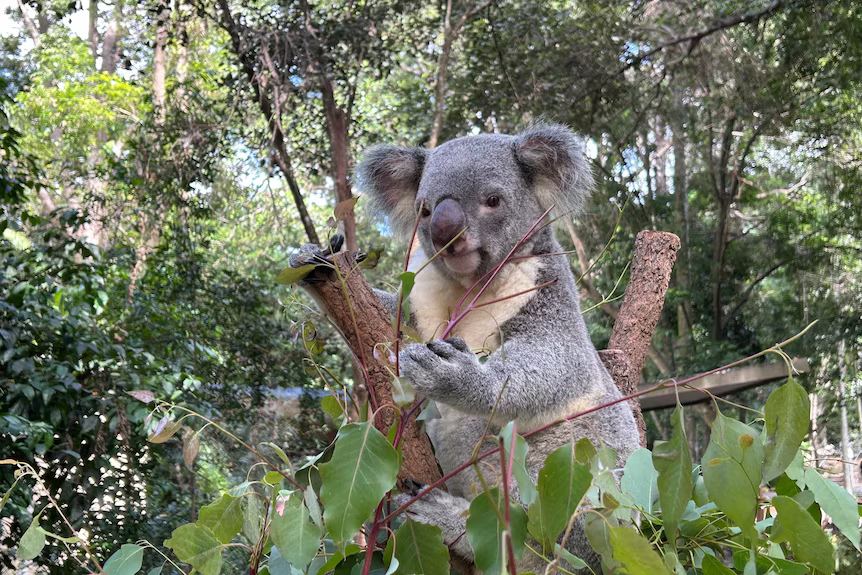
A conservation park south of Brisbane with a free koala centre and genuine wild koalas in the surrounding forest — the alternative to paying for a wildlife park, if you are prepared to look up and be patient.
✍️ By Frank Adam Burns📅 Updated 2026📍 Brisbane, QLD
🎟
Free
Koala centre and park
🚗
~30 min
South of Brisbane
🚴
Yes
Mountain bike trails
🌳
Open forest
Wild koala habitat
Daisy Hill Conservation Park sits about half an hour south of the Brisbane CBD in the Logan area, and it is the free alternative to a wildlife park. It protects open eucalypt forest that is genuine koala habitat, and the koala centre on site costs nothing to enter.
The Koala Centre
The centre is an education facility run by Queensland's park service rather than a zoo. It covers koala biology, the threats the species faces in South-East Queensland, and the rehabilitation work done in the region.
It is free, it is compact, and it is aimed squarely at helping visitors understand what they are looking at before they walk into the forest. There is a raised viewing area and interpretive displays.
Be clear about what it is and is not: this is not a sanctuary where you hold a koala. It is a conservation and education centre attached to real habitat.
Seeing Wild Koalas
The surrounding forest supports a wild koala population, and seeing one is a matter of patience and looking up rather than a guarantee.
Koalas sleep up to twenty hours a day, wedged in tree forks, and they are grey-brown against grey-brown bark. Scanning the forks of larger eucalypts slowly, rather than sweeping the canopy, is the technique. Early morning and late afternoon are when they are most likely to move.
If a guaranteed koala is what a child in your group needs, Lone Pine is the honest answer and this is not. If the idea of finding one yourself in real forest appeals, this is one of the better places within reach of Brisbane to try.
Walking and Riding
The park carries a network of walking tracks through open forest, ranging from short loops near the centre to longer routes into the surrounding reserve. The terrain is undulating rather than steep.
Daisy Hill is also well known for mountain biking, with a substantial trail network used regularly by local riders. Walkers and riders share some routes, so awareness matters in both directions.
There are picnic areas and toilets near the centre, and the immediate area around the building is level and accessible. The forest tracks are unsealed.
Practical Notes
Bring water — there is little on the tracks. Closed shoes rather than sandals, since the ground is uneven and this is real bush. Sun protection matters even under open canopy.
Snakes are present, as they are anywhere in South-East Queensland bushland, and will move away given the chance. Ticks are worth checking for after walking off-track.
Opening hours for the centre are shorter than the park itself, and they vary — worth checking with the Queensland Parks and Wildlife Service before making the trip specifically for it.
Getting There
Daisy Hill is about thirty minutes south of the Brisbane CBD by road, off the Pacific Motorway corridor, and it is a natural add-on to a day heading towards the Gold Coast.
Public transport reaches the general area but not the park entrance conveniently, so this one genuinely suits a vehicle or a charter more than most Brisbane attractions.
Questions About Daisy Hill
Yes — both the koala centre and the conservation park are free to enter.
No. It is a conservation and education centre attached to real habitat, not a sanctuary. For holding a koala, Lone Pine is the answer.
No. Koalas sleep up to twenty hours a day and are well camouflaged. Scan the forks of larger eucalypts slowly, and try early morning or late afternoon.
About thirty minutes south of the CBD by road, off the Pacific Motorway corridor.
Yes — Daisy Hill has a substantial and well-used trail network. Some routes are shared with walkers.
The area immediately around the koala centre is level and accessible. The forest tracks are unsealed and undulating.
Water, closed shoes and sun protection. There is little water on the tracks and the ground is uneven.
Cooee Tours acknowledges the Turrbal and Yuggera (Jagera) peoples as the Traditional Custodians of the land on which Brisbane stands. We pay respect to Elders past, present and emerging.
See It With a Local
Daisy Hill pairs well with a southern Brisbane day or a Gold Coast run. Family owned and operating in South-East Queensland since 1974.