Coastal road trips, ancient outback, the world's largest reef, and the slower journeys this country rewards — tailored by Brisbane-based specialists since 1991.
Begin your journeyAustralia is the only country that's also a continent. Distances are real, climates vary wildly between states, and the best route is rarely the most obvious one. We help you make confident decisions on timing, pacing, and which regions are genuinely worth combining on one trip.
Start with one of our itineraries and we'll adapt it around your interests and pace. Or start with a blank page and we'll shape the trip from the ground up — coastal road trip, reef-and-rainforest, Red Centre, or all of the above across three weeks.
Our office is on Adelaide Street in Brisbane, with operational depots in Sydney, Melbourne, Cairns, Gold Coast, and the Sunshine Coast. Same time zone as most of our travellers, real humans on the phone, and a specialist by name on every trip.
Australia is the only country that's also a continent — seven and a half million square kilometres, four climate zones, six states, and two territories. From Cape York's monsoon rainforest to nipaluna/Hobart's wild south, the country runs four thousand kilometres top to bottom. No single trip covers it. The smart approach is to pick a region, do it well, and come back.
Most first-time visitors choose between three configurations. A seven-to-ten-day single region works well for the East Coast (Sydney–Cairns), the Red Centre (Alice–Uluru), or Tasmania. Fourteen to sixteen days lets you combine two regions properly — East Coast plus Red Centre, or East Coast plus Tasmania. Twenty-one days or more for the proper cross-country visit, with time for the slower regional pace this country rewards.
We acknowledge Aboriginal and Torres Strait Islander peoples as the Traditional Custodians of the lands across the continent — the world's oldest continuous living culture, over 65,000 years on Country. Cooee's office stands on the lands of the Turrbal and Yuggera/Jagera peoples (Meanjin, Brisbane). The destinations in this guide cross many Nations: Gadigal Country in Sydney, Wurundjeri Woi-wurrung in Melbourne, Anangu at Uluru, Bininj/Mungguy at Kakadu, palawa in Tasmania, Wadandi in Margaret River. We name the relevant Custodians on each destination below.
A short list of the destinations our Brisbane specialists keep returning to. Each links through to the full regional guide with itineraries, lodgings, and seasonal advice.
Opera House, Harbour Bridge, Bondi, the Northern Beaches, the Blue Mountains in striking distance. The harbour itself defines the city.
The world's largest reef system — UNESCO listed, 2,300 kilometres of coral, accessible from Cairns and Port Douglas with snorkel, dive, and scenic flight options.
Seventy-four tropical islands, Whitehaven Beach's silica sand, Heart Reef from above, and sailing the protected waters of the inner reef.
The island state — Cradle Mountain, Wineglass Bay, Port Arthur, MONA, the Tamar Valley wine region. Our most consistently five-star reviewed destination.
The Twelve Apostles, surf beaches, and rainforest gorges from Torquay to Allansford. One of the world's great coastal drives, best in 3–5 days from Melbourne.
Wildlife sanctuary off the South Australian coast — sea lions at Seal Bay, koalas in the wild at Hanson Bay, Remarkable Rocks, Flinders Chase National Park.
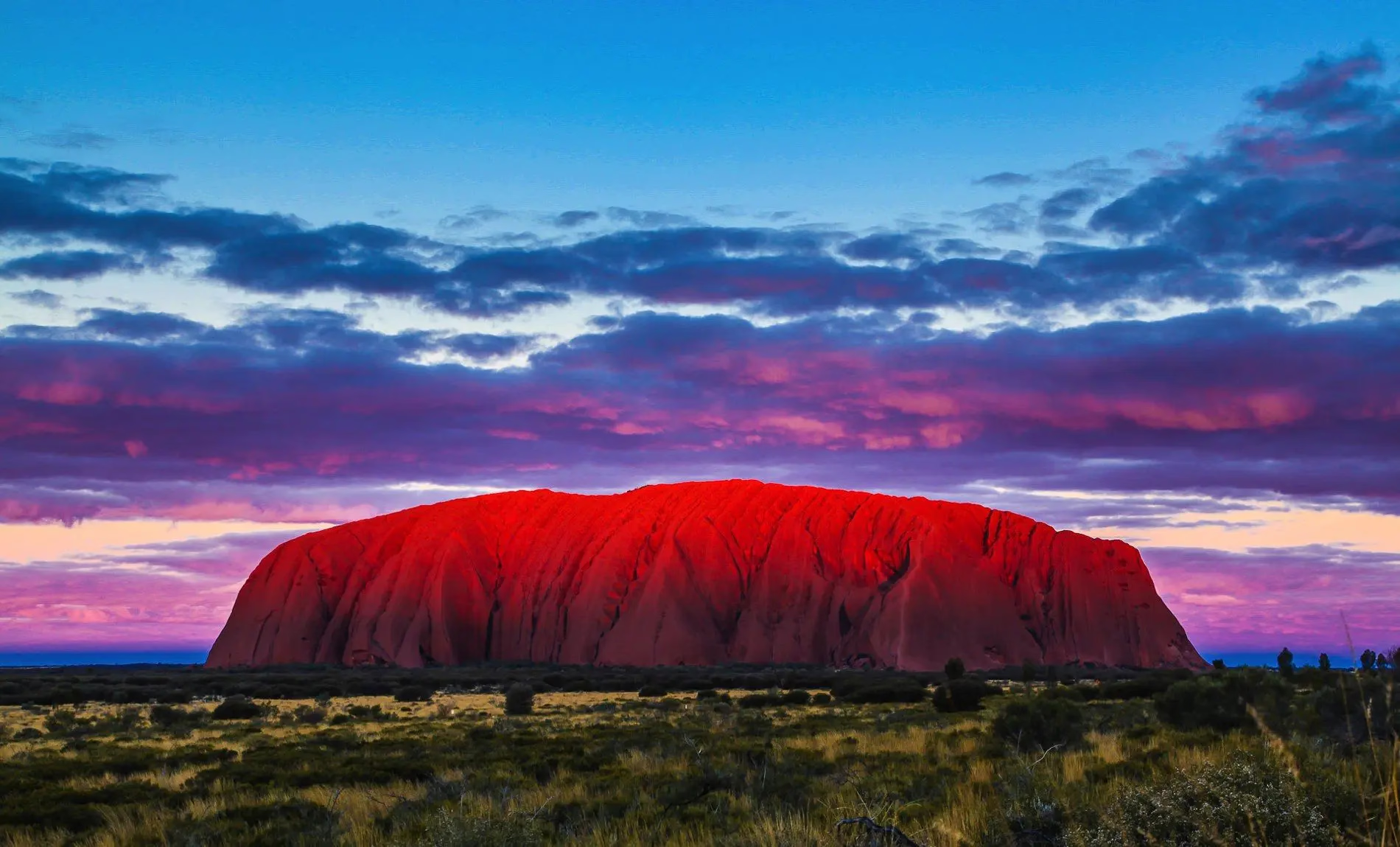
Sacred sandstone monolith, sunrise and sunset experiences with Anangu Traditional Owners, and Kata Tjuta (the Olgas) 40 kilometres west. Climbing permanently closed since 2019.
UNESCO dual-listing (natural and cultural). Twenty thousand square kilometres of wetlands, rock art galleries at Ubirr and Nourlangie, Bininj/Mungguy guide-led tours.
Cabernet country, surf breaks, ancient Karri forests, and a coastline of limestone caves — three hours south of Perth, a short break worth flying for.
The world's oldest tropical rainforest — 180 million years — meeting the Great Barrier Reef at Cape Tribulation. Mossman Gorge, Cooper Creek, Daintree River crocodile cruises.
Australia's remote north-west — Bungle Bungle Range, Mitchell Falls, the Gibb River Road, and Aboriginal-led cultural experiences. Dry season (April–October) only.
The outback loop — Alice Springs, West MacDonnell Ranges (Ormiston Gorge, Standley Chasm), Kings Canyon Rim Walk, then south to Uluru-Kata Tjuta.
A short list of departures travellers are booking right now. Each is a starting point — we adapt the route, the pace, and the inclusions to suit you.
The complete East Coast in one trip — Sydney Harbour, Brisbane, Whitsundays sailing, Cairns, Great Barrier Reef snorkel/dive, and the Daintree Rainforest.
Alice Springs base, West MacDonnell Ranges day trips, Kings Canyon Rim Walk, then south to Uluru-Kata Tjuta with Anangu Traditional Owner experiences.
Full circuit of the island state — Hobart, MONA, Port Arthur, Freycinet Wineglass Bay, Cradle Mountain, Launceston and the Tamar Valley.
A Victorian short break — Melbourne city, the Great Ocean Road and Twelve Apostles, then Yarra Valley and Mornington Peninsula cellar doors.
Hamilton Island base, sailing the 74 islands, Whitehaven Beach landing, Heart Reef scenic flight, and outer Great Barrier Reef snorkelling.
Perth city, Rottnest Island day trip, then south to Margaret River wine country, surf breaks, Karri forests and the Cape Leeuwin lighthouse.
Everything our Brisbane specialists know that affects an Australian trip — seasons by region, iconic experiences, tour styles, sample itineraries, practical detail. Open the sections you need; ignore the rest.
Australia is the only country that spans tropical, sub-tropical, temperate, and arid climate zones. The "best time" depends entirely on where you're going.
Dry season May to October. Comfortable 25–30°C days, low humidity, clear skies. The peak window for Great Barrier Reef, Kakadu, Top End, the Whitsundays, and the Kimberley. Avoid the wet season November to April for outdoor exploration — high humidity, road closures, marine stingers in tropical waters, and cyclone risk.
April to September is the sweet spot. Days 20–28°C, cold desert nights (down to 0°C in June–July, which is the surprise that catches many travellers out). October-November is shoulder, warmer but still manageable. Avoid December to February — 40°C+ days make outdoor walks unsafe by mid-morning.
Year-round destinations. Spring (September–November) and autumn (March–May) deliver the best balance. Summer (December–February) is hot, humid, busy, and expensive but ideal for beaches. Winter (June–August) is mild, dry, and cheaper — perfect for cultural and city itineraries.
October to April is the prime window. Tasmania especially — the island is at its best from late spring through early autumn. Avoid Tasmania June to August unless you specifically want the deep cold. Melbourne is famously four-seasons-in-one-day year-round.
Two main hubs: Cairns (outer reef boats 1.5–2 hours offshore) and Port Douglas (Agincourt Ribbon Reefs, calmer water, more upmarket). Snorkel-only travellers should consider Heron Island or Lady Elliot Island (off Gladstone) for shore-access reef. May-October dry season for best visibility.
Both are unforgettable, both are necessary. Sunrise is quieter and quicker. Sunset is the ceremony — Sounds of Silence dinner or Tali Wiru fine dining at Anangu-owned locations. The rock cannot be climbed under any circumstances since 26 October 2019 — respect this and don't ask.
Whitehaven Beach landing is on every list and worth it. Heart Reef can only be seen by air — helicopter or seaplane from Hamilton Island or Airlie Beach.
Two-and-a-half to four days of premium rail across the continent. The Ghan: Adelaide-Alice Springs-Darwin (3 days). The Indian Pacific: Sydney-Adelaide-Perth (4 days). Off-train excursions at major stops, all-inclusive premium cabins. Book 6–12 months ahead.
Hobart's Museum of Old and New Art is a destination in itself. Pair with Cradle Mountain (3-day Overland Track or day-walk), Wineglass Bay, and Port Arthur.
Don't visit Kakadu without doing at least one tour led by a Bininj/Mungguy guide. Animal Tracks Safari, Kakadu Cultural Tours, and Ayal Aboriginal Tours are the long-standing operators. Rock art at Ubirr and Nourlangie is best read with a local.
One day is too rushed. Three to five days lets you see Torquay, Apollo Bay, Twelve Apostles, Loch Ard Gorge, the Otway forest canopy, and finish at Warrnambool with whales (June–September) or surf (year-round).
Take any harbour ferry — Circular Quay to Manly is the classic. Bridge Climb is iconic but expensive; the Pylon Lookout from the southern end is a quieter alternative.
200 vineyards, world-class Cabernet, and the Margaret River Pro surf competition annually. Three to four days is the minimum.
Either the Gibb River Road (4WD, self-drive or guided), or an Expedition Cruise from Broome to Wyndham/Darwin (7–13 nights). Dry season only — April to October.
Max 16 travellers, expert local guides at each destination, all logistics handled. Cooee's most-booked format — about 65% of our Australian bookings.
The Ghan, Indian Pacific, and Spirit of Queensland. We book the gold or platinum service classes and pair with pre- and post-rail stays.
You drive; we plan the route, book the accommodation, hold the bookings for key experiences, and provide 24/7 backup. The right fit for travellers who want autonomy with the safety net.
Saffire Freycinet (Tasmania), Longitude 131 (Uluru), Lizard Island (Great Barrier Reef), Berkeley River Lodge (Kimberley), El Questro (Kimberley), qualia (Hamilton Island). Private guiding, helicopter transfers where required.
Fully bespoke. Your pace, dates, interests. Designed in 2–4 weeks of proposal iterations. The right fit for milestone trips, multi-generational families, and accessibility-led travel.
Sydney (2 nights) → fly to Cairns → Great Barrier Reef day boat → Daintree Rainforest & Cape Tribulation → Cairns return. Best for first-timers wanting the iconic mainland coast at a comfortable pace.
Alice Springs (2 nights) → West MacDonnell Ranges (Ormiston Gorge, Standley Chasm, Glen Helen) → Kings Canyon (Rim Walk at sunrise) → Uluru-Kata Tjuta (3 nights with sunrise, sunset, base walk, and Field of Light) → fly out Ayers Rock. The desert visit done properly.
Sydney (2 nights) → Whitsundays sailing (3 nights from Hamilton Island) → Cairns & Great Barrier Reef (2 nights) → fly Alice Springs → Uluru-Kata Tjuta (3 nights) → fly out. The most-booked Cooee Australia itinerary — reef plus rock in one trip.
The fourteen-day classic plus Tasmania (5 nights) or the Top End (Kakadu + Litchfield, 4 nights). The proper Australian visit with time for the slower regional pace this country rewards.
Australian citizens travelling domestically need no documentation beyond standard photo ID for flights. International visitors: most Western and East Asian passports qualify for the eVisitor (subclass 651) or ETA (subclass 601) — both online, fast, low-cost. New Zealand citizens enter freely under the Trans-Tasman arrangement. Passport must have at least 6 months' validity beyond your departure date for most travellers.
The country is enormous. Sydney to Cairns is 2,400 kilometres by road (24 hours driving). Perth is 4,000+ km from Sydney. Tasmania is a separate island. Domestic flights are essential for any multi-region itinerary — we book them as part of the tour.
Left-hand driving. International licences accepted for short visits. Outback driving requires real preparation — satphone, water, spare fuel, awareness of road-train length. We handle all transport on guided tours; self-drive supported includes route briefings and 24/7 backup.
Currency: Australian Dollar (AUD). EFTPOS and contactless accepted universally. GST is 10% and included in displayed prices. Tipping is not required — 10% in restaurants if service exceeds expectations. Daily budgets in AUD: $200–350 budget, $400–700 mid-range, $800+ luxury. Brisbane, Adelaide, Hobart are generally more affordable than Sydney, Melbourne, Cairns.
Among the safest countries globally. Emergency: 000 (police, fire, ambulance). Reciprocal Medicare with the UK, New Zealand, and several European countries; travel insurance still essential. UV is extreme — SPF 50+ daily, hat, sun-safe clothing. Marine stingers in tropical waters November-April (stinger suits, vinegar at lifeguard stations). Crocodile-safe in the Top End: never swim in non-designated water. Snakes and spiders exist but bites are rare and antivenom is universally available.
Australia is the home of the world's oldest continuous living culture — over 65,000 years. On Country: don't photograph people, ceremonies, or sacred sites without explicit permission. Don't climb Uluru (closed since 2019, not negotiable). Don't take rocks, sand, or anything else from Anangu Country or anywhere else. Acknowledge the Traditional Custodians of every place you visit.
Depends on the region. May-October for tropical north (Cairns, Kakadu, Whitsundays) and Red Centre. October-April for southern states (Sydney, Melbourne, Tasmania, Perth). April-June or August-October for multi-region trips covering both.
Seven to ten days for one region. Fourteen to sixteen for two regions. Twenty-one+ for a comprehensive cross-country visit.
No — Cooee small-group tours handle all transport. Self-drive supported tours suit travellers comfortable with long distances. Premium rail (The Ghan, Indian Pacific) covers specific cross-country routes.
Among the higher-cost destinations globally. Indicative AUD daily: $200–350 budget, $400–700 mid-range, $800+ luxury. Cooee tour packages bundle accommodation, transport, and guiding — usually 15–25% lower than equivalent self-built itineraries.
Most Western and East Asian passports qualify for eVisitor or ETA online. New Zealand citizens enter freely under Trans-Tasman.
Yes — we partner only with Aboriginal-owned and operated cultural experiences. At Uluru, Anangu Traditional Owners lead all cultural tours. At Kakadu, Bininj/Mungguy guides share Country on their terms. Fees flow directly to the relevant operators.
You work with one Cooee Australia specialist who shapes the itinerary, coordinates the moving parts, and keeps everything in one place. No hand-offs, no being passed between three sales reps, no losing context two days into the trip.
Our guided tours are capped at 16 travellers. Most average 10 to 14. That gets you access to lodges, restaurants, Aboriginal-led cultural experiences, and remote-region tours that larger coaches simply cannot run.
On Country — at Uluru, Kakadu, the Daintree, the Kimberley — we partner only with Aboriginal-owned and operated cultural tours. Fees flow directly to those operators. The work belongs to Traditional Owners, by right.
One Brisbane-based Cooee specialist plans your trip end-to-end — the route, the rail bookings, the reef boats, the lodges, the local Aboriginal-led cultural experiences — and stays the same point of contact through the journey. A 15-minute conversation is usually all we need to know whether we're a fit.
The Anangu-led sunrise at Uluru was unlike anything else we've done. Cooee timed it right and the Field of Light afterwards was magic. Worth every minute of the flights to get there.
Tasmania completely surprised us. Cooee's small group made all the difference at MONA and Wineglass Bay. The Cradle Mountain day was the trip highlight, and they timed the seasons perfectly.
East Coast plus Red Centre in 14 days — sounded ambitious but Cooee made it work. Whitehaven Beach, outer reef snorkel, then Uluru. Three different countries within one country. Couldn't recommend more.
Tell us your travel month, which region/s you have in mind, and what you'd like to do. A Brisbane-based Cooee Australia specialist will be in touch within 1 business day with options and an indicative quote.