Cellar Doors
Dozens of cool-climate wineries spread around Stanthorpe and Ballandean — tastings, vineyard lunches and varieties the rest of Queensland can't grow.
Queensland's high country — cool-climate wine around Stanthorpe, apple and stone-fruit orchards, and the granite monoliths of Girraween. The day trip most visitors are surprised exists.
Keep driving south from Toowoomba along the New England Highway and the country keeps climbing — until, around Stanthorpe, you're in the Granite Belt: Queensland's highest and coolest settled country, where winters genuinely frost and the state, improbably, grows serious wine. Cool-climate cellar doors, apple and stone-fruit orchards and berry farms spread across the granite hills, with Stanthorpe as the working hub.
On the region's edge, Girraween National Park stacks its famous granite monoliths and spring wildflowers — the wild counterpart to the vineyard afternoons. It's a full day from Toowoomba at minimum; most who make the drive wish they'd booked the weekend.
Dozens of cool-climate wineries spread around Stanthorpe and Ballandean — tastings, vineyard lunches and varieties the rest of Queensland can't grow.
Apples, stone fruit and berries by the season — pick-your-own in summer, roadside stalls year-round, and the produce culture that predates the wine.
Granite domes, balancing boulders and spring wildflowers — walks from gentle creekside strolls to the famous Pyramid scramble for the sure-footed.
Granite Belt wine days are classic Cooee charter territory — nobody has to be the designated driver.
Call 0409 661 342| Getting there | New England Highway south via Warwick — around two hours from Toowoomba, or roughly three from Brisbane. |
|---|---|
| Cost | Free to tour; cellar door tasting fees vary and are often redeemable on purchase. |
| Best time | Autumn for vintage and orchard colour; spring for Girraween's wildflowers; winter for fireside reds — it's Queensland's only true four-season region. |
| Combine with | A Toowoomba weekend for the full Southern Queensland high-country loop. |
The Granite Belt got into farming the way most hard countries do: by accident, after something else. Stanthorpe began in the 1870s as a tin town — the name splices the Latin for tin onto the English for village — and when the mining faded, the miners' district discovered what its altitude and drained granite soils were actually for. Orchards took hold through the late nineteenth century, and the region's great demographic turn came after the First World War, when soldier-settlement schemes and, decisively, Italian migrant families built the fruit-growing culture that still defines the district. The Italian surnames on the region's road signs, wineries and packing sheds are not decoration; they are the founding families, several generations on.
Wine came the same way — from fruit-growing logic pushed one step further. Table grapes and small plantings existed for generations, but the modern industry dates from the 1960s onward, when growers began proving that this high, cool, frost-prone corner of Queensland could produce wines the textbooks said belonged a thousand kilometres south. The argument has long since been won: the Granite Belt is today a recognised wine region with scores of family-scale producers, and the sight of vineyard rows running between granite boulders and apple orchards has become the district's visual signature.
What makes all of it possible is elevation. The Granite Belt rides the southern end of the Great Dividing Range at roughly 800 metres and higher — Queensland's highest settled district and its coldest, with real winters, genuine frosts and the occasional flurry of snow that makes statewide news whenever it happens. Cold nights and warm, dry summer days give fruit and grapes the slow ripening that lower Queensland cannot offer, and give visitors the novelty the region trades on: a corner of the Sunshine State that owns four proper seasons and dresses accordingly.
The Granite Belt's wine identity rests on two pillars: altitude and independence. The altitude delivers the cool-climate style — bright, structured whites and medium-weight, savoury reds, with Shiraz, Cabernet, Chardonnay and Verdelho long established as the regional backbone. The independence shows in the scale: this is overwhelmingly a district of family producers where the person pouring your tasting frequently grew, made and named the wine, and cellar doors run from polished tasting rooms with restaurants attached to tin sheds where the dog greets you first. Both ends of that spectrum are the genuine article.
The region's calling card is its embrace of alternative varieties — the Mediterranean and Iberian grapes that suit the climate and set the district apart from safer wine maps. Ask at cellar doors about the region's celebrated alternative-variety trail and you will be steered toward Tempranillo, Fiano, Vermentino, Saperavi, Nebbiolo and stranger friends; tasting your way along it is the fastest education in why winemakers find this granite country so interesting. Tasting fees vary and are commonly redeemable against purchase — confirm at each door — and weekends reward bookings, especially for groups of six or more.
A workable cellar-door day needs discipline that the district itself will conspire against: three or four wineries with a proper lunch in the middle beats seven at a gallop, every time. Cluster your choices geographically — the Ballandean concentration in the south, the doors around Stanthorpe itself, and the Summit–Applethorpe country to the north each make a coherent half-day — and settle the driver question before the first pour, not after it. The distances are short but the roads are country roads, and the local constabulary knows exactly what weekend visitors are up to.
Stanthorpe is the hub and wears the district's history on its streets — a substantial country town with heritage pubs, a regional art gallery, riverside parkland along Quart Pot Creek and the museums that keep the tin-and-orchard story. It is the natural base: accommodation in all grades, the region's biggest run of cafes and provisioning, and everything else within a twenty-five-minute radius. The town also keeps Queensland's coldest weather records with a certain civic pride — the Big Thermometer is a local landmark precisely because the readings are worth commemorating.
Ballandean, fifteen minutes south, is the wine village — the heaviest concentration of cellar doors in the region, several with restaurants, set among the granite-and-vineyard country that produces the district's postcard views. The Summit, Applethorpe and Thulimbah, north of Stanthorpe along the old fruit-growing ridge, are orchard country proper: packing sheds, farm gates, pick-your-own operations in season and roadside stalls whose contents track the harvest. Glen Aplin and Severnlea fill in the middle ground with more cellar doors and berry farms tucked along the highway.
The distances are mercifully small — the whole settled Belt runs perhaps thirty minutes north to south — which is why the district suits touring so well. A day can plausibly touch orchard country, three cellar doors, a granite lookout and a Stanthorpe dinner without hurry, and a weekend can do it all twice. The connective back roads through Eukey and Sundown country add granite scenery to every transfer, and getting slightly lost among the boulders and vine rows is a recognised regional pastime with no recorded downside.


Before it was wine country, the Granite Belt was — and remains — Queensland's orchard. Apples, pears, stone fruit and grapes dominate the summer and autumn harvest; strawberries and other berries run their own seasons on the farms around Stanthorpe and Applethorpe; and the district's vegetable growers supply the state's markets through the warm months from the same high paddocks. For visitors this translates into a produce trail that parallels the wine one: farm-gate stalls, packing-shed shops, pick-your-own operations and a weekly rhythm of markets in and around Stanthorpe.
Timing determines the experience. High summer through autumn is harvest festival territory — stone fruit from roughly Christmas onward, apples and grapes carrying through the early months of the year — and it is the season to find the stalls fullest and the pick-your-own farms open. Winter swings the offer toward stored apples, preserves, jams and the district's excellent juices and ciders. Individual farm openings shift with each season's harvest and staffing, so confirm locally — the Stanthorpe visitor information centre keeps the current state of play — rather than driving to a gate on the strength of an old brochure.
The supporting cast has range: cheesemakers, olive growers, lavender farms, breweries and distilleries have all colonised the district's cool climate, and several make natural pit stops between cellar doors for whichever member of the party is driving. Prices at the farm gates are consistently kind, the quality is what altitude and cold nights do for fruit, and the boot-space warning issued for every Queensland farm district applies here with compound interest: between the wine boxes and the apple bags, Granite Belt cars ride home noticeably lower on their springs.
The region's name is literal, and Girraween National Park is where the granite performs. A short drive south of Ballandean, the park stacks its famous monoliths — the Pyramid, Castle Rock, the Sphinx and the improbable balancing boulders around them — above a landscape of heath, creek and forest that turns extravagant with wildflowers in spring; the park's name is usually translated as 'place of flowers', and September to November argues the case. Walking tracks run from easy creekside strolls to the steep bare-rock scramble up the Pyramid's flank, which rewards the sure-footed with one of inland Queensland's great summit views.
Plan the park like the high country it is. Carry water and sun protection in all seasons, wear genuine footwear for anything beyond the creek circuit, and treat the bare granite with respect when wet — the friction that makes the Pyramid climbable disappears in rain. Winter days are often ideal walking weather, cold mornings notwithstanding, while summer walking belongs to the early hours. Park access is free, day-use facilities at the main entrance are good, and the wildlife — wallabies at dusk, a serious bird list — performs most reliably early and late.
Girraween is the headline, but the granite theme continues throughout the Belt: lookouts and boulder country thread the back roads, Sundown National Park guards the district's remote south-west for the properly adventurous, and even the vineyard drives are punctuated by outcrops the ploughs simply went around. The juxtaposition is the region's photographic signature — vines, orchard rows and old sheds framed by rock that has been sitting there, magnificently indifferent, for a couple of hundred million years.
Autumn is the insider's first pick. Vintage wraps up, the poplars and orchard rows turn, the air sharpens and the district produces its most photogenic weeks — with apple harvest still running and cellar doors relaxed after the summer rush. Winter is the novelty act and proudly so: the coldest settled district in Queensland does mornings below zero, fireplaces in every tasting room, red-wine weather by mid-afternoon and, occasionally, the snowfall that puts Stanthorpe on the evening news. Queenslanders drive hours for the privilege of wearing their good coats; book winter weekends well ahead.
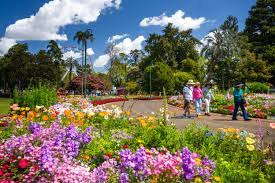
Spring belongs to the flowers — Girraween's wildflower show through September and October, blossom across the orchard country, and the district's own spring festival traditions; confirm event dates locally as they move year to year. Spring is also where the Granite Belt pairs most naturally with the region's biggest drawcard to its north: the Toowoomba Carnival of Flowers runs 18 September to 5 October in 2026, and an itinerary that puts the Carnival's gardens and the Belt's wildflowers-and-wine in the same week is about as good as southern Queensland touring gets. Summer, finally, is harvest and altitude — stone fruit, berries, warm days that stay shy of coastal humidity, and evenings cool enough for a jumper, which in January is its own tourism pitch.
The practical read: there is no wrong season, but there are different packing lists. The district runs several degrees colder than Toowoomba and ten or more colder than Brisbane in any month, so layer accordingly — the visitor shivering at a cellar door in a coastal wardrobe is a recognised local genre. Whatever the season, weekends carry the events and the crowds; midweek carries the quiet cellar doors and the accommodation deals.
Eating well is structurally guaranteed here, because the district grows the menu. The top tier is the vineyard restaurant — several Ballandean and Stanthorpe-district cellar doors run serious dining rooms where the matching of plate to estate wine is the entire point, and weekend lunch bookings are close to mandatory in the busy seasons. The middle tier is Stanthorpe's cafe and pub scene: country-generous breakfasts, good coffee, heritage pub dining rooms, and bakeries whose apple products enjoy the home-ground advantage you would expect of Queensland's apple capital.
The produce culture fills every gap between sit-down meals. Cheese rooms, chocolate makers, jam and preserve kitchens, cideries, breweries and distilleries dot the touring routes, most with tastings of their own, and assembling a picnic from farm gates and Stanthorpe providores is the region's best-value lunch — eaten among granite boulders or beside a vineyard, it outranks most restaurants for setting. If the trip is built around food as much as wine, aim for the harvest months when the stalls peak, and check locally for the district's food-and-wine event weekends, which cluster through autumn and winter.
For the table-minded traveller heading home via Toowoomba, the theme continues: the Garden City's own food scene has risen sharply, and September's FEASTival program — 26 to 27 September in the 2026 Carnival — puts the Downs' producers on show in one weekend. Sequencing the Granite Belt's cellar doors and Toowoomba's festival eating into a single southern-Queensland food loop is not gluttony; it is efficient itinerary design, and we can supply the coach.

A wine region sounds like a hard sell for children, but the Granite Belt quietly runs a full parallel program. The headline family acts are seasonal fruit picking — an activity with a one hundred per cent approval rating among under-twelves when the strawberries or stone fruit are on — and Girraween's boulder country, which is essentially a natural playground with national-park signage; the creek tracks and the lower granite slabs entertain sure-footed kids for hours. Add the district's animal farms, mazes and berry-and-ice-cream stops, whose current opening days are best confirmed locally, and the child's version of the itinerary fills as fast as the adult's.
Winter offers travelling families the cheapest possible magic trick: taking Queensland children somewhere genuinely cold. Frost on the paddocks, breath-fog in the morning, a fireplace at dinner and the outside chance of snow constitute a complete holiday narrative for a generation raised in the subtropics, and Stanthorpe's parks and creekside paths give the days structure between warm-ups. Pack proper layers — the cold is real, and the region's charm depends on being dressed for it.
The logistics are family-friendly by nature: short drives, no crowds by coastal standards, motels and cottages that welcome children, and picnic infrastructure everywhere. The honest structural advice is to alternate — a cellar door for the adults, then a pick-your-own or a boulder scramble for the crew, with the ice-cream stop as the treaty that keeps the whole delegation at the table. Families who run the alternating model report that the children request the return trip as often as the adults do.
The Granite Belt hands photographers a combination no other Queensland region can: vineyard and orchard geometry, monumental granite, and genuine four-season light. The signature frames assemble themselves — vine rows leading to a granite outcrop, orchard blossom against cold blue sky, the Pyramid's bare rock face going gold at sunset — and the district's compactness means a single golden hour can cover several of them. Girraween is the marquee location: late light on the monoliths, wildflower foregrounds in spring, and night skies dark enough for serious astrophotography once the moon cooperates.
The seasonal specials are worth planning around. Winter delivers frost photography almost nowhere else in the state can — white paddocks, rimed vines and fog lifting off Quart Pot Creek on the coldest mornings, all requiring nothing more than an early alarm and gloves. Autumn turns the poplars and orchard rows; vintage adds working harvest scenes to the vineyard country, photographed most politely from roadsides or with a wave to the crew; and summer's storm skies build the big southern-Queensland cloudscapes over the granite hills by late afternoon.
Practical notes: the best light lives on the back roads, so drive them slowly and use the pull-offs — farm traffic has right of way over tripods. Ask before photographing on private cellar-door and orchard properties; permission is almost always cheerfully given, frequently with a better vantage point thrown in. And carry more warm clothing than the forecast suggests, because the difference between a frost photographer and a hypothermic optimist on this high country is a second jacket.
Be honest with the map and the Granite Belt rewards you. From Toowoomba it is around two hours south-west: down the New England Highway across the southern Downs to Warwick, then up the long granite rise to Stanthorpe — a straightforward, well-surfaced run through progressively higher country. From Brisbane allow roughly three hours via Cunninghams Gap and Warwick. Those times make a Toowoomba day trip possible but firm — roughly four hours of driving bracketing the day — which is why the standing local advice is to stay at least one night if the itinerary allows. The district's cottages, motels and vineyard stays are a large part of its appeal, and winter-weekend demand for the fireplace stock is real.
Structure the visit by clusters, not kilometres. Base in or near Stanthorpe; give Ballandean and the southern wine country one half-day, the northern orchard villages another, and Girraween a morning at minimum. Book weekend restaurant lunches and busy-season accommodation ahead; carry layers in every season; and if the party plans to enjoy the cellar doors properly, appoint or hire the driver before leaving base — distances are short, but they are still country roads with country consequences. Fuel, supplies and mobile coverage are all solid around the towns and thinner toward the parks.
For the bigger picture, the Belt slots neatly into a southern-Queensland high-country loop: Toowoomba and the Darling Downs at the top, Warwick's heritage in the middle, Stanthorpe's wine and granite at the bottom, with the whole circuit navigable inside a long weekend. Our guide to the best day trips from Toowoomba sets the Granite Belt alongside its northern rivals — and makes the case that this is the one most worth converting from a day trip into a weekend.
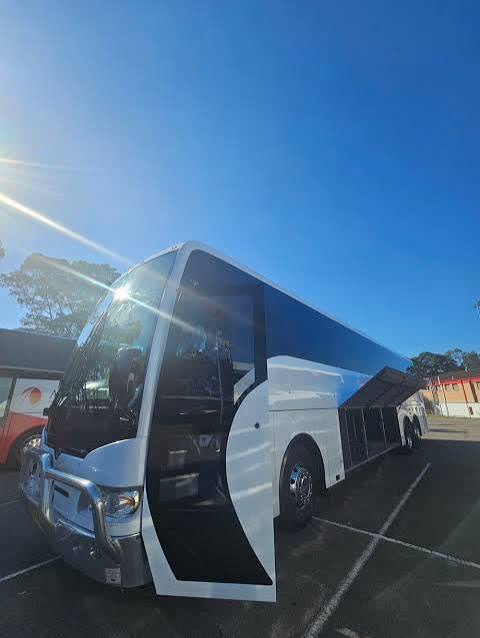
The Granite Belt is the definitive argument for coach touring, for one structural reason: a wine region visited by car requires somebody to spend the day declining Queensland's most interesting tastings. Cooee Tours has been solving that problem since 1974. Our wine tours put the whole district on the right side of the windscreen — cellar doors, vineyard lunch, farm-gate stops — with a driver-guide who knows which doors suit the group and nobody in the party doing arithmetic between pours. Garden clubs, probus groups, birthday parties and corporate days all charter the same happy formula; call 0409 661 342 or email contact@cooeetours.com.au to build one.
The Belt also pairs commercially well with our September flagship. The Carnival of Flowers day tours — from $89 per adult out of Brisbane CBD and Chermside, $99 from the Gold Coast and $109 from the Sunshine Coast — cover the Toowoomba end of the spring story, and the full program's 2-day weekend tours from $595 and 3-day tours from $880 are where the high-country loop gets room to breathe: Carnival gardens one day, southern Downs and wine country beyond. For travellers building the trip around food and wine specifically, the program's dedicated food-trail and wine itineraries are the natural fit.
What the coach changes, beyond the driving, is the shape of the day. Distances between cellar doors become conversation instead of navigation, the Range and high-country scenery gets watched instead of managed, and the group arrives at each stop together and unhurried — which, in a district whose entire ethos is unhurried, is not a small thing. The Granite Belt by coach is the region experienced on its own terms; the Granite Belt by designated driver is a compromise somebody at the table always regrets.
The Granite Belt is the surprise Queensland keeps in its bottom drawer: a genuine cool-climate wine and orchard district, two hours from Toowoomba and three from Brisbane, that most east-coast travellers still have not filed under Queensland at all. Its case rests on things no other part of the state can offer — real seasons, real frost, granite landscapes of quiet grandeur and a family-scale wine industry that treats visitors as guests rather than throughput. It is not on the way to anywhere, which has kept it honest; you go because you mean to, and it repays the intention.
The distilled advice: stay a night rather than day-tripping if you possibly can; travel midweek for the quiet version or book early for the weekend one; cluster your cellar doors and anchor the day with a proper vineyard lunch; give Girraween a morning whatever else the itinerary loses; and pack a coat in every month with an R in it, plus most of the others. Confirm farm openings, event dates and restaurant days locally — the district runs on harvest time and small-family staffing, and its schedules move accordingly. Sort the driving before the tasting, whether that means a nominated volunteer or a coach with a professional at the wheel.
And consider the calendar play seriously: a spring trip that takes in Toowoomba's Carnival of Flowers on the way down and the Granite Belt's wildflowers and wine at the bottom is, for our money, the best week southern Queensland offers a traveller. The Garden City supplies the spectacle, the Belt supplies the seasons and the Shiraz, and the high country in between supplies the drive. Queensland's coldest region turns out to be one of its warmest experiences — locals have known it for a century, and the secret is now formally out.
Toowoomba is one very good destination out of a very long list. Cooee Tours has been running coaches since 1974 — start with the continent, the country next door, or somewhere further afield.
Every destination below has its own travel guide, things-to-do pages and tour range — built the same way as this one.