Hot Air Ballooning Near Toowoomba
First, the honest bit: balloons don't currently launch from Toowoomba itself. But the region's closest sunrise flights sit right on your route up the Range — here's how to add one.
Where the flights actually are
Let's start where other guides fudge it: at the time of writing there is no balloon operator launching from Toowoomba or over the immediate Darling Downs. The closest flights operate from Ipswich — about an hour east of Toowoomba, conveniently on the Warrego Highway route from Brisbane — where a boutique operator flies small-group sunrise flights over the heritage city, Somerset and Scenic Rim country. Further operators fly the Gold Coast hinterland and Scenic Rim out of Brisbane and the coast. Always check current operators and availability before planning around a flight.
How a sunrise flight works
Ballooning is a dawn sport everywhere in the world, and South East Queensland is no exception: you meet in the dark roughly 45 minutes before sunrise, launch as the light comes up, and fly for about an hour wherever the morning's wind decides. The whole experience runs three to four hours including the pack-down (passengers traditionally help) and the optional cooked breakfast afterward — which veterans will tell you is a legitimate part of the ritual. Cool, still mornings fly best, which makes autumn and winter prime season in this part of the world.
A balloon cannot be steered — the wind writes the route. That's not a limitation; it's the entire point.
Pairing a flight with Toowoomba
The geography works beautifully for a weekend: fly at dawn out of Ipswich, be back on the ground and fed by mid-morning, and you're barely an hour from Toowoomba's gardens by lunchtime. It turns the two-day Toowoomba weekend into something genuinely special — sunrise over the Somerset country, sunset from Picnic Point, same day.
The practical notes
Book ahead and build in flexibility — flights are weather-dependent and cancellations rebook to another morning, so don't schedule one for the only day you have. Dress in layers with closed shoes and a hat (the burner is warm overhead; the pre-dawn paddock is not). Most operators carry small groups per balloon and set their own minimum ages for children, so check the details when booking.
For groups
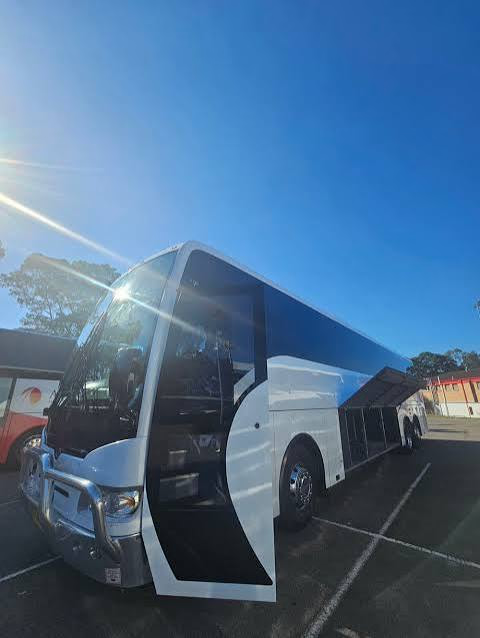
Planning a group weekend around a flight plus the Darling Downs? That's charter territory — Cooee can build the coach itinerary around an operator's launch schedule. Call 0409 661 342 and we'll piece it together.
Why this country looks so good from the air
Some landscapes waste altitude. Forested ranges read as an undifferentiated green shag from above; open ocean is a rumour of texture. The country around Toowoomba is the opposite case — it may be the best-composed aerial subject in Queensland. The Lockyer Valley floor is stitched into irrigated paddocks of wildly different greens and browns, creek lines wander through in dark corridors of trees, and the Great Dividing Range stands along the western edge like a stage flat, with Toowoomba sitting on its crest at roughly 700 metres. West of the Range, the Darling Downs unrolls in those enormous cultivated rectangles that make the region one of Australia's great grain and cotton provinces. From a basket a few hundred metres up, all of it becomes a quilt with a horizon.
The light does half the work. Dawn — the only hour balloons keep — comes in low and raking across this country, throwing long shadows off every tree line and windmill, gilding the paddock stubble and firing the irrigation greens. Mist pools in the creek flats on cool mornings and burns off as you watch. Even the working infrastructure earns its place: silos, farm dams flashing back the sunrise, the geometry of centre pivots. It is agricultural country doing what agricultural country does, and from above it turns out to have been landscape art all along. That is the real answer to why people set alarms for 4am — not the balloon itself, but what this particular corner of Queensland does at first light.
A very short history of going up in a basket
Hot air ballooning has the odd distinction of being both the newest-feeling and the oldest form of human flight. The Montgolfier brothers put the first passengers aloft over Paris in 1783 — more than a century before the Wright brothers — using little more than a silk envelope and a smoky fire, and the physics has not changed since: heat the air inside the envelope, make it lighter than the air outside, and the sky does the rest. What has changed is everything around the physics. Modern envelopes are engineered fabrics, the burners are precisely controlled, pilots are licensed aviators flying under civil aviation rules, and the romantic contraption of the eighteenth century is now a regulated aircraft with logbooks and maintenance schedules.
Australia took to the sport with particular enthusiasm because Australia has what balloons need in bulk: open landing country, cooperative weather and long agricultural valleys that forgive an aircraft which cannot choose its destination. South East Queensland's flying country — the valleys east of the Great Dividing Range — offers exactly that combination, which is why commercial sunrise flights have operated in the region for decades. The activity has settled into a familiar shape worldwide, and the version you will find near Toowoomba is the classic one: small groups, first light, a slow drift over farmland, and a landing wherever the morning's breeze politely suggests. Two and a half centuries on, the Montgolfiers would recognise every part of it except the espresso afterwards.

Dawn, explained
The dawn start is not showmanship; it is meteorology. Overnight, the air settles into layers and goes still — winds drop, thermals die, and the atmosphere near the ground becomes as smooth and predictable as it will be all day. That stable window is when a balloon, which has no steering and modest defences against turbulence, flies at its best. Once the sun has been up for a few hours it starts heating the ground unevenly, the warmed air begins to rise in invisible columns, and the atmosphere turns from a millpond into a river with currents. Pilots want to be launched, flown and packed away before that transition arrives, which is why every commercial balloon flight in the world meets in the dark and why there is no such thing as a lunchtime balloon ride.
The same physics writes the calendar. Cool seasons produce more of those calm, stable mornings than hot ones, and a crisp autumn or winter dawn over the valleys east of Toowoomba is the pilot's idea of perfect. It also explains the cancellation culture that surprises first-timers: a morning that looks flyable from a hotel window — sunny, pleasant, a light breeze — can be unflyable at altitude, and the decision belongs entirely to the pilot on the day. Operators fly at dawn, conditions permitting, and "conditions permitting" is doing real work in that sentence. Treat a cancelled flight as the system functioning rather than failing; the same conservatism that costs you a morning is what makes the sport's safety record what it is.
What it actually feels like
The consistent surprise, reported by almost everyone who flies, is the stillness. A balloon travels with the wind, at the speed of the wind, so there is no rush of air past your face, no buffeting, no sensation of speed at all — the basket feels stationary while the world slides by underneath. Between burner blasts the quiet is nearly total: you can hear dogs barking on farms below, cattle complaining, a truck changing gears on a road two kilometres away. People who are nervous about heights are frequently astonished to find the basket does not trigger their vertigo; without a structure connecting you to the ground, the brain seems to file the experience under "scenery" rather than "ledge". It is the gentlest form of aviation ever devised.
The takeoff is similarly undramatic — the ground simply lets go, and passengers often miss the actual moment of lift. What drama exists is sensory rather than kinetic: the heat of the burner overhead in the cold morning air, the abrupt colour of sunrise arriving at altitude a few minutes before it reaches the ground, the strange intimacy of drifting at treetop height over a paddock and then, at the pilot's whim, climbing until the horizon bends away. Landings range from kiss-soft to agreeably bumpy depending on the breeze, and a light bump with the basket tipping gently on its side is within the normal repertoire, not an emergency. You climb out into wet grass in the middle of a paddock you could never have named, which is somehow the perfect ending.
Booking it without getting burned
Because ballooning near Toowoomba is operator-dependent — companies come and go, launch sites shift, and schedules change with seasons and demand — the golden rule is to book direct with the operator and confirm everything close to your travel dates. Third-party voucher sites and resellers add a layer between you and the only people who actually know whether Tuesday is flying, and unwinding a voucher after a weather cancellation is nobody's favourite holiday task. Dealing direct also gets you accurate answers on the questions that matter: the current meeting point, what the weather-cancellation and rebooking policy is, whether your dates are already heavily booked, and what the fine print says about refunds versus credit.
A short interrogation is worth your time before you pay anyone. Ask how long the operator has been flying the area, what happens to your money if the weather refuses to cooperate for your whole stay, and how the morning actually runs from meeting point to breakfast. A good operator answers all of this cheerfully and in detail — enthusiastic transparency is the tell of a professional outfit in this industry. And a scheduling rule that cannot be repeated too often: never make the flight the hinge of the trip. Put it on your first available morning, keep a second morning free as the backup, and plan the rest of the itinerary so that a cancellation costs you a sleep-in rather than the holiday's centrepiece.
Photographing from the basket
A balloon basket is simultaneously the best and the trickiest camera platform you will ever stand in. The good news: it is stable, slow-moving and vibration-free between burner blasts, so you need no heroic shutter speeds and no special gear — a phone or any camera with a modest zoom does the job. The classic frames come early, when you are low: long dawn shadows, mist in the creek lines, your balloon's own shadow rippling across a paddock with the sunrise behind it. If other balloons share the sky, they are the gift that keeps giving — a balloon photographs far better from another balloon than from the ground, and the envelope's colours at first light are absurdly flattering.
The craft points are few but real. Strap or pocket everything — a dropped phone from 300 metres is gone, and pilots are rightly firm about loose objects leaving the basket. Shoot early and often, because the best light is the first twenty minutes and it does not linger. Include the basket edge, the burner flame and your fellow passengers in some frames; pure landscapes blur together later, while the shots with humans and hardware in them carry the memory. And put the camera away entirely for a stretch of the flight. The whole point of the exercise is a form of attention that screens interrupt, and the flight is shorter than you want it to be. The paddocks will hold still for photographs; the feeling will not.
Who it suits — and who should think twice
Ballooning is gentler than its altitude suggests, but it is honest to say it is not for every body. The non-negotiables are standing for the duration of the flight — there are no seats in a standard basket — and climbing over the basket wall to get in and out, which asks for a certain agility that operators can advise on but not remove. Landings can involve a jolt, which is why operators commonly decline pregnant passengers and ask about recent injuries and back or joint conditions. Children are welcome above operator-set minimum ages, chiefly because a passenger needs to see over the basket wall to get anything from the experience. If any of this raises a question for your party, ask the operator directly before booking; they field these queries daily and answer them straight.
Temperament-wise, the surprise runs in the activity's favour. As noted above, acrophobia often stays on the ground — the basket reads as a balcony without a building, and many self-declared height-haters finish the flight as converts. The genuinely poor fits are impatient itineraries rather than nervous passengers: travellers with one rigid morning and a flight to catch, groups whose plans collapse if the weather cancels, anyone who cannot cheerfully absorb a 4am alarm followed by a possible scrub. Ballooning rewards the traveller with slack in the schedule and a philosophical attitude. If that is not this trip, take the escarpment lookouts instead and fly another year — the valleys are not going anywhere.
The Carnival weekend, upgraded
September gives the balloon-plus-Toowoomba plan its best excuse. The Carnival of Flowers — 18 September to 5 October in 2026, the 77th festival — fills the city with the gardens, the Grand Central Floral Parade on Saturday 19 September and a program that runs for weeks, and spring mornings in the valleys sit close to ballooning's sweet season. The shape of the upgraded weekend writes itself: a dawn flight over the Lockyer or Somerset country on your first morning, then up the Range to spend the rest of the weekend at the festival. You will have seen the country from the air at sunrise and walked its most famous gardens by afternoon, which is about as complete a portrait of the Darling Downs region as a single weekend can paint.
Book both halves early, because September is high season for everything in this story — Carnival accommodation is famously tight, and clear spring mornings are exactly when balloon manifests fill. Keep the flight on the first morning and the festival as the flexible remainder, so a weather scrub costs you nothing but sleep; the Carnival of Flowers day tours from $89 also mean the Toowoomba half of the plan can be handed to someone else entirely. And a note for the ambitious: the Carnival's evening program means a day that starts in a pre-dawn paddock can end at a festival event twelve hours later. Pace accordingly. It is a magnificent day, but it is a long one.
The ground-level alternative: the Downs by coach
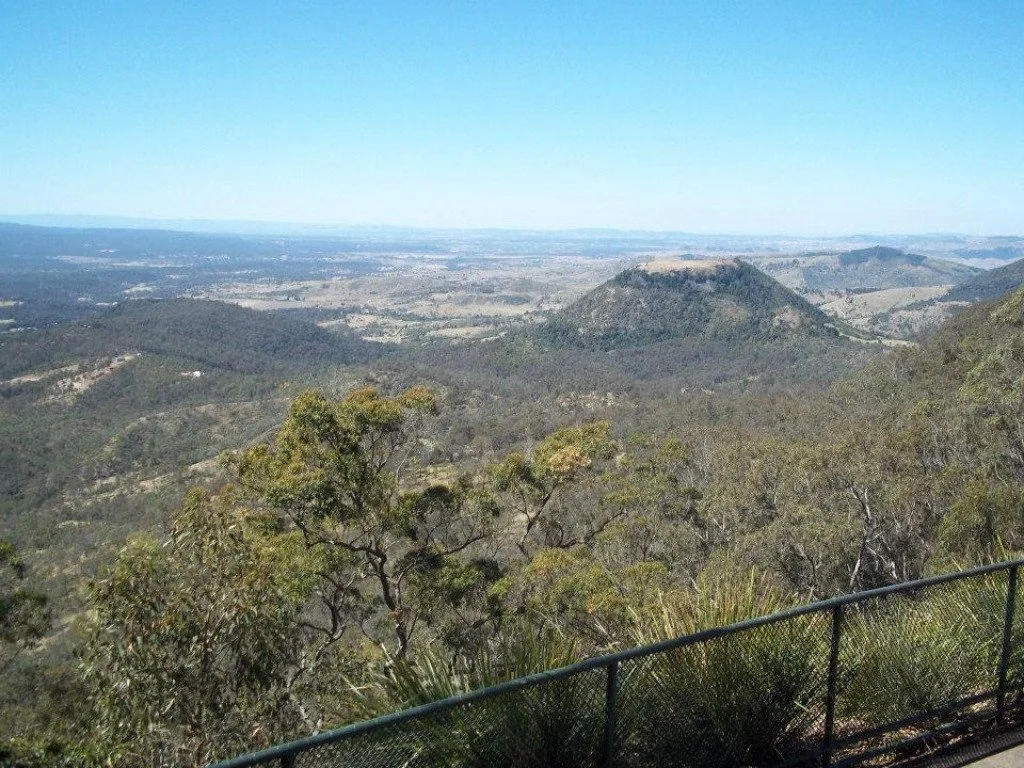
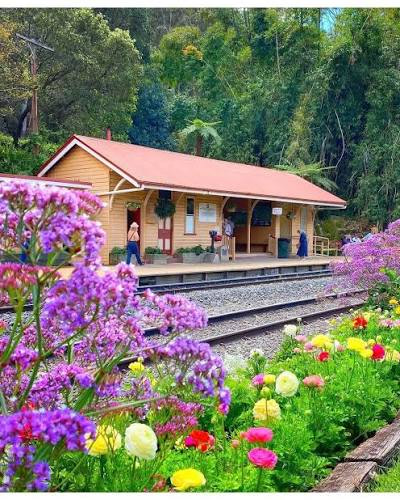
Here is the quiet truth this article has been circling: the reason ballooning near Toowoomba is worth chasing — that extraordinary patchwork of valley and Range — is fully visible without leaving the ground, and Cooee has been showing it to people from a coach seat for decades. The climb up the Toowoomba Range is the region's great free spectacle: the road winds up the escarpment with the Lockyer Valley falling away behind, and a high coach seat turns the ascent into a slow-motion aerial view that no car driver, eyes glued to the bends, ever properly sees. At the top, Picnic Point hangs the whole valley below you from a railed terrace, and Spring Bluff's heritage railway station sits tucked into the Range like a diorama.
The coach version has three arguments the balloon cannot match: it runs on schedule regardless of wind, it costs a fraction of a flight, and it includes the gardens, the commentary and the company. A Cooee day tour from Brisbane covers the Range, the Carnival gardens and the escarpment lookouts from $89 adult — with Gold Coast and Sunshine Coast departures too — and nobody has ever had a coach tour scrubbed for turbulence. The honest recommendation is not either-or but both, budget permitting: fly at dawn once for the miracle, and let the coach do the reliable, repeatable version of the view. If the budget picks one, pick the one that is guaranteed to happen, and let the balloon be the excuse for the return trip.
Lookouts: the free version of altitude
Between a balloon flight and a coach seat sits a third option that costs nothing at all: Toowoomba's escarpment lookouts, which deliver a genuine high-altitude panorama for the price of walking to a railing. Picnic Point is the flagship — the Lockyer Valley spread below, Tabletop Mountain in the foreground, a cafe within strolling distance — and it shares ballooning's love of golden light, with the difference that it performs at both ends of the day. Sunrise from the lookout gives you a version of the balloonist's dawn — mist in the valley, long shadows, that first-light gilding — with a thermos in hand and no alarm-clock negotiation beyond your own.
The lookout comparison is worth taking seriously rather than as a consolation prize. What a balloon adds is motion, the floor dropping away and the champagne-adjacent theatre of the thing; what the escarpment adds is time — you can stand at the edge for two hours as the light changes, walk the trails, come back after dinner. Photographers in particular often get more keepers from an unhurried evening at the railing than from a single fast-moving flight. The ideal Toowoomba trip stacks the altitudes: escarpment on day one to learn the landscape's shape, balloon at dawn on day two to float through it, and the coach ride down the Range at dusk to say goodbye to it. Each one makes the others better.

Building the two-day version
If the flight is the anchor, build the weekend around its failure modes. Day one: early departure from Brisbane, dawn flight in the valley country, late breakfast, then up the Range for an afternoon of Toowoomba's gardens and an evening on Margaret Street. Day two: the escarpment in morning light, the Cobb+Co Museum or a second round of gardens, a long Darling Downs cafe lunch, and the run home. If the weather scrubs the day-one flight, everything shuffles painlessly — Toowoomba absorbs the extra day without complaint, and the flight moves to day two's dawn with the escarpment as its backup. This is the resilient version of the plan: no single cancellation can hole it below the waterline.
For travellers who would rather not run their own logistics, the structure maps neatly onto Cooee's 2-day weekend tour from $595, which handles the Toowoomba half — Range, gardens, escarpment, accommodation and a proper unhurried pace — while you arrange the flight directly with an operator around it. Groups planning a bigger production, as the original article notes, can go full charter and have the coach itinerary built around a launch schedule. Either way the underlying principle holds: let the balloon be the garnish, not the plate. A weekend that treats Toowoomba as the certainty and the flight as the weather-permitting bonus ends happily in every version of the forecast.
The honest verdict
Should you build a balloon flight into a Toowoomba trip? If your schedule has slack, your knees can manage a basket wall and a 4am alarm reads as adventure rather than assault — yes, emphatically. Sunrise over the valley country east of the Range is one of South East Queensland's genuinely great experiences, and pairing it with the Garden City's spring gives the whole trip an amplitude that neither half achieves alone. Go in with the right expectations: book direct, confirm details close to travel, treat the weather as a co-author of the plan, and hold the whole thing lightly. The travellers who have a bad time ballooning are almost always the ones who tried to schedule certainty into an activity whose entire charm is surrender.
And if the basket never leaves the ground on your dates — it happens, and no operator can promise otherwise — the region has already built you the consolation. The Range climb by coach, the railing at Picnic Point, Spring Bluff in its cutting, the Downs rolling west from the crest: this country hands out altitude generously at ground level, and during the Carnival of Flowers it dresses for the occasion. Take the day tour, stand at the escarpment at golden hour, and you will understand exactly what the balloonists are chasing. Then book the flight for next time. The best travel regions give you a reason to come back; this one gives you a sunrise.
See the Carnival the easy way
Cooee Tours runs coach day tours from $89pp and 2-day overnight tours from $595pp — no traffic, no parking, local driver-guide included.
Carnival of Flowers Tours