Tour or Drive?
Wine tours versus self-drive, honestly
We run wine tours, so treat what follows accordingly — but there are real situations where driving yourself is the better call, and we would rather say so than pretend otherwise.
The real question
This is not really about wine
People frame this as a preference — do you like being driven, or do you like the freedom of your own car. That is not the question. The question is what happens to the day when the person behind the wheel cannot drink, and whether the road you are on forgives a driver who is tired, unfamiliar with it, or a little further through a flight than they meant to be.
Answer those two honestly and the decision usually makes itself. This page sets out the law, the roads, the money and the practical differences, and then says plainly which situations point which way.
The constraint
What the law actually says
In Queensland, a driver on an open licence must have a blood alcohol concentration below 0.05. Learner, P1 and P2 licence holders — and drivers of certain vehicle classes including buses and heavy vehicles — must be at zero. There is no allowance for having eaten well, for being a big person, or for feeling fine.
Tasting pours add up faster than people think
A cellar-door tasting pour is small, which is exactly why the risk is easy to underestimate. A flight of six at one venue is not a trivial amount, and across three or four venues in a day the total is well beyond what most people picture when they say they will "just have a sip". Alcohol also clears at a rate you cannot speed up — coffee, food and fresh air change how you feel, not your reading.
Spitting helps, but only if you actually do it
Using the spittoon is normal, expected cellar-door behaviour and it genuinely works. The catch is that almost nobody sustains it across a whole day, particularly once lunch and a good conversation are involved. If your plan depends on the driver spitting every pour at every venue, it is a fragile plan.
The roads
What the drive is actually like
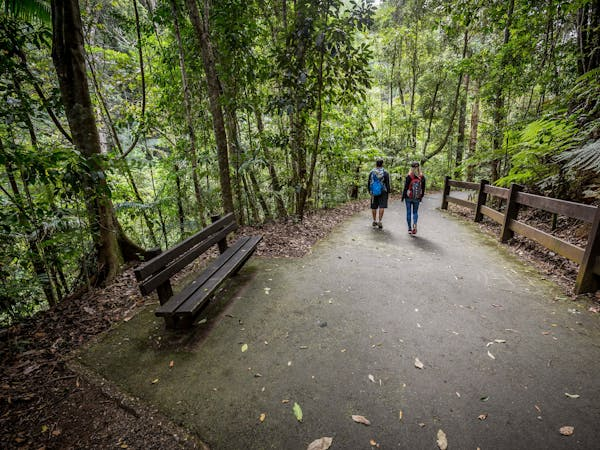
This is the part people underestimate, because the map makes it look like an hour on a highway. Most of it is. The last part is not.
Getting onto the plateau
Tamborine Mountain sits well above the coastal plain, and every road up it climbs and winds. They are sealed, signposted and used by ordinary traffic all day, so this is not an expedition — but they demand attention, they are slow behind a caravan, and there is limited room to overtake. A driver who does not know them will take them cautiously, which is correct and also means the trip takes longer than the estimate.
The Lamington roads are a step harder
If your day includes O'Reilly's in the Canungra Valley, understand that the road up to it is long, narrow and winding, with sections where two cars need to cooperate. The same is true of the approach to Binna Burra. These are genuinely tiring drives, and the second one — the descent, at the end of the day, into low afternoon sun — is the one that catches people.
Weather changes the calculation
The hinterland catches cloud and rain the coast does not. Low cloud on the plateau reduces visibility quickly, and the roads become slick well before you would expect. In summer, afternoon storms are common and can arrive fast. None of that makes the drive unsafe for a careful driver — it does make it a job rather than a pleasure.
Distance is not the useful measure
Tamborine Mountain is not far from the Gold Coast beaches in kilometres, and that is exactly what misleads people. The motorway section moves quickly; the climb does not, and neither does the plateau itself, where the speed limits are low and the traffic between venues is slower than the map suggests. Budget an hour each way from the coast and treat anything better as a bonus. The Canungra Valley and the Lamington roads take longer again.
Parking
Straightforward at most venues and tight at a few, particularly on weekends when the mountain is busy and the gallery walk fills. Larger vehicles have fewer options, which is one practical reason charter operators know which venues can take a coach and which cannot.
Cost
Where the money actually goes
We are not going to quote you numbers that will be wrong in three months. What is stable is the structure of the cost, and that is what determines which option is better value.
| Cost | Self-drive | Guided tour |
|---|---|---|
| Getting there | Fuel, and hire car if you do not have one. Fixed regardless of group size. | Included, and generally priced per person. |
| Tastings | Paid individually at each venue. Some waive or credit the fee against a purchase. | Usually some included; check exactly how many before booking. |
| Lunch | Your choice, your cost, your booking to make. | Often included, sometimes an add-on. This is the biggest variable between operators. |
| The driver | Free, but one person gives up the day's main activity. | Included. Everybody participates. |
| Scales with group size | Barely — a car costs the same with two or four in it. | Yes, per person, until you reach charter territory and it flips again. |
The crossover
For two people visiting one or two venues, self-drive is almost always cheaper. For four to six people doing a full day across three or four venues with lunch, the two options land close enough together that cost stops being the deciding factor. Past about eight people, a charter starts to look better than multiple cars — and considerably better than multiple cars plus the parking and the convoy problem.
What is genuinely hard to compare
Tour inclusions vary so widely between operators that a headline figure tells you very little on its own. One operator's price covers four tastings and a two-course lunch; another's covers transport and a single pour, with everything else paid at the venue. Comparing those two numbers as though they describe the same day is the most common mistake people make when shopping around. Get the inclusions in writing before you compare anything.
The cost nobody counts
The designated driver's day. If you would have to pay somebody to give up the thing you came for, it has a value — and on a two-person trip it is effectively half the enjoyment of the day. That is not an argument that settles anything on its own, but it belongs in the sum.
The answer
Which one is right for you
Drive yourself if…
You are visiting one or two venues
A single cellar door with lunch is an easy self-drive afternoon, and one modest flight is well within a careful driver's limit. Bringing in a vehicle and a guide for that is over-engineering the day.
Somebody genuinely does not mind not drinking
Not "will take one for the team" — genuinely does not mind. Plenty of people would rather drive a pretty road than taste eighteen wines, and if you have one of them, the constraint disappears.
You want to build your own day
Cellar doors plus a waterfall walk plus a lookout plus two hours doing nothing is a lovely day and it does not fit a schedule. If the wine is one part of a broader hinterland trip, your own car gives you something no tour can.
You are travelling with young children
Car seats, nap timing and the ability to leave immediately are worth more than the tasting. Several venues are genuinely good with children — but on your own terms.
You are staying up there
If your accommodation is on the mountain or in the valley, the drive that makes a tour worthwhile has already been done. Short local trips between venues are a different proposition.
Take a tour if…
Everyone wants to taste
The single clearest case. If nobody in the group wants to be the driver, the decision is already made and everything else is detail.
You are a group of six or more
Multiple cars means a convoy, and a convoy means somebody gets lost, somebody parks somewhere else, and the group arrives at the first venue across twenty minutes. One vehicle removes an entire category of problem.
It is an occasion
Birthdays, hens and bucks days, anniversaries and corporate days all share a property: the point is that everyone is together and nobody is working. A designated driver is working.
You want to cover ground
Three or four venues across two sub-regions in a day is doable with a driver who knows the roads and exhausting without one.
You do not know the area
Venue opening days here are genuinely inconsistent, some of the best places are easy to miss, and the difference between a good hinterland day and a mediocre one is mostly knowing which combination works. A guide is buying you that as much as the driving.
The day itself
How the two days actually differ
Cost and legality decide most of this, but the texture of the two days is different in ways worth knowing before you commit.
Pace
A tour runs to a schedule because it has to — venues expect groups at particular times and lunch is booked. That is a genuine constraint if you fall in love with the second cellar door and want to stay. Driving yourself, you can. The flip side is that the schedule is also doing work for you: without one, a lot of self-drive days lose an hour somewhere in the morning and end up cutting the last venue.
Who you spend it with
A scheduled tour puts you with strangers, which some people enjoy and some do not. On a good day it is sociable and you get recommendations you would not have found. On a bad one it is a long time in a small vehicle with people you would not have chosen. A private charter or your own car removes the variable entirely.
What you learn
This is the underrated difference. A driver who works these roads weekly knows which venue is pouring something interesting this month, which one has just changed hands, and which one is closed today despite what the website says. That local currency is genuinely hard to replicate from a browser, and it is most valuable to visitors who have never been up there.
The end of the day
The clearest practical difference and the one people feel most. Being dropped at your accommodation at five in the afternoon is a materially different experience from a forty-five minute descent, the motorway and finding a park. If the day has been a good one, that last hour is when the choice pays for itself or does not.
The middle ground
The option most people forget
The choice is usually presented as scheduled tour or own car. There is a third option that suits a lot of groups better than either: a private charter, where you keep the itinerary and hand over only the driving.
What it changes
You choose the venues, the timings and the pickup points. You can put a rainforest walk in the middle, skip lunch at a cellar door and eat somewhere else entirely, or spend two hours at one place because the group is enjoying it. A scheduled tour cannot do that, and your own car cannot do it with everyone drinking.
When it makes sense
Broadly from about eight people, and clearly so past a dozen. It is also the answer for mixed groups — the party where four people want cellar doors, three want a waterfall and one wants a distillery. And it is usually the right structure for anything with a reason attached: a birthday, a team day, a wedding party, visiting family.
Before you commit
Questions worth asking either way
If you are booking a tour
Ask how many tastings are included and at which venues, because "wine tour" covers everything from four full flights to one token pour. Ask whether lunch is included or an add-on — this is the single biggest difference between operators at similar headline prices. Ask what the group size is, since a small group moves through a cellar door very differently from a full coach. Ask where pickup happens, as some operators use central points rather than door-to-door. And ask what happens if a venue is closed, because in this region that is a real possibility rather than a hypothetical.
If you are driving
Confirm opening days for every venue you plan to visit, not just the first — midweek closures are common and the smaller estates are the most likely to catch you out. Book lunch, particularly on a weekend. Decide who is driving before you leave, not at the second cellar door. Check whether your chosen venues have non-alcoholic options so the driver has something worth having. And take a cooler bag, because anything you buy will otherwise sit in a hot car for the rest of the day.
Either way
Build the day around two or three venues, not five, and put something that is not wine in the middle of it. The hinterland's advantage over other Australian wine regions is that the rainforest, the waterfalls and the lookouts are right there — and a day that uses them is better than a day that does not, whoever is driving.
Common questions
Tour or drive: your questions
Can I drive to the Gold Coast wineries and still taste?
Only within the legal limit, which for a fully licensed Queensland driver is a blood alcohol concentration below 0.05. Learner, P1 and P2 drivers must be at zero. Standard tasting pours are small, but a full flight at three or four cellar doors adds up quickly, and there is no reliable way to self-assess. If you intend to taste properly across several venues, you should not be the driver.
How bad are the roads to Tamborine Mountain?
Not dangerous, but demanding. Every access road onto the plateau climbs and winds, with tight corners and limited overtaking. They are sealed and perfectly manageable for an alert driver in good conditions. In rain, in low cloud, at dusk, or with a driver who has been tasting, they are a lot less forgiving — and the Lamington roads to O'Reilly's and Binna Burra are harder again.
Is a wine tour cheaper than driving?
Rarely for two people, often for six or more. Self-drive costs you fuel and possibly a hire car and pay separately for every tasting and lunch. A tour bundles transport with a driver and usually some of the tastings. The crossover point depends on group size and how many venues you visit — the more people and the more stops, the better a tour looks.
What does a designated driver miss out on?
More than people expect. They miss the flights, obviously, but they also spend the day managing corners and car parks rather than relaxing, and they carry the responsibility for everyone else. If the designated driver is one of a couple, it is worth asking whether either of you actually wants that day.
Are there non-alcoholic options for drivers?
Increasingly yes. Several hinterland venues now carry non-alcoholic wine and sparkling, and there is good coffee and food across the mountain. It is worth checking before you choose venues if somebody in the group is driving, because the provision is genuinely uneven.
Can I take a rideshare to the wineries?
Getting up there is usually possible. Getting back can be a problem — coverage in the hinterland is thinner than on the coast, and a late-afternoon pickup from a cellar door on a quiet weekday is not something to rely on. If you go this way, arrange the return in advance rather than assuming.
Is there public transport to the hinterland cellar doors?
Nothing useful. There is no practical public-transport route from the Gold Coast beaches to the Tamborine Mountain or Canungra Valley venues. Your options are a car, a rideshare, a tour or a private charter.
What size group makes a private charter worth it?
Broadly from about eight people upward, and it becomes clearly better past a dozen. Below that a scheduled shared tour usually makes more sense. A charter buys you the itinerary — your venues, your timings, your pickup points — which matters most for celebrations, corporate days and mixed groups with different interests.
When is self-drive genuinely the better option?
When you are only visiting one or two venues, when somebody in the group is happy not to drink, when you want to combine the cellar doors with walks or waterfalls on your own schedule, when you are travelling with young children, or when you are staying in the hinterland rather than on the coast. In those cases a tour buys you less than it costs you.
Can we do a tour and still see the national parks?
Yes, and the better hinterland days are built this way. A tour that visits two cellar doors and includes a rainforest walk or a waterfall stop is a more enjoyable day than four tastings in a row, and it solves the problem of a group where not everyone is there for the wine. Ask when you book rather than assuming the itinerary is fixed.
Decided a tour is the answer?
Tell us the date, the group size and whether you want the mountain or the valley. We will come back with a plan rather than a brochure.