Toowoomba Street Art: The Self-Guided Walk
Between the sandstone banks and Federation pubs, Toowoomba hides one of regional Australia's best public art collections. You just have to look down the laneways.
How a garden city became a mural city
Through the mid-2010s, the First Coat street art festival brought Australian and international artists to Toowoomba's blank walls, year after year — and when the festival wound up, the walls stayed. The legacy is dozens of large-scale murals threaded through the CBD's laneways and side streets, layered against Victorian and Federation architecture in a way few Australian cities can match, with new works still arriving since.
The walk
There's no single official route, and that's the charm — the collection is dense enough in the blocks around Ruthven and Margaret Streets that a slow two-hour wander finds the bulk of it. Work the laneways systematically: every gap between buildings in the central grid is a candidate, and the best pieces are often a deliberate half-block off the main streets. Toowoomba Regional Council and the visitor information centre publish current mural maps if you'd rather hunt with a list.
The rule of the walk: if a laneway looks like nothing, check it anyway. That's where the good ones live.
Pair it with the heritage streets
The murals share their blocks with one of Australia's better-preserved 19th-century streetscapes, which makes the walk a two-for-one — contemporary paint against colonial sandstone. Our heritage walking guide covers the buildings; do both in a single loop and you've read the whole city in an afternoon.
Practicalities
Flat, walkable, free, and good in any season — street art is the classic Toowoomba wet-weather and winter activity, and the cafes are never more than a block away for warming stops (the coffee guide maps those). Photographers: overcast light is your friend here — murals hate hard shadows as much as flower beds do.
On a Cooee day tour
Our Toowoomba day tours include free time in the city centre — enough for a laneway loop between the gardens and lunch. Tell your driver-guide you're chasing murals and they'll point you at the current favourites.
A collection that refuses to hold still
The most useful thing to understand before you set out is that Toowoomba's street art is a living collection, not a fixed one. Murals weather in the Range's honest climate, buildings change hands and get repainted, and new commissions keep arriving through council programs, business owners and the artists themselves — so the wall that anchored last year's photographs may be a different picture this year, or scaffolding, or gone. Treat that as the point rather than the problem. A street art city is a gallery that rehangs itself continuously, and the walk you take this spring is genuinely unrepeatable, which is more than any museum can offer.
It also means you should hold route advice loosely, including ours. The reliable constant is geography: the laneways and side streets off Ruthven and Margaret Streets remain the core of the collection, as they have since the festival years, and the density thins as you move out from that central grid. Our street art page keeps the practical overview current, and the visitor information centre's maps track individual works — but the walk itself rewards the explorer's method over the completionist's. Wander the core, check every gap, and let the city surprise you.
What the festival years actually changed
It is worth pausing on why the First Coat era mattered, because the festival's real legacy is bigger than the murals it left. Before it, large-scale wall art in a conservative regional city was a permission problem — every blank wall had an owner with doubts. The festival years solved that culturally: building owners saw finished works raise the tone of their laneways rather than lower it, the council learned to say yes, and the public learned to walk down service lanes on purpose. By the time the festival era wound up, the machinery of a mural city — willing walls, willing artists, an audience — had become self-sustaining.
That is why the collection kept growing after the event stopped, and why it now spans styles the way few single-festival cities do: photorealism next to abstraction, giant fauna next to quiet typography, international names layered against local ones. The works rotate, but the ecosystem endures, and you can read the whole story on the walls themselves — older pieces going nobly chalky beside fresh paint, walls on their second or third life, the occasional patch of primer promising the next chapter. Toowoomba effectively volunteered to become a permanent open-air gallery, and then, more unusually, followed through.
How to look: the walk as a skill
Street art hunting improves quickly with technique, and the first technique is pace. Walk at half your usual speed and the hit rate roughly doubles — most misses happen because a piece sits behind you, above you, or three metres down a gap you strode past. Build the habit of turning around at the end of each lane; murals face the direction their audience arrives from, which is not always the direction you are walking. Look high for the wall-sized statements, low for the small interventions — painted meter boxes, stencils, paste-ups and tucked-away miniatures that operate as the collection's footnotes.
The second technique is systematic coverage. The central grid is compact enough to be worked like a search pattern: pick the block bounded by the two main spines, walk its perimeter, then thread every lane and arcade that crosses it before moving to the next block. Two hours covers the core this way without hurry. The third technique is talking to people — baristas, shopkeepers and gallery staff all track the newest walls the way other locals track weather, and a single “anything new gone up lately?” will often redirect your whole afternoon for the better.

Beyond the walls: the rest of the culture in one city block radius
The murals are the loudest part of a broader cultural scene that deserves the same afternoon. Toowoomba's CBD holds a regional art gallery with a serious collection, independent galleries and studios in the same heritage blocks as the street art, a restored theatre that anchors the performing arts, and a calendar of openings and live music that punches well above the city's size. The pleasant consequence for walkers is that the culture is arranged at walking density: you can move from a laneway mural to a gallery room to a theatre foyer inside ten minutes, all under the same run of awnings.
If you want the full picture — galleries, venues, public art and how the scenes fit together — our street art and culture guide maps it properly. The short version for planning purposes: allow half a day rather than two hours if you are gallery-inclined, check what is on at the theatre before you fix your date, and note that wet weather barely dents the itinerary — the indoor and outdoor halves of Toowoomba's art offering trade off against each other as the sky demands. It is the best bad-weather day in regional Queensland.
Photographing the walls
Murals are deceptively hard to photograph well, and the laneway environment sets the difficulties: tight sightlines, high contrast, and parked service vehicles with impeccable timing. The tools that help most are a wide lens — something in the 16–24mm range lets you take in a two-storey wall from a lane four metres wide — and patience with light. Overcast days are genuinely ideal, killing the hard shadows that slice laneway walls on sunny afternoons; failing cloud, shoot walls while they are fully in shade rather than half-lit. Keystone distortion is the giveaway of a rushed mural photo, so square up to the wall when you can and correct in software when you cannot.
The better photographs usually include the city. A mural filling the frame is documentation; a mural with the laneway's brick, fire escapes and distant heritage parapets around it is a photograph of Toowoomba — and adding a person for scale turns the good ones excellent. Respect the working laneways while you shoot: stay clear of loading docks, keep out of businesses' doorways, and ask before photographing people. The collection photographs differently every season, which is one more argument for repeat visits — winter's moody grey and spring's festival colour produce entirely different albums from the same walls.
The dusk lap
Most visitors walk the murals in daylight and leave before the city's second act, which is a mistake. In the last hour of light the laneways change character completely — the low sun reaches down some lanes and ignites the west-facing walls, colours saturate, and the contrast between glowing paint and darkening brick gives the collection a theatricality that flat noon light never manages. As dusk settles, Margaret Street's heritage run lights up, the evening trade spills onto the footpaths, and a final slow lap of the core delivers murals, architecture and street life in a single circuit.
The dusk lap is also the natural bridge between an art afternoon and a Toowoomba evening. Finish the walk at the theatre end if there is a show on, or simply let the lit awnings steer you to dinner inside the same blocks you have spent the day reading. For photographers, the blue-hour window — roughly twenty minutes after sunset — is the bonus round: enough ambient light to hold the murals, enough darkness for the street lights to warm the frame. Bring a steady hand or a small tripod, and expect to be the last person in the lane and glad of it.

Carnival season: the walk at festival pitch
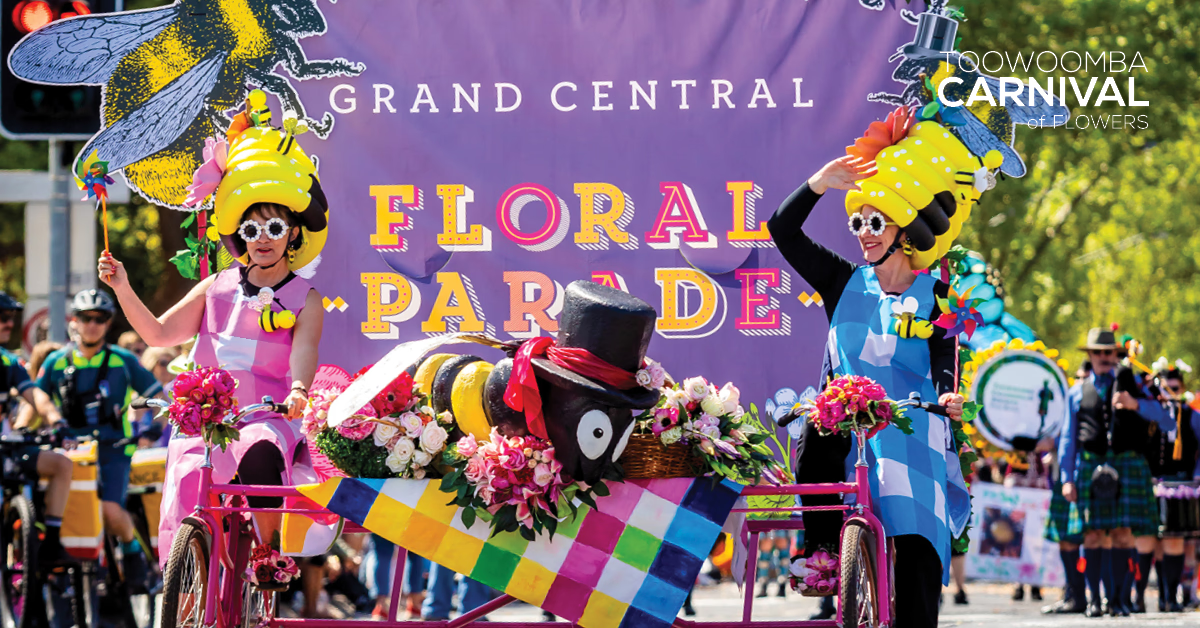
In spring the street art walk acquires a festival around it. The Toowoomba Carnival of Flowers — 18 September to 5 October in 2026, the city's 77th — floods the CBD with visitors, colour and programmed events, and the laneways become the connective tissue between garden venues, market stalls and stages. Parade day is the pinnacle of the overlap: the Grand Central Floral Parade (Saturday 19 September 2026) rolls floral floats through the same central streets the murals overlook, and for one morning the city's two great outdoor art forms — painted and planted — share a single frame.
Tactically, Carnival crowds concentrate on the gardens and the programmed events, which leaves the laneways surprisingly workable even at peak season — a mural hunt is the classic escape hatch when Queens Park hits maximum density at midday. The Carnival markets add food stalls and makers to the city blocks, so the walk gains snack infrastructure it lacks the rest of the year. If you are coming from the coast for it, Cooee's Carnival day tours (from $89 adult / $69 child from Brisbane) land you in the centre with free time built in — enough for the laneway loop between the flowers and the parade.

Doing it with kids: the mural hunt
Street art is the rare cultural outing that children take to faster than adults, because at its heart it is a treasure hunt with a spectacular prize rate. Frame it that way and the walk runs itself: set a tally, award points for spotting works above head height or smaller than a hand, and let the kids navigate lane by lane — their lower eyeline and total lack of dignity about peering into gaps make them genuinely better spotters than their parents. The flat, compact grid keeps small legs viable for the whole loop, and surrender is always one block from a bakery.
The content skews family-friendly — giant animals, birds and playful pieces are a persistent theme of the collection — and the hunt pairs naturally with the rest of a Toowoomba family day: playground time at Queens Park, the transport spectacle of the museum, milkshakes in the cafe blocks. For a wet-weather family visit, the combination of laneway art under awnings and indoor galleries is close to unbeatable. One practical note: laneways are working spaces with occasional vehicles, so keep the hunt on footpaths and corners, and save the photo posing for the pedestrian-only lanes.
Fuel stops: running the walk on flat whites
No street art city feeds its walkers better per metre. Because the mural core and the cafe core occupy the same blocks, the walk can be structured as art punctuated by espresso — a coffee to start, a laneway loop, a pastry, another loop, brunch when the tally hits double figures. The cafes lean into the relationship, with mural-adjacent seating and walls of their own commissioned from the same artist ecosystem, so the line between gallery and dining room blurs agreeably. Downs portions being what they are, one proper cafe meal fuels the entire circuit.
The scene changes hands and hours like cafes everywhere, so check current openings rather than marching to a specific door — but you will never be more than a block from somewhere good in the core grid, and the locals' queue remains the most reliable guide published. Sunday afternoons and Mondays run quietest, which suits walkers who prefer empty lanes and does not suit walkers who prefer open kitchens; choose your priority. Either way, the art-and-coffee pairing is the walk's greatest luxury: nowhere else in regional Australia can you critique a two-storey mural without letting your flat white go cold.

Etiquette for a gallery that people live in
The walk crosses a functioning city, and the collection survives on the goodwill of the people who own its walls, so a little etiquette protects the whole arrangement. Laneways here are still service lanes: give delivery drivers right of way, keep clear of loading docks and back doors, and treat private courtyards as private even when a tempting corner of paint shows over the fence. Businesses whose walls carry murals are hosts, not amenities — buying a coffee from the cafe whose wall you have just photographed is the walk's version of a gallery donation, and it is noticed.
Respect the work itself the same way. Touching murals accelerates exactly the weathering that shortens their lives, climbing for a better angle is how paint and walkers both get damaged, and tagging over commissioned pieces is the one act the whole ecosystem — artists, owners, council — unites against. Photograph freely, share generously, and credit artists where signatures or the current maps make attribution possible; visibility is a real currency for working muralists, and the visitor who posts a credited photo is quietly funding the next wall. The collection exists because thousands of small courtesies keep compounding. Add yours.
Getting here, and the case for the coach
Toowoomba sits about 125 kilometres from Brisbane — roughly 1.75 hours up the Warrego Highway and the Range — and the street art walk is close to the perfect day-tour anchor because it needs no tickets, no bookings and no weather. Drivers should park once on the CBD fringe and stay on foot; the walk's entire logic collapses if you try to do it by car, and central parking tightens sharply in festival season. Coach travellers have it simplest of all: a city-centre drop-off puts you inside the core grid from the first minute.
Cooee Tours' Toowoomba tours — from the $89 Carnival day tours up to the 2-day weekend from $595 — all include free city time that fits a laneway loop, and the driver-guides keep genuinely current on which walls are worth the detour this month, which no printed map can promise. The 2-day format suits art-lovers best: it buys you the dusk lap and a second morning in the lanes, which is when the collection stops being a checklist and starts being a place you know. Questions, or a group with mixed interests to please? Call 0409 661 342 — splitting a coach group between gardens, galleries and laneways is a solved problem.
The verdict
Toowoomba's street art walk is the best free cultural experience on the Darling Downs, and it might be the best in regional Queensland — not because any single wall would stop traffic in Melbourne, though several would, but because of the whole: a genuinely deep collection, threaded through an intact heritage grid, at walking density, with excellent coffee as the connective tissue. It asks two hours minimum and rewards a full day. It works in rain, heat, winter and festival crush. And because the works rotate, it is one of the few attractions anywhere that is measurably different every time you come back.
Our honest advice compresses to five lines. Walk the core grid slowly and check every gap. Get a current map from the visitor centre or the council, then be willing to abandon it. Time your loop to end at dusk. Spend money in the laneways whose walls you photograph. And come back — in spring for the Carnival's colour, in winter for the empty lanes and moody light — because a gallery that rehangs itself deserves a second visit, and Toowoomba, quietly, has become one of the best galleries in the country. It just keeps its doors on the outside of the buildings.
Seasons of the wall: when to walk it
Every season reshuffles the walk's virtues, so it helps to choose on purpose. Spring is the social season — festival energy, the city at its busiest and best-dressed, and the flower–mural double act at full strength — at the price of company in the popular lanes. Summer on the Range is milder than the coast's but still asks for early starts; the upside is long evenings that stretch the dusk lap to luxurious length. Autumn is the sleeper pick: stable light, thin crowds, and the deciduous street trees adding their own colour to laneway sightlines. Winter is for purists — cold, clear mornings, fog that turns the lane mouths cinematic, empty footpaths and cafes with fires going. There is no wrong answer, only different walks wearing the same map.
Weekday versus weekend matters nearly as much as season. Weekdays give you working laneways — more delivery vans, but also the city going about its actual life, which is the context the murals were painted for. Weekends empty the service lanes and fill the cafes, making Saturday morning the single most comfortable window for a first visit: quiet walls, open kitchens, and the whole core grid at its most photogenic before the brunch rush peaks. However you time it, build in slack — the reliable experience of this walk is that it takes longer than planned, because the lane you meant to stride through had other ideas.
See the Carnival the easy way
Cooee Tours runs coach day tours from $89pp and 2-day overnight tours from $595pp — no traffic, no parking, local driver-guide included.
Carnival of Flowers Tours