Toowoomba Heritage Walk: The Architecture Trail
Toowoomba's 19th-century wealth built it one of Australia's better-preserved regional streetscapes. Two hours on foot reads the whole story.
Why the buildings are this good
Toowoomba boomed as the capital of the Darling Downs through the late 1800s, when wool, grain and the audacious railway up the Range poured money into the young city — and the money built to last. Because later booms treated the city gently, the centre keeps an unusually intact run of Victorian and Federation architecture: sandstone banks, ornate verandahed pubs, civic halls and churches, all still working buildings rather than museum pieces.
The city-centre loop
Start on Ruthven and Margaret Streets, the historic commercial spine, where the grandest facades cluster — banks built like temples, emporiums with their iron lacework, and corner pubs holding their ground since the coaching era. The Empire Theatre is the jewel: a beautifully restored theatre whose auditorium is worth timing a show around. City Hall, the historic post office precinct and the civic churches round out the loop, with the street art laneways threading the contemporary counterpoint between them.
Look up. Toowoomba's ground floors have been modernised like every Australian main street — the 19th century survives from the awnings upward.
Beyond the loop
The heritage belt continues into the older residential streets, where Federation homes and established gardens set the scene for jacaranda season. The Cobb & Co Museum puts the coaching-and-railway story behind the buildings into context — do the museum after the walk and the streetscape snaps into focus. Further out, Spring Bluff Railway Station is the heritage walk's country cousin: the Range railway's showpiece stop, kept in bloom for over a century.
Doing it well
Two hours covers the centre at a reading pace; add the museum and it's a half-day. Flat, free and weatherproof under the awnings, it slots naturally between gardens on any itinerary — the two-day plan runs it Saturday afternoon. The visitor information centre stocks heritage trail maps if you want names and dates for every facade.
The seventy-year boom that built the streetscape
To read Toowoomba's architecture you first need the economics, and the economics run in one long arc from the 1860s to the 1930s. Wool came first: the Darling Downs' pastoral runs generated the kind of money that wanted town houses, banks to sit in and churches to be seen in. Then the railway climbed the Range in the 1860s — an engineering feat that regional Queensland still dines out on — and Toowoomba became the funnel through which the entire Downs traded with the coast. Grain, dairy and beef broadened the base, merchants and professionals thickened the middle, and for seven decades nearly every year added another substantial building to the grid.
The end of the arc matters as much as the beginning. The prosperity ran long enough to leave layers — Victorian confidence, Federation flourish, interwar restraint — but it tapered before the post-war decades that flattened so many Australian main streets in the name of progress. Toowoomba modernised its shopfronts and paved its car parks like everywhere else, yet the wholesale demolition that gutted comparable cities largely passed it by. What survives is not a curated precinct but an honest cross-section of a boom: the buildings stand where commerce put them, still doing approximately the jobs they were built for, which is precisely what makes the walk feel like reading rather than sightseeing.
Reading the layers: Victorian, Federation, interwar
The trail rewards a little period literacy, and the shorthand is simple. The Victorian generation announces itself with symmetry and classical borrowings — columns, pediments, heavy cornices — because the institutions of a young colonial city wanted to look older and more permanent than they were. The Federation generation, arriving around the turn of the century, relaxes: redder brick, more romantic rooflines, decorative gables and the exuberant ironwork that Australians now reflexively associate with heritage pubs. The interwar buildings are the quiet third act — cleaner lines, stripped classicism and early moderne touches, the sound of a boom maturing into respectability.
Once you can tell the layers apart, the streets turn into a timeline you can walk in any order. A single block on the historic commercial spine will often hold all three generations shoulder to shoulder, each one built in the confident expectation of standing forever next to its elders. Do not worry about pinning exact years to facades as you go — the visitor information centre's trail maps carry the documented details for those who want them — the more useful skill is spotting the conversation between the eras: how a Federation verandah defers to a Victorian neighbour, or how an interwar frontage squares its shoulders between two ornate grandparents.
Verandahs, awnings and the art of the top storey
Australian main streets have a signature architecture problem: their most beautiful storey is the one nobody looks at. Toowoomba is the happy exception that proves the rule, because so much of its upper-level fabric survives — parapets bearing original business names, arched windows in matched rows, iron lacework on the verandahed pubs, and the kind of masonry detail that Victorian builders included simply because leaving it off never occurred to them. The street-level awnings, themselves part of the heritage vocabulary, do double duty: they shade the footpath exactly as designed, and they hide the modern shopfront clutter so that a raised sightline delivers the 19th century almost unbroken.
The practical technique for the walk is to use the street's width. Cross to the opposite footpath from whatever you are examining, because the awnings that protect you also block your view upward on the near side. Corner buildings are the reliable rewards — boom-era builders saved their best towers, turrets and curved facades for intersections, where two streets' worth of customers could admire the investment. And keep an eye out for ghost signs, the fading painted advertisements on side walls and upper brickwork; they are the streetscape's marginalia, recording flour brands, drapers and cordial makers that outlived their businesses by a century.
Why the banks look like temples
First-time walkers reliably ask the same question: why does a regional city have bank buildings this grand? The answer is that in the pre-electronic economy, architecture was the balance sheet you could see. A bank competing for the wool cheques of the Darling Downs demonstrated solvency in sandstone — columns, vaulted banking chambers, doors built to suggest a vault behind them — because depositors judged security by masonry. Every institution in town played the same game: insurance offices, stock and station agents, newspaper offices and lodges all built to impress, and the main streets became an arms race of confidence conducted in stone and brick.
The same logic explains the pubs, which functioned as far more than drinking houses. A boom-era country pub was hotel, labour exchange, auction room and coach terminus at once, and its two-storey verandah was both advertisement and amenity — the widest, laciest verandahs marked the establishments where the serious business of the Downs got done over a counter lunch. Walking the trail with that in mind converts ornament back into information: the decoration was never decorative. It was each building stating, as loudly as the planning laws of the day allowed, exactly how much money it expected you to trust it with.
Queens Park: heritage you can picnic on
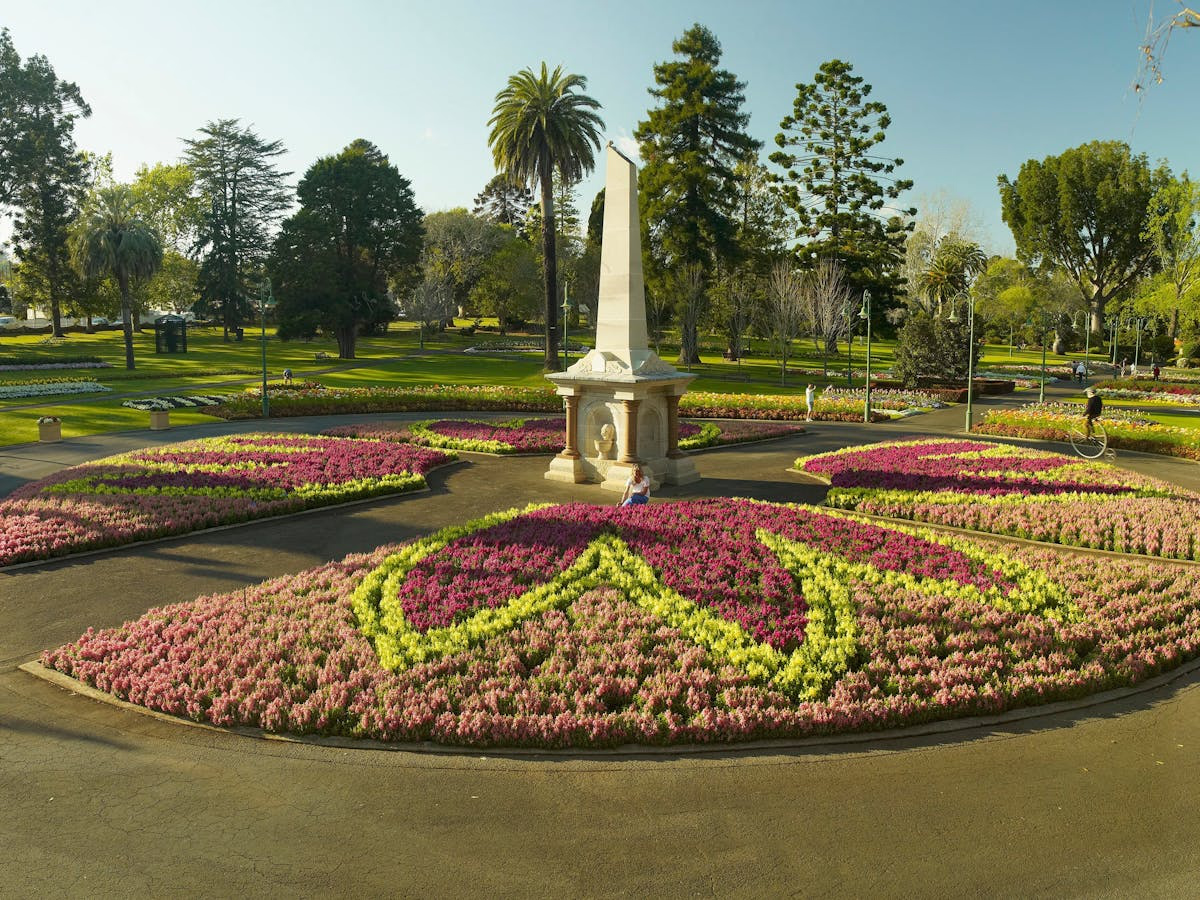
The trail's green chapter is Queens Park, and it belongs on the architecture walk as fully as any bank. Heritage-listed and around 26 hectares, the park was reserved early in the city's life and laid out with the same Victorian confidence as the streets — formal avenues, specimen trees planted by people who knew they would never see them mature, and a botanic gardens corner that has been the city's pride for over a century. This is heritage as landscape: the park is the boom era's statement that a proper city required not just commerce and churches but civic beauty, free to all comers, forever.
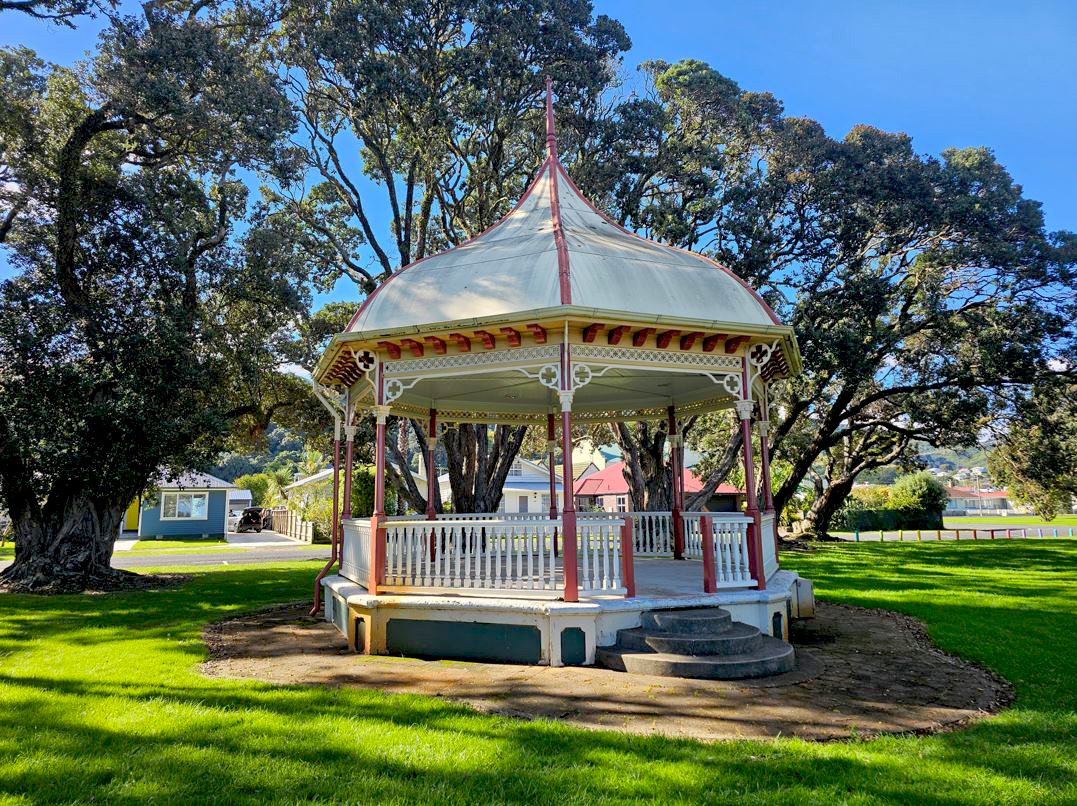
The band rotunda is the park's built centrepiece and one of the most photographed structures in Toowoomba — a classic piece of civic-park architecture from the age when a Sunday brass band was infrastructure, not nostalgia. Around it, the park's furniture of gates, fences and memorials fills in the story of a community furnishing its shared front room across generations. Time your visit for spring and the heritage reading gains a spectacular overlay, as the Carnival of Flowers plantings turn the Victorian layout into the frame for tens of thousands of blooms — the 19th-century bones carrying the 21st-century show.
Before the rails: the Cobb & Co chapter
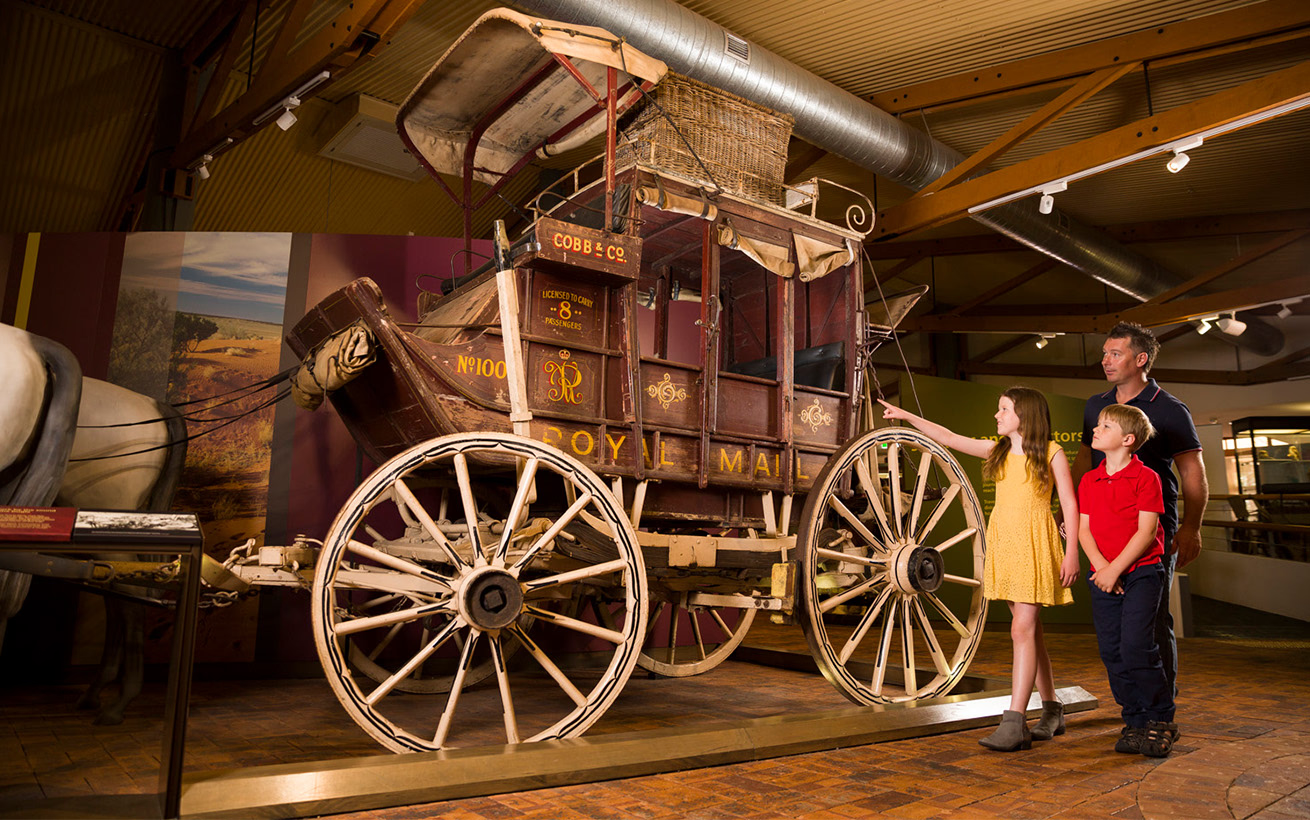
The buildings make more sense once you know what arrived at their doors, and before the railway that was the coach. Toowoomba sat at the hub of the Darling Downs coaching network, and Cobb & Co — the name that became Australian shorthand for horse-drawn transport itself — ran the routes that stitched the Downs' towns to the Range city. The corner pubs on the trail were the physical infrastructure of that system: staging posts where teams were changed, passengers fed and mail exchanged, which is why so many of them anchor intersections on the old approach roads with stables-scaled yards behind.
The full story lives at the Cobb+Co Museum on Lindsay Street, directly opposite Queens Park and therefore a natural final stop on the walk. Its heart is the National Carriage Collection — dozens of horse-drawn vehicles covering the full working vocabulary of pre-motor Australia — and seeing the actual coaches recalibrates the streetscape behind you. The scale of a loaded mail coach explains the width of the old verandah posts; the elegance of a private carriage explains the grandeur of the doorways built to receive it. Do the museum after the streets and the whole city clicks into gear.
The trades that built it, still working
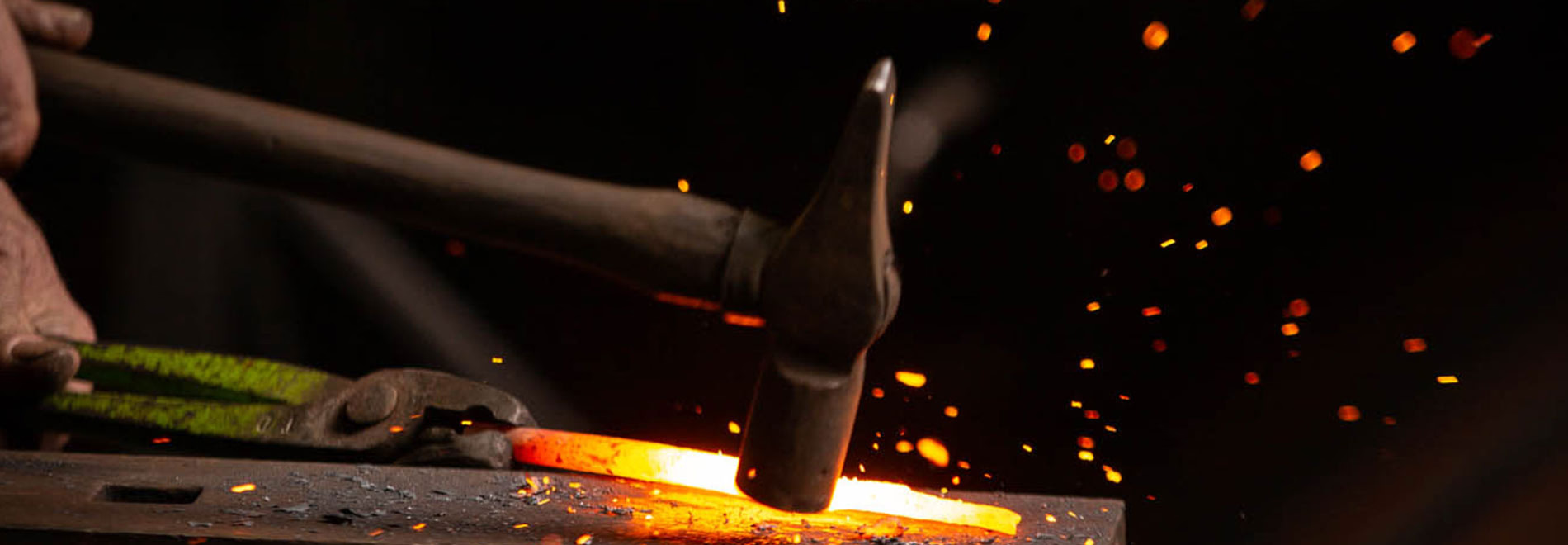
One of the museum's quiet triumphs is that it keeps the boom era's skills alive rather than merely displaying its objects. Its heritage trades program puts working artisans — blacksmithing, leatherwork, wheelwrighting and their cousins — in front of visitors, hammering and stitching with the same techniques that built the coaches and shod the horses of the Downs. Check session times before you visit, but if your timing works, watching a smith draw out hot iron is the single best interpretive aid the heritage walk has: every bracket, hinge and rail you passed on the streets was made exactly this way, one heat at a time.
For anyone walking the trail with children, the trades sessions are also the difference between a dutiful outing and a genuinely good day — architecture is abstract at age eight, but fire, hammers and enormous wheels are not. The museum's hands-on approach gives younger visitors a working model of the pre-motor world, after which the streetscape stops being a row of old buildings and becomes the place where all those wheels and horseshoes were headed. It is the rare heritage experience that works equally well as a scholarly coda for adults and a reward for patient kids.
The golden hour: heritage streets after five
The trail's best light is its last. As the working day empties the footpaths, the low sun comes across the grid and does for the facades what it does for the escarpment — warms the masonry, deepens the shadows in the mouldings, and picks out detail that flat noon light irons away. Margaret Street at dusk is the walk's closing argument: awnings glowing, upper storeys catching the last colour, and the street settling into its evening trade beneath a skyline that has barely changed in a hundred years. If you can only walk the loop once, walk it in the final ninety minutes of daylight.
Evening also solves the trail's one aesthetic nuisance: parked cars and daytime traffic, which thin out after five and leave the streetscape closer to its historic proportions. Stay on into darkness and a second show starts, as the significant buildings switch on their lighting and the theatre district warms up — timing your walk to end at a show is the most stylish structure the itinerary offers. A dinner within the heritage blocks completes it; there is a particular satisfaction in eating inside walls you spent the afternoon reading from the outside.

Photographing the trail
Heritage streetscapes are a genre with rules, and Toowoomba's grid teaches them quickly. Shoot early or late, because raking light is what makes masonry legible — the mouldings, string courses and rustication that vanish at midday become the whole photograph at 7am. Get elevation where you legally can; even a first-floor arcade window or a modest rise in the footpath separates the awning line from the parapets and reveals the street as its builders drew it. And work the corners: the trail's tower-and-turret intersections give you two facades in one frame with sky behind, which is the classic boom-town composition for a reason.
Detail is the second discipline. The trail's most rewarding photographs are often a metre wide, not a block wide — a ghost sign's surviving letters, iron lace against a blue winter sky, the worn brass of a doorplate, the geometry of a pressed-metal awning ceiling. A standard zoom covers the genre, though a longer lens earns its place for compressing parapet details from across the street. Photographers planning a spring visit should note the double opportunity: Carnival plantings put foregrounds of flowers beneath the heritage backdrops, a combination the city's photographers have been exploiting cheerfully for decades.
Carnival season: the streetscape in fancy dress
For three weeks in spring the heritage trail gets a festival laid over it. The Toowoomba Carnival of Flowers — running 18 September to 5 October in 2026, its 77th year — is famous for its gardens, but the city's built fabric is the festival's stage set: floral displays against sandstone, the Grand Central Floral Parade (Saturday 19 September 2026) rolling through the historic commercial heart, and the whole grid busier and better dressed than at any other time of year. Walkers who care about architecture should not be put off by the crowds; the buildings honestly look their best with the city in bloom beneath them.
The tactical adjustment is timing. During Carnival, walk the streets early — before the day-trip influx crests mid-morning — then spend the busy middle of the day in the gardens with everyone else, and return to the facades for the quiet golden hour. If you would rather delegate the logistics entirely, Cooee Tours' Carnival of Flowers day tours run from $89 adult / $69 child out of Brisbane, with the coach handling the Range and the parking while you spend your energy on the city. The heritage loop slots neatly into the itinerary's free time in the centre.
Logistics: the flattest, gentlest great walk in Queensland
Part of the trail's appeal is how little it asks. The heritage core sits on the CBD's gentle grid — no hills worth the name, continuous footpaths, awning cover for most of the commercial spine, and seats, cafes and facilities never more than a block away. That makes it one of the most accessible heritage experiences in regional Australia: wheelchair and walker friendly on the main streets, easily broken into fifteen-minute segments, and entirely free. Brisbane visitors can treat it as the anchor of a day tour from Brisbane — the 1.75-hour coach run up the Range delivers you to the top of the loop with the whole day ahead.
The walk's unhurried pace and level going also explain why it stars on seniors' itineraries. Cooee Tours has been running coach touring since 1974, and the dedicated seniors tours pace Toowoomba exactly the way this trail wants to be paced — unrushed city time, a proper lunch, and a driver-guide who knows which corners hold the best stories. For independent visitors the only real planning decisions are shoes, a hat, and whether to end the day at the museum or the theatre; the streets themselves will handle the rest of the entertainment.
Pair it with the edge of the world
The natural companion to a morning among the facades is an afternoon on the escarpment, because the two experiences explain each other. Picnic Point, on the city's eastern rim, looks out over the Lockyer Valley and the drop the railway builders and coach drivers had to solve — stand at the lookout and the entire logic of Toowoomba's existence assembles itself below you. Every bale of wool and bag of grain that paid for the sandstone came up that slope; every grand facade on the trail is, in the end, a monument to the difficulty of the hill.
As a day's structure it is hard to better: streets in the morning light, lunch in the centre, park and museum through the early afternoon, then the escarpment for the wide view and the late sun over the valley. It converts a walking tour into a complete argument about the city — geography at the lookout, economy in the streets, culture in the park — and it ends with one of southern Queensland's great free views. Pack the camera for both ends of the day; the trail and the escarpment are two halves of the same photograph.
An honest verdict
Toowoomba's heritage trail will not suit travellers who need their history behind glass with an audio guide and a gift shop at the exit — this is a working city wearing its past casually, and the interpretation is mostly the kind you bring with you or pick up from a trail map. That is exactly its strength. Few Australian cities let you walk an unbroken conversation between the 1860s and the 1930s at street level, for free, with excellent coffee at every third corner, and fewer still surround it with gardens, a national museum collection and an escarpment view to finish on.
Give it the two hours as a minimum, but the walk repays a full day and improves with repetition — the streetscape reveals a new ghost sign or parapet flourish every pass, and the seasonal overlays of spring flowers and winter light change the reading entirely. Come during the Carnival for the city at full theatrical dress, or in an ordinary quiet week to have the 19th century largely to yourself. Either way, look up, cross the street often, and finish at the museum; the Darling Downs built its capital to be read slowly, and it is still perfectly legible.
See the Carnival the easy way
Cooee Tours runs coach day tours from $89pp and 2-day overnight tours from $595pp — no traffic, no parking, local driver-guide included.
Carnival of Flowers Tours