Crows Nest & Hampton: The Hinterland Half-Day
Forty minutes north of Toowoomba, the Downs turn to granite country — waterfalls, rock pools, antiques and a hamlet with a serious food reputation. This is the loop.
The shape of the loop
Head north on the New England Highway through Highfields, climb gently along the ridge to Hampton, continue to Crows Nest, walk the national park, and roll home the same way with the westering light on the paddocks. Door to door it's a comfortable half-day from Toowoomba — a full day if you walk everything and eat like you should.
Hampton — the produce ridge
Blink and you'd miss it; stop and you won't want to leave. Hampton sits on the cool ridge country where the Downs' growers do some of their best work, and the hamlet's cafes and produce stops trade on exactly that — celebrated each year by the Hampton Festival, the little food festival with the big reputation. Morning tea here is the loop's first mandatory stop.
Crows Nest — village and granite
The village of Crows Nest does the country-town essentials well: antiques and collectibles, a proper bakery, pub, and a village green with its namesake story. But the reason you're here is just east of town.
Granite country runs on different time. Give the falls an hour more than you think they need.
Crows Nest National Park
The park packs waterfalls, granite gorges and eucalypt bush into a compact trail network — Crows Nest Falls is the headline walk, with the Valley of Diamonds lookout peering into the gorge where the light glitters off the granite (hence the name). Tracks are well-formed but include rocky sections and steps; carry water, wear real shoes, and swim only where signage allows. Spring wildflowers and post-rain flows are the park at its best.
Making it a full day
Extenders can push on: the Bunya Mountains are another hour beyond Crows Nest for ancient rainforest and bunya pines, or loop home via Goombungee for the western-Downs backroads version. The full menu is in our day trips guide, and the two-day itinerary slots this loop neatly into a Sunday.
For groups
This loop is a favourite for our private group charters — garden clubs and seniors groups especially. Call 0409 661 342 and we'll build the day around your pace.
The highway that makes the loop
The New England Highway north of Toowoomba is one of the great underrated drives in southern Queensland, and it earns that status by stealth. It leaves the city as an ordinary arterial, and within ten minutes it is riding the spine of the Great Dividing Range, with the country falling away to the east toward the coast and stretching west into the grain plains of the Darling Downs. The road follows the watershed itself for much of the run — rain falling on your left is bound for the Pacific, rain on your right for the Murray-Darling — which is the kind of fact that improves a drive without demanding anything of the driver. Traffic is light once the Highfields shops fall behind, the bends are gentle, and the whole forty minutes to Crows Nest asks nothing more than an open window.
The character shift is the thing to watch for. The first stretch is ridge suburbia dissolving into acreage; by Hampton the paddocks have turned emerald and the air has cooled; past Hampton the soil goes sandy, the timber closes in, and granite boulders start shouldering out of the grass like something surfacing. Three distinct countrysides in forty minutes is the loop's opening argument, and it is best made with an early start, when the light is low across the paddocks and the ridge is still wearing its morning mist.

Highfields: the fifteen-minute first act
The loop's capsule itinerary treats Highfields as a corridor, but the village fifteen minutes out of Toowoomba deserves billing as the first act. This is where the city's northern growth meets the ridge country — garden centres, gift barns and a genuinely strong cluster of cafes strung along and behind the highway, plus a pioneer village that preserves the district's timber-getting and dairying history in slab huts and machinery sheds you can wander at your own pace. As a first coffee stop it beats anything on the ridge for choice; as a history primer it explains the country you're about to drive through.
The strategic use of Highfields depends on your day's shape. Northbound with a full agenda, take the quick coffee and press on — the ridge's food is ahead of you. Southbound with time in hand, it is the natural place for the day's last unhurried stop, when the nurseries and gift barns reward browsing and the late-afternoon kitchens are still open, which is not guaranteed further north. Our Highfields guide walks the village in detail, pioneer village included.

What to actually eat at Hampton
Hampton's reputation was built on a simple proposition: cool-climate ridge country grows things the plains can't, and a kitchen sitting among the growers can serve them hours from harvest. In practice that means the hamlet's cafes and produce stops trade in whatever the ridge is doing that season — berries and stone fruit in the warm months, brassicas and roots in the cold, local beef and lamb year-round, and preserves, honey and baked things that travel home in the boot. The Hampton Festival each year is the concentrated version of the same idea, a food festival with a national reputation attached to a locality most Queenslanders couldn't place on a map.
The ordering strategy is to ask what's local today and follow the answer wherever it goes — the whole point of eating on a produce ridge is surrendering the menu decision to the season. Morning tea northbound is the classic Hampton stop, but the contrarian play is lunch on the southbound return, when the walking is done and a long table feels earned. Kitchen days and hours move with the seasons up here, so check locally before anchoring the day to a particular room; the full picture is on our Hampton page.

Crows Nest village, slowly
The village rewards a slower lap than most day-trippers give it. Start at the village green, where the Crows Nest name gets its origin story — the tale of Jimmy Crow, the Aboriginal man who camped in a hollow tree by the waterhole and directed travellers on the road north, is told on the monument at the green's centre. From there the main street unfolds as a working museum of country-town commerce: verandahed shopfronts holding antique dealers and collectible rooms whose stock genuinely turns over, a bakery whose morning queue constitutes the town's social calendar, and a pub doing the honest counter-meal thing it has done for generations.
The browsing here is the real deal rather than the curated version — dealers' rooms where the finds still cost find money, and a monthly-market rhythm worth checking locally if your dates are flexible. Give the village an hour minimum, two if anyone in the car has ever restored furniture. The full stop-by-stop tour, park included, is on our Crows Nest page.
Walking the park properly
The earlier capsule covered the headlines; here is the walker's detail. The track network radiates from the day-use area just east of town, and the core circuit — down to the falls lookout and around to the Valley of Diamonds — runs a comfortable couple of hours at sightseeing pace, with enough rock-step sections to justify real shoes and a water bottle each. The falls drop into a gorge pool the colour of dark tea, and the granite around them holds the day's heat into the afternoon, which is why the gorge rim in spring smells of warm rock and eucalypt oil — the park's signature perfume. Koalas are present but discreet; goannas are neither.
Two timing rules repay obedience. Walk before lunch, not after — the circuit is kinder to an empty stomach than a bakery-loaded one, and the light in the gorge is better before the sun goes west of the rim. And after rain, wait a day, then go: the falls at half-flood a day or two after a wet spell are the best version of the park, while the falls in drought are an honest trickle framed by magnificent rock. Swim only where signage allows, and keep a respectful distance from every edge — the lookouts are fenced for reasons the gorge makes obvious.
The loop through the seasons
The loop works all year, but it works differently. Spring is the showpiece: wildflowers through the granite country, the ridge orchards blossoming, and the whole run doubling as a warm-up or wind-down for the Carnival of Flowers in Toowoomba below — from 18 September to 5 October 2026 the city's gardens hit competition peak, and pairing a mid-week garden day with a village-loop day is the strongest two-day combination the region offers. Summer flips the schedule: walk at eight, eat at noon, be under a cafe verandah by two, and remember the ridge runs usefully cooler than the plains. Autumn is the sleeper season — still air, low light, exotics turning in the village gardens. Winter mornings up here are properly cold and diamond-clear, made for bakery breakfasts and midday walks.
If your visit lands in Carnival season and the logistics of doing everything look daunting, the coach solves it: Cooee's Carnival of Flowers day tours from $89 handle the Toowoomba garden day, leaving your own wheels free for the ridge loop on the quieter day either side. The villages absorb festival overflow gracefully — busy enough to hum, never so busy that the bakery queue stops being a pleasure.
Coming home the long way: the Spring Bluff option
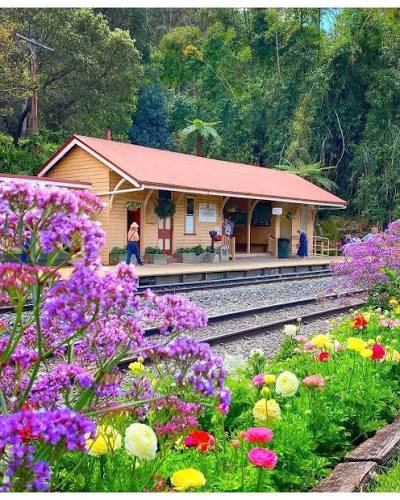
The straight run home down the New England is perfectly pleasant, but the connoisseur's return bends east off the ridge to take in Spring Bluff, the heritage railway station tucked into the Range between Murphys Creek and Toowoomba. The station is the survivor of Queensland Rail's station-garden tradition — a working halt maintained like a show garden, with its beds brought to competition standard every September for the Carnival — and reaching it via the backroads from the ridge country turns the day's return leg into a second scenic act. From the station you climb the old road up the Range to re-enter Toowoomba from the east, escarpment forest the whole way.
The detour costs perhaps forty-five minutes over the direct run and pays it back in full during garden season; mid-week visits get the platform largely to yourselves. There's a cafe at the station in season — opening days vary, so confirm locally rather than arriving hungry. Track the detail on our Spring Bluff page, and note the two loops join naturally: north-loop morning, Spring Bluff afternoon is the region's best self-drive double.
Provisioning: the picnic argument
There is a strong case for running this loop as a rolling picnic rather than a sit-down day. The supply chain assembles itself as you drive: bakery goods from Highfields or the Crows Nest queue, ridge fruit and preserves from Hampton, and whatever the produce stalls are moving that week. The park's day-use area supplies tables, shade and the sound of falling water; the village green supplies the town-square version. Building lunch this way keeps the day's timing flexible — no kitchen deadlines — and puts your food budget straight into the small businesses that keep these villages alive, which is the kind of virtuous circle that also happens to taste better than it needs to.
The counter-argument is Hampton's long lunch, and the mature resolution is to do both across two visits — picnic loop in walking weather, table loop in eating weather. Either way, carry more water than the forecast suggests (the granite country is thirsty walking), and remember country waste facilities are minimal: whatever you carry in, carry out, particularly in the national park where the rule is absolute.
The loop with children
This is arguably the best children's day trip on the Downs, because its attractions are all verbs. The park leads: a walk short enough to finish, rocks engineered by nature for scrambling, a waterfall with an audible payoff, and wildlife odds good enough to sustain a whole drive's worth of watchfulness. The villages hold up their end — the Jimmy Crow story at the village green gives Crows Nest a narrative hook children remember, the bakeries convert good walking behaviour into tangible rewards, and Highfields' pioneer village turns history into sheds you can climb through rather than cabinets you can't touch. Playgrounds at Highfields and Crows Nest handle the residual energy.
The parental logistics are gentle: forty minutes is the longest unbroken car leg, every stop has toilets and shade, and phone coverage holds along the highway even as it fades in the gorge. The two rules that matter — fenced lookouts are fenced for reasons, and gorge edges are not negotiating spaces — are easier to enforce here than at most waterfall parks because the main tracks keep their distance until the lookouts. Aim to be rolling home by four; the kangaroo hour on the ridge is real.
Photographing the ridge and the gorge
The loop offers three distinct photographic subjects, and they want different hours. The ridge country is a golden-hour subject — paddock light at either end of the day, mist over the Hampton fields early, long shadows west of the highway late. The gorge is the opposite: it needs the sun high enough to reach the water, making late morning to early afternoon the working window, with a polariser to manage the glare off the granite and pull the tannin colour out of the pools. The villages are overcast subjects, their verandahs and shopfront detail photographing best in the flat, even light that ruins landscapes.
A cloudy-bright day therefore isn't a lost day; it's a village-and-detail day. The one shot that requires planning is the Valley of Diamonds glitter — the mica-flecked granite that named the gorge catching direct sun — which asks for a clear midday and a little patience at the lookout. And the shot everyone misses is behind them on the drive up: pull over legally somewhere on the ridge and photograph the highway itself running the watershed, because that ribbon of road through two drainage basins is the loop's whole story in one frame.
The coach version, and who it suits
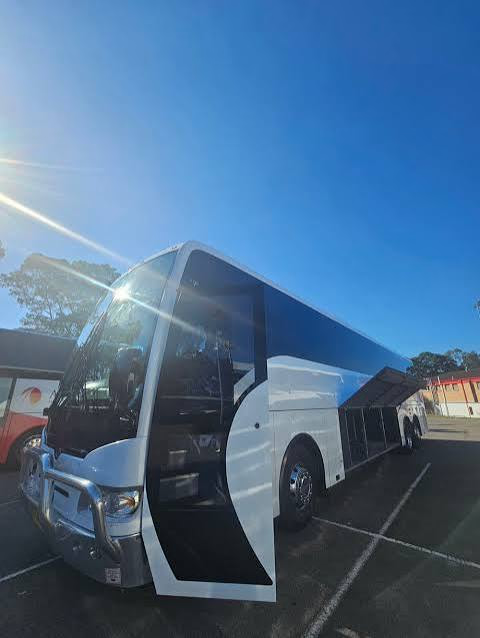
The group-charter note above deserves expansion, because this loop is close to purpose-built for coach touring. The distances are short, the stops are frequent, the walking is optional at every stage, and the content — food, gardens, antiques, a waterfall — maps precisely onto what garden clubs, probus chapters and seniors' groups ask us for. A Cooee charter runs the day at the group's pace: extended Hampton lunch for the food-first groups, longer park time for the walkers, extra village browsing for the collectors, and a driver-guide whose commentary has been marinating in these roads since well before the bypass existed. Nobody in the group sits out the day driving it.
For individuals and couples, the ridge features across our broader touring calendar rather than as a standing solo departure — the Toowoomba tours index shows what's currently scheduled, including the Carnival-season program from $89 and the 2-day weekend tours from $595 that give the region the overnight it deserves. For anything bespoke, the direct line remains the best tool: 0409 661 342, and describe the group and the day you want.
Practical notes for the day
Fuel and phone first: fill up in Toowoomba or Highfields, because options thin north of Hampton, and download offline maps before leaving the city — coverage is solid along the New England but drops into the park's gorge sections. Weather next: the ridge runs cooler than Toowoomba, which runs cooler than Brisbane, so the layer you almost left behind is the one you'll want at the falls lookout in any season but high summer. After heavy rain, check park alerts before committing — track closures are routine and short-lived — and remember the falls' best form arrives a day or two after the rain, not during it.
Money is straightforward: the park is free, the villages take cards but the market stalls prefer cash, and the antique rooms reward the buyer who can settle on the spot. Timing is the only real discipline the day demands. The loop's minimum honest version is five hours; the full version with the park circuit, a proper lunch and the Spring Bluff return is eight. Book nothing before 6pm back in Toowoomba, and let the day take the length it wants.
The verdict
Among the day trips radiating from Toowoomba, the northern loop is the one to do first, and the one locals repeat most. It has no single knockout sight on the scale of the escarpment view or the Carnival's massed beds — its genius is sequence, the way fifteen-minute intervals keep producing a new register: village, ridge, hamlet, granite, gorge, falls, and home through the long light. It asks no fitness beyond a couple of hours of easy walking, no budget beyond lunch and temptation, and no planning beyond a fuel stop and a weather check. As a half-day it satisfies; as a full day with the Spring Bluff return it ranks with anything in regional Queensland.
It is also the ideal second day of a Toowoomba visit — the exhale after a garden-city day, proof that the Darling Downs' appeal keeps going past the city limits in every direction. Do it once as a visitor and you'll understand why Toowoomba people do it on ordinary Sundays; do it in spring, with the Carnival below and wildflowers above, and you'll understand why they never quite get around to moving away.
Pairing the loop with the rest of your visit
Slotted into a longer Toowoomba stay, the loop performs best as the counterweight to a city day. The natural two-day shape is gardens first, ridge second: a full day among Queens Park, Laurel Bank and the escarpment establishes the Garden City's case, and the northern loop the next morning answers it with granite and paddocks — the region arguing both sides of its own character. During the Carnival of Flowers the pairing sharpens into strategy, with the city day spent among the festival's beds and the ridge day spent recovering from the crowds among people who mostly aren't there. Day-trippers up from Brisbane for a single day face the harder choice; the honest advice is that first-timers owe the city day its priority, and the loop is the reason to come back.
The loop also chains outward for the ambitious: Goombungee's backroads to the west turn the half-day into a grand circle of the northern Downs, and the Bunya Mountains beyond Crows Nest convert it into a serious full-day expedition — both covered in the wider day-trips guide. The ridge sits at the hinge of all of it, which is exactly why it earns the first free morning of any stay.
See the Carnival the easy way
Cooee Tours runs coach day tours from $89pp and 2-day overnight tours from $595pp — no traffic, no parking, local driver-guide included.
Carnival of Flowers Tours